Cher visits the Schonbrunn Palace, Vienna, Austria
AKA: Schloss Schonbrunn
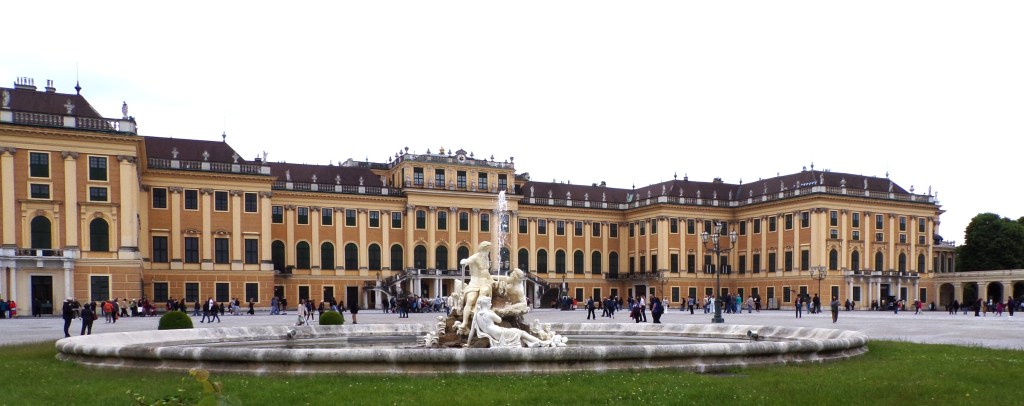
Spectacular Summer Palace of the Habsburgs
Also known as Schloss Schonbrunn, this was the spectacular summer palace of the Habsburgs.
The Habsburg Dynasty shaped Austria for centuries. Even today, palaces, museums and public squares tell the story of this noble family’s rise and fall – its enduring power, its enticing myth.
Schonbrunn Palace and Gardens, Vienna Austria – are very similar in grandeur to Versailles, France. Its opulence, layout, sheer size and complexity require at least several hours to visit – so prepare for lots of walking!
P.C. Cher B 30 May 2025
Our Viking Grand European Tour stop in Vienna included a 3.5 hour visit to Schonbrunn. Our museum guide led us through the main parts of the massive palace. We enjoyed an all-too-brief time to wander in the expansive gardens on our own.
To fully appreciate all that Schonbrunn has to offer, like a visit to Versailles, one should allow at least a full day. However, if you only have a few hours, take the opportunity! (See Visit at the end of blog).

P.C. Co-traveler 30 May 2025
The Habsburgs
To appreciate Schonbrunn, one must first understand a bit of the Habsburg Legacy.
**Habsburg Strategy for Success** Instead of bloody conquests, one of Europe’s most powerful dynasties was achieved by strategic marriages.
- For 645 years, the Habsburg family held the political, cultural, and architectural power and defined the legacy of Austria.
- Beginning in 1278, their influence eventually stretched from Bohemia to Hungary to Italy and to Spain.
- From the 1400s until its dissolution in 1806, the Habsburgs became Emperors of the Holy Roman Empire
- 1717-1780. The reign of the Empress Maria Theresa laid key foundations for modern Austria. Her spirit of reform brought in compulsory school, tax reform, and the abolition of torture. (more on her below)
- Her son, Joseph II, moved towards a more progressive state through centralization and administrative modernization.
- 1800s – Two states – one crown. The Foundation of the Austrian Empire brought a new chapter. which culminated with the formation of the Dual Monarchy of Austria-Hungary in 1867. This created a multi-lingual real union in the heart of Europe and a balancing act between central authority and cultural diversity – two states, one crown.
- 1918 – end of an era. The greater the empire grew, the more fragile it became. National tensions rose. Political upheavals and World War I led to its collapse. The end of an era was marked on November 11, 1918, in Schonbrunn Palace, when Emperor Karl I signed his declaration of renunciation.
While the monarchy became history, its colorful legacy lives on. Today the tales of the opulent grandeur – and intriguing contractions – of the Habsburgs is told and retold all across Austria in palaces, squares and museums.
Visitors to Schonbrunn will get a glimpse of some of this fascinating family and the people that created its story.
UNESCO World Heritage Site
Schonbrunn Palace is one of Austria’s most important cultural assets with millions of visitors each year. (This means you need to plan ahead with this in mind before you visit!)
In December 1996, Schonbrunn Palace was honored as a UNESCO World Heritage Site because of its unique Baroque palace and gardens.
P.C. Cher B 30 May 2025
Schonbrunn’s Story
The 1,441-room Baroque palace is one of the most important architectural, cultural, and historic monuments in Austria. It has been a major tourist attraction since the mid-1950s. The 300 year history of the opulent palace and vast gardens, reflect the ever-changing tastes, interests, and aspirations of successive Habsburg monarchs.
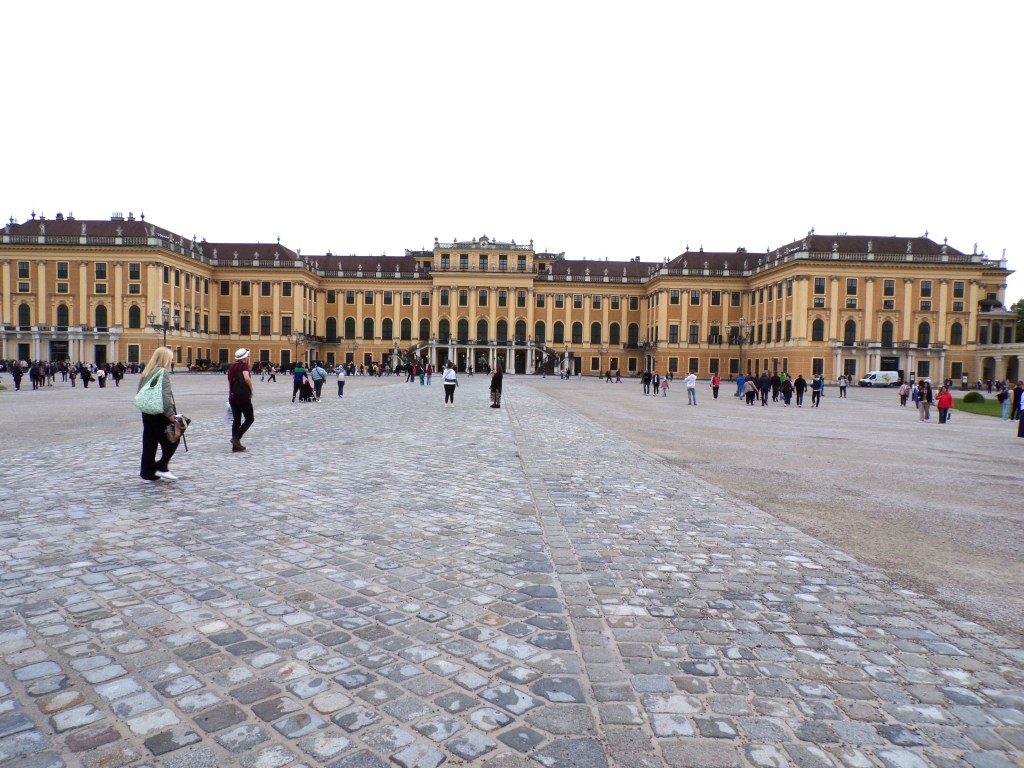
The first glimpse of the spacious grandeur of Schonbrunn complex can be seen in the vast Parade Court which serves as a visitor entrance to the palace and the acres of parks and gardens behind it.
P.C. Cher B 30 May 2025
Max and Maria
The site originated in 1569 when Maximilian II acquired the wooded land outside the city of Vienna. In 1583, the woodland was destroyed during the Turkish Siege. This left the ground free to build this spectacular palace. It was built between 1695 and 1713.
In the late 1600s, Emperor Leopold I commissioned renowned Baroque architect Johann Bernhard Fischer von Erlach to design an imperial hunting lodge for his son, Crown Prince Joseph (Emperor Joseph I). Over the next century, it grew into a palatial imperial residence.
Enter Empress Maria Theresa (1717-1780). As was her style, she perfected it. She ordered and redesigned most of the interior from Baroque into Rococo, the next up-and-coming artistic design style.
Between 1717-18, the facade was altered. It was painted in the characteristic color of “Schonbrunn yellow” we see today.

P.C. Cher B 30 May 2025
Empress Maria Theresa
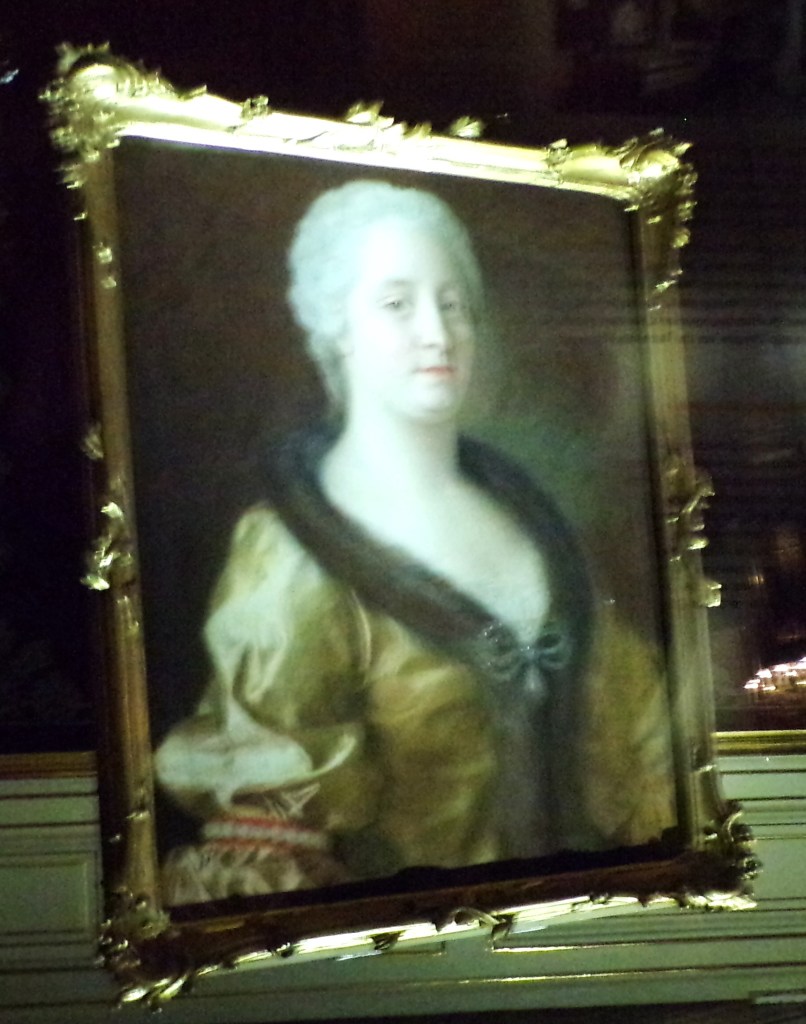
Maria Theresa. Along with the Habsburgs, one cannot discuss Schonbrunn without sharing a bit about this infamous woman. Everywhere, within and without the palace, she left her indelible mark of culture, design and power.
Maria Theresa had a huge impact on Austria during her reign, as we were reminded again and again during our visit to Austria. During her reign, Schonbrunn Palace became the glittering focus of court life as an imperial summer residence. It played host to the leading statesmen of Europe.
Most of the palace we see today was created during her reign. She ascended to the throne in 1740 after her father Karl VI had declared a change in succession. This unprecedented declaration enabled females to take over the rule of the Habsburg countries.
The early years of Maria Theresa’s reign were characterized by foreign political failures as parts of Poland and Italy were lost in various wars.
But she left an indelible imprint on Austrian domestic politics. She introduced compulsory education, established a new administrative structure and improved the social situation for farmers.
P.C. Cher B 30 May 2025
Maria Theresa led a very full and accomplished life as a “working mom!” While she successfully ruled as a major world power, she gave birth to 16 children! 13 survived infancy and 10 of whom survived to adulthood! (One of her daughters is the infamous Marie Antoinette, 1955-1793).
In 1765, Maria Theresa’s life dramatically changed. Franz Stephan von Lohringen, her beloved husband, died. This event had such a significant impact on her that she set aside her more impulsive and colorful ways. Until her own death in 1780, she lived a sombre existence and wore only black mourning gowns.
A touching personal testimony to the great love of Maria Theresa for her husband was found following her own death. In a note found in her prayer book, she had recorded the precise duration of her happy marriage: ‘29 years, 6 months, 6 days, making 29 years, 335 months, 1,540 weeks, 10,781 days, 258,744 hours’.
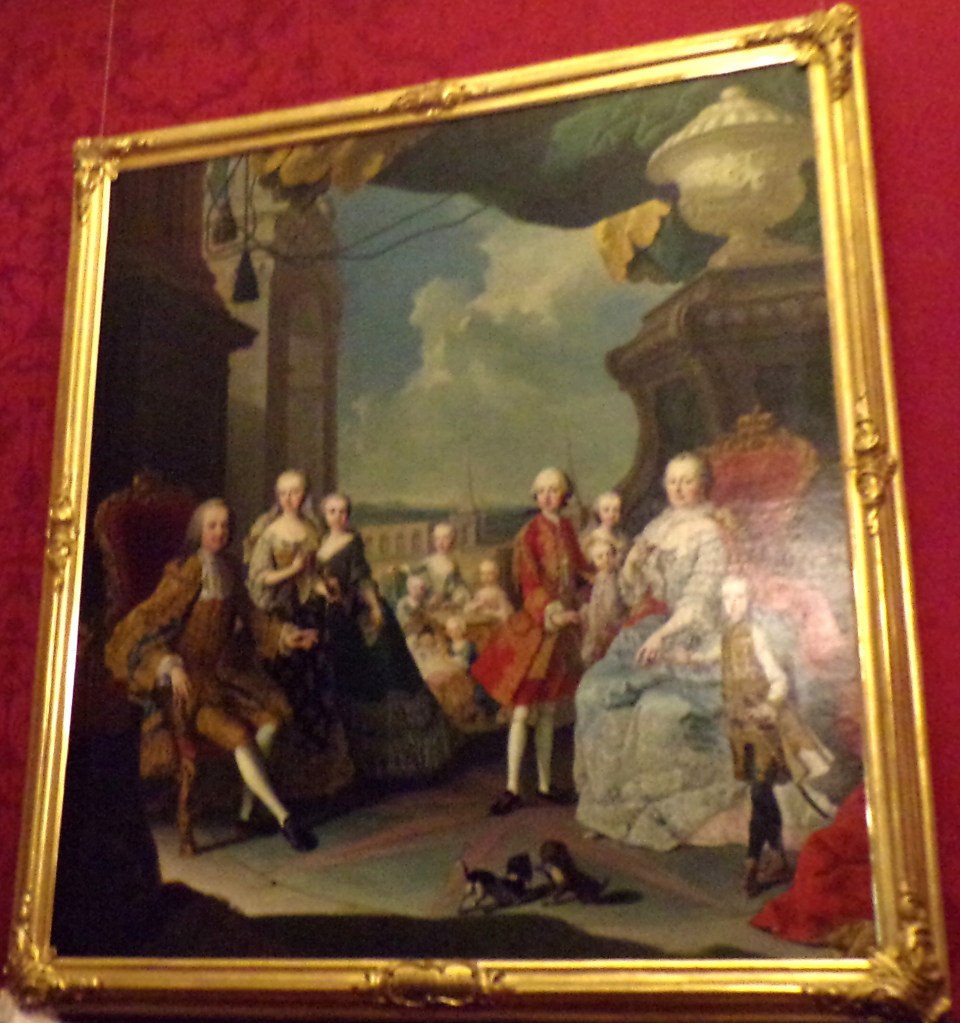
Maria Theresa & Her Family on the Terrace of Schonbrunn Palace
A famous family portrait hangs in the palace. (Original is in the Kunst Museum, Vienna). Maria Theresa with her family pose on the terrace of Schonbrunn Palace about 1755. Her husband, Emperor Francis I, is on the left side. Standing next to her, dressed in red, is their eldest son, the future emperor Joseph II. Eleven of her children appear in this family portrait. It was was presumably painted before her last two children were born: Marie Antonia (Marie Antoinette) and Maximilian Francis.
P.C. Cher B 30 May 2025
Parade Court & Fountains
Visitors are welcomed to the Schonbrunn Palace with the expansive Parade Court and its two welcoming fountains and sculptures.

P.C. Cher B 30 May 2025
The Danube, Inn and Enns Rivers are represented in the group of sculptural figures in the western basin.

P.C. Cher B 30 May 2025
This on-site map provides a look at the vastness of the complex. The palace (lower center in brown) and yellow surrounding areas are part of 3 hour tour. Exploring the balance of the complex would take a day or more, depending on how long one lingers and takes photos!

P.C. Cher B 30 May 2025
Park & Gardens
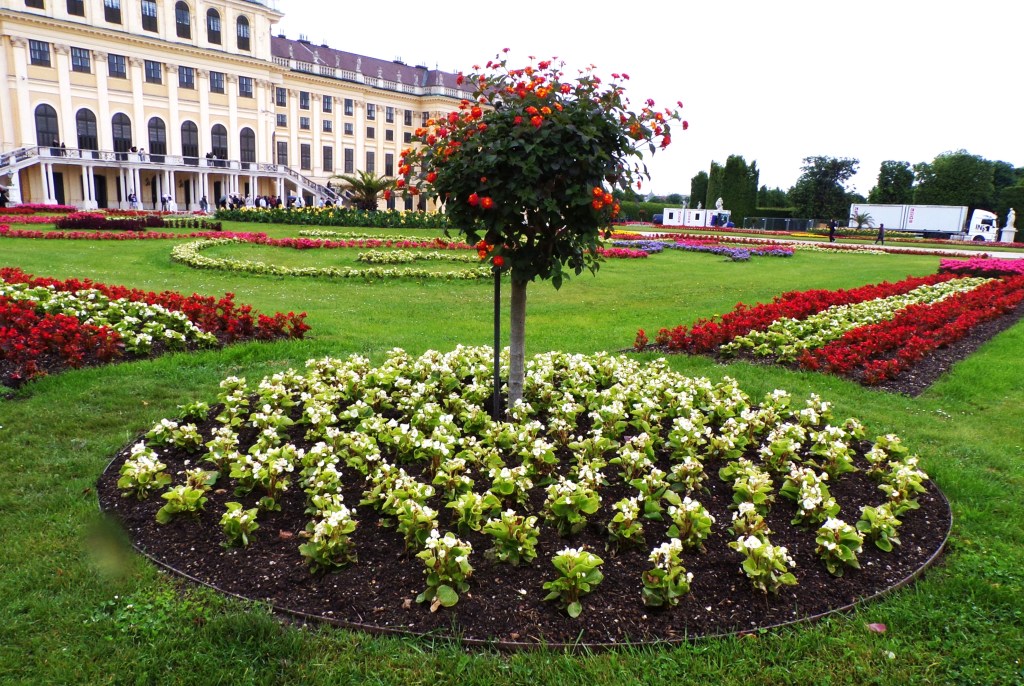
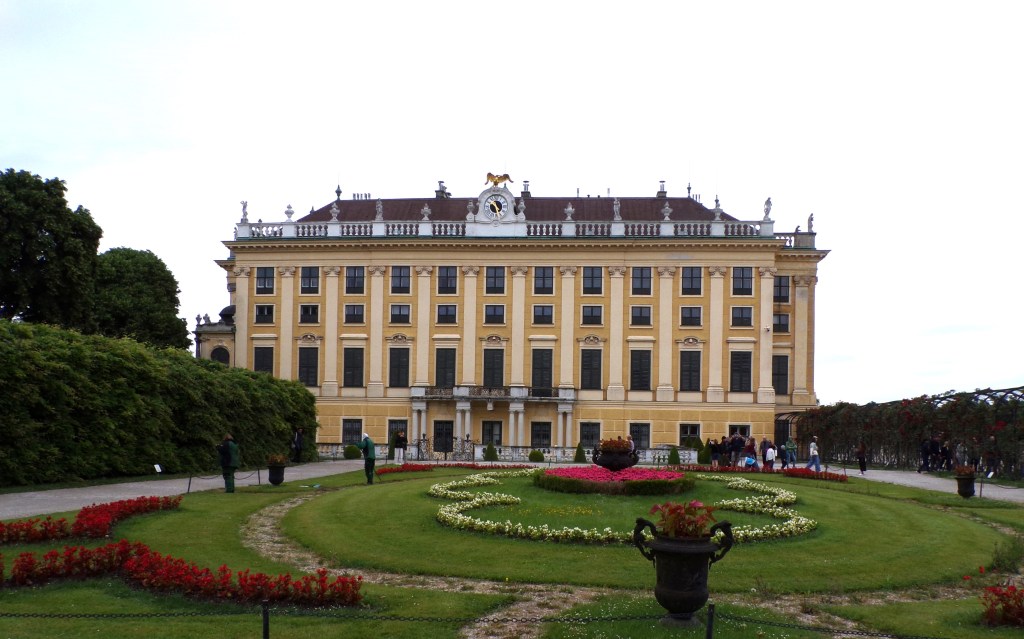
The gardens extend from east to west for 3/4 mile (1.2 km). From north to south is about .62 miles (1 km). The gardens opened to the public around 1779. It is a popular recreational amenity for locals and visitors from around the world.
From the back…

P.C. Cher B 30 May 2025
From the sides…
P.C. Cher B 30 May 2025
Fountains…

P.C. Cher B 30 May 2025
The vast Park behind the Palace…

P.C. Cher B 30 May 2025
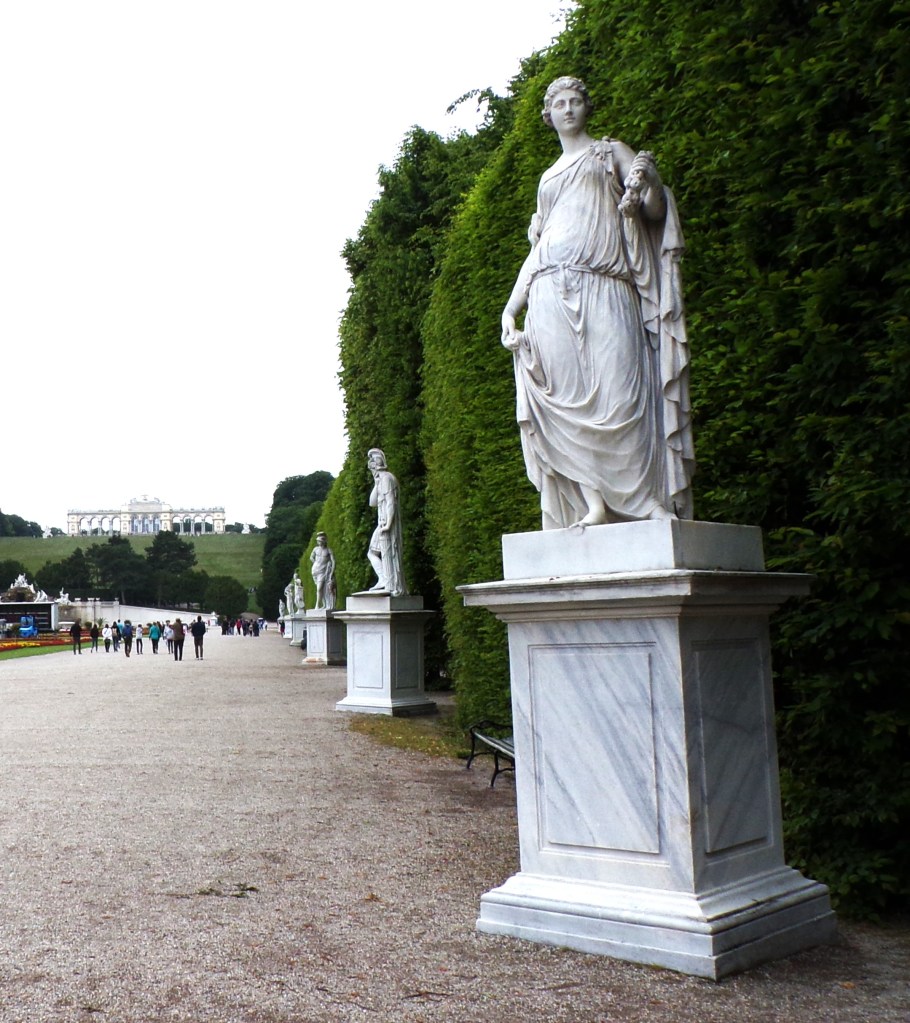
Garden Sculptures…
The park behind the palace is lined on both sides with 32 larger-than-life-size sculptures. These represent mythological deities and virtues.
P.C. Cher B 30 May 2025
32 Mythological Statues dot the large park. Each one represents figures of Greek mythology in Roman history.
The Gloriette…
An inviting, classical, arched building can be seen in the distance from the backside of the palace. Built on the crest of the hill in 1775, it appears close behind the Roman Ruins (more on this later) but is actually quite a distance away (see map above).
The Gloriette consists of a central section in the form of a triumphal arch, flanked by arcaded wings with semi-circular arches. Gloriette visitors can enjoy a expansive view of the complex from the viewing platform on the flt room and/or dine in the Cafe Gloriette.

P.C. Cher B 30 May 2025
Roman Ruins…
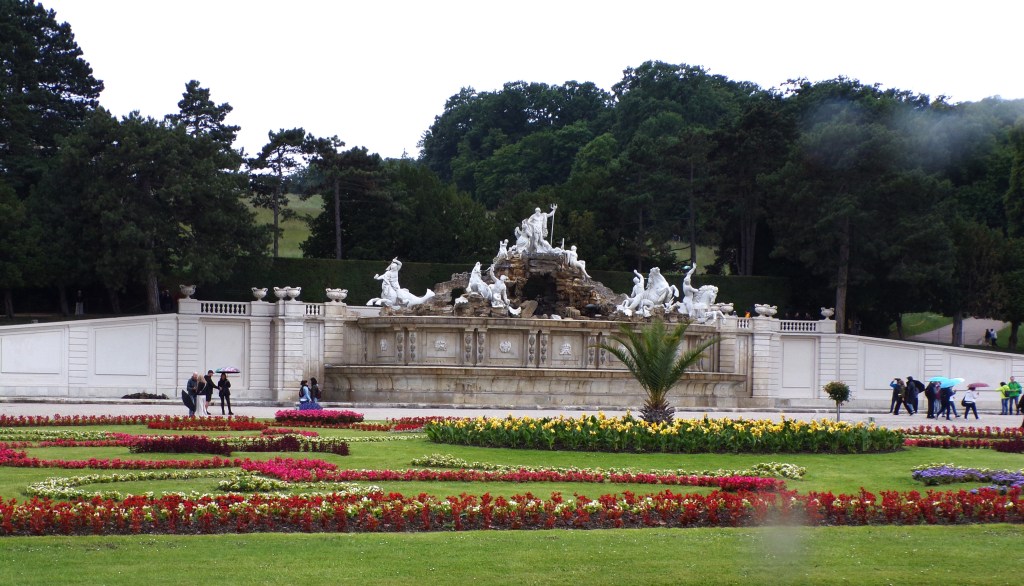
The Roman Ruins, incorporated with the Beautiful Fountain, stand at the foot of the wooded slopes of Schonbrunn Hill, seen here in the distance from the backside of the palace. Built in 1778, it is completely integrated as a picturesque garden feature into the surrounding landscape.
The Roman Ruins and Beautiful Fountain were designed to enhance the prestige and image of the Habsburgs. Its goal was to present them as the successors of the heroic Roman emperors.
The pool in front of the ruins includes a group of sculpted figures, They represent the gods of the Rivers Danube and Enns. Additional heroic statues are included behind the arch along a picturesque path in the woods.
P.C. Cher B 30 May 2025
Palace Interior
Palace Chapel…
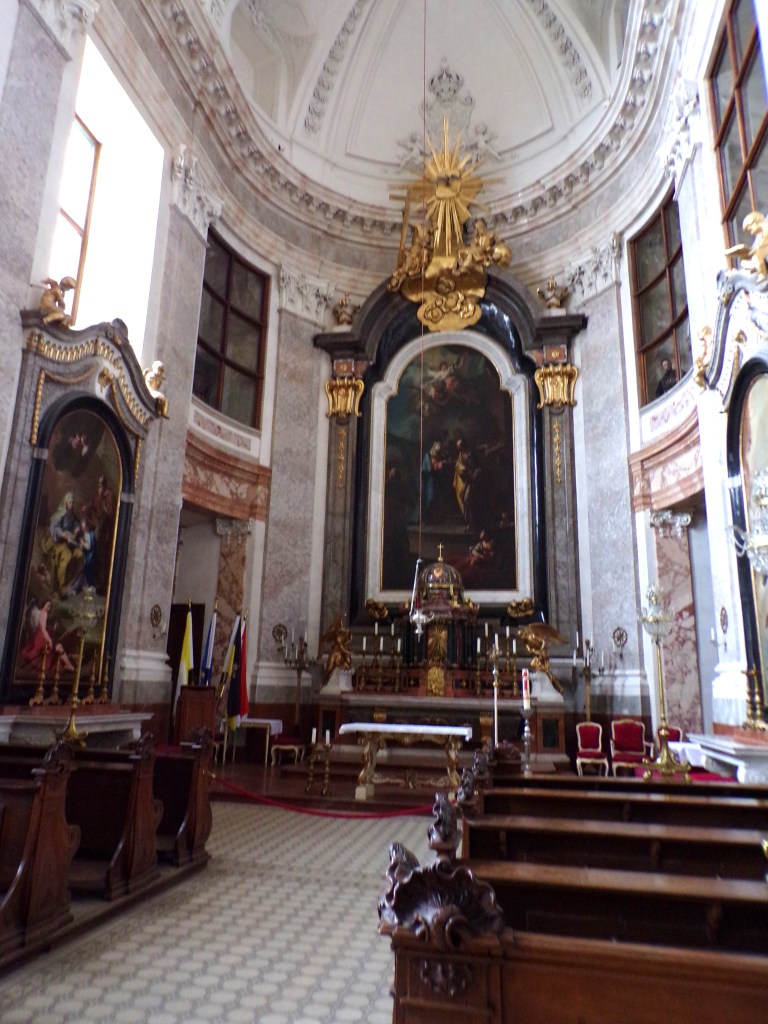
The first room we visited on our palace tour was the palace chapel – and a fitting introduction!
Built around 1700, it was remodeled extensively by Maria Theresa in 1740. A devout Catholic, and in keeping with Habsburg tradition, attendance at divine service was an essential part of daily court routine.
Maria Theresa hired leading Baroque Austrian artists of the day to provide the chapel a new and glorious interior. The marble high altar had lateral pilasters. It was finished with a rounded pediment and crowned by a gilded sculpture of the Holy Trinity. The altarpiece depicts the Marriage of Mary and Joseph. The door of the massive marble tabernacle is embellished with a gilt relief of the pieta. Two other altars in the form of framed alcoves contain gilt lead statues.
P.C. Cher B 30 May 2025
Mary Magdalene, surrounded by allegorical representations of the Christian virtues of faith hope and charity, is seen on the chapel ceiling painting.

P.C. Cher B 30 May 2025
(Note: visitors can attend a divine service today; check the palace website for times and availability. schlosskapelle.at/ Reminder that there is very limited seating so plan ahead! )
The Grand Gallery…
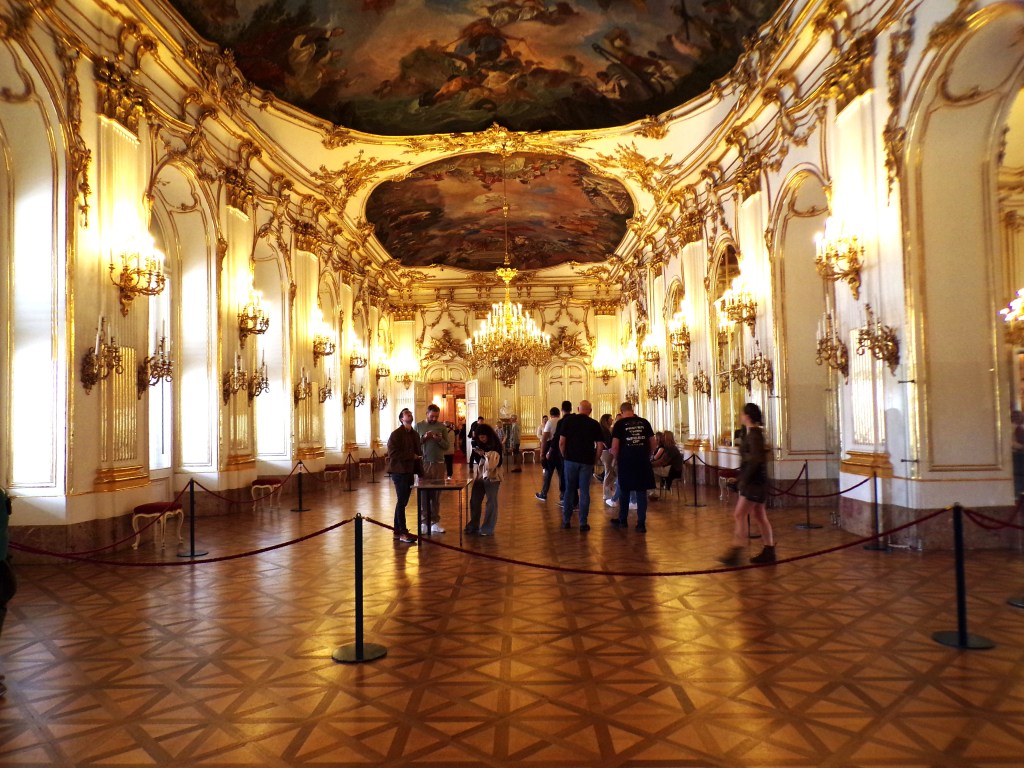
The Grand Gallery is the architectural centerpiece of the palace. It is 130 feet long and 20 feet wide. The epitome of grand Rococo design is embodied in the tall windows, splendid crystal mirrors, and chandeliers with white-and-gold stucco. It was just what Maria Theresa ordered!
The Grand Gallery was the ideal setting for courtly events. It is still used today for state receptions and banquets.
P.C. Cher B 30 May 2025
Comparisons can again be made to the Palace of Versailles. The tall windows which overlook the gardens are duplicated by mirrors on the opposite wall. Ceiling chandeliers and wall sconces reflect on the polished walls, guaranteeing the Grand Gallery is full of light.
The Chandeliers…
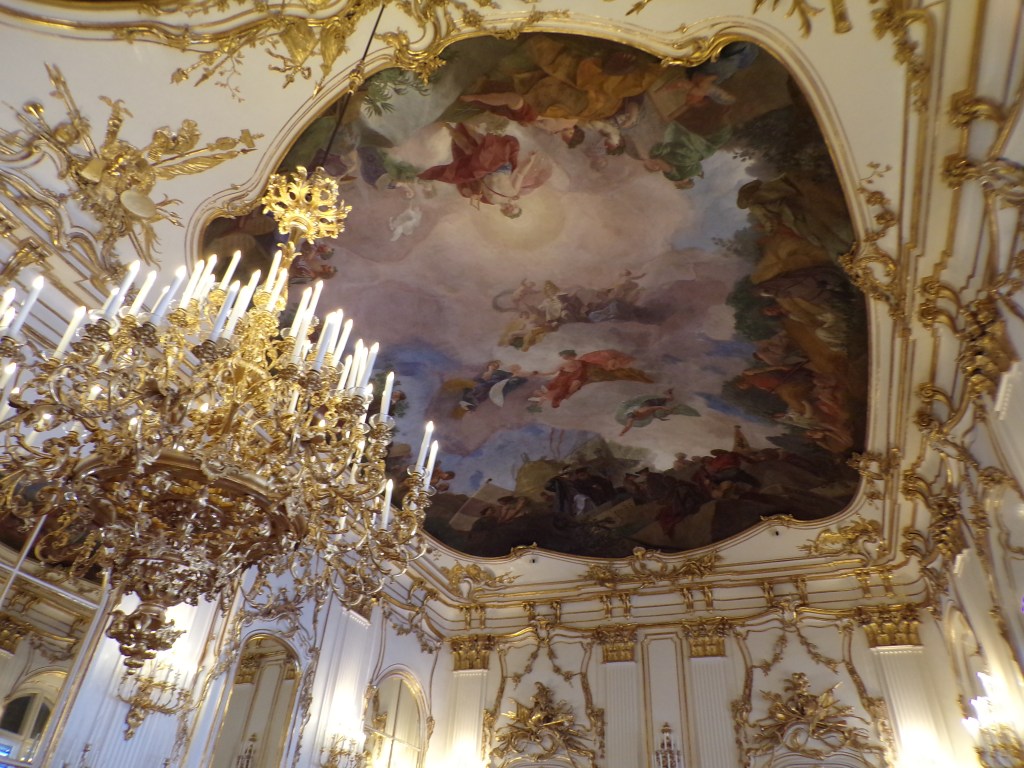
Two large carved wooden and gilt chandeliers are not only impressive; they have an historical story of their own! The original 72 candles were replaced in 1898 when the palace installed electricity. In 2011/2012, an comprehensive restoration of the Grand Gallery added candle-shaped LED lights with integrated crystals which imitate flickering candlelight!
P.C. Cher B 30 May 2025
The Ceiling Frescoes
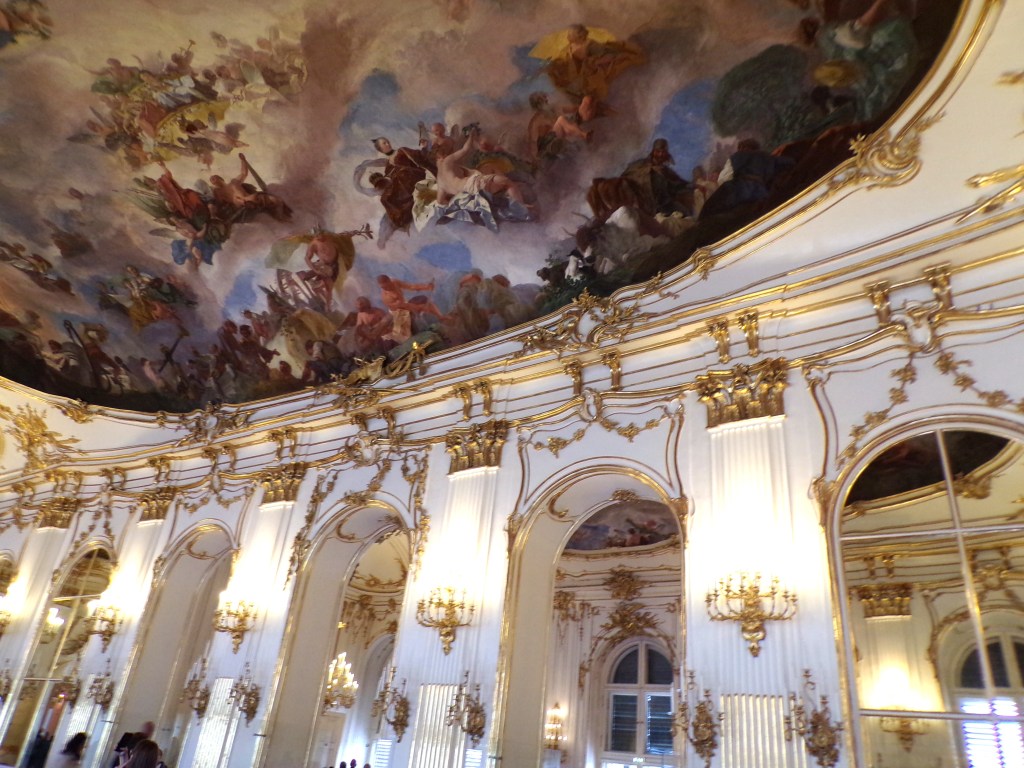
The ceiling frescoes follow a significant program created by the original painter.
According to the palace website, the eastern ceiling fresco is an allegory of the military might of Maria Theresa’s armies. Mars, the war god, gallops across the skies on a white horse. A group of high-ranking officers stand on a commanding height to Minerva, goddess of warfare.

P.C. Cher B 30 May 2025
The middle fresco shows Maria Theresa, enthroned as ruler of the Habsburg Monarchy, with her husband Franz Stephan as Emperor of the Holy Roman Empire. The personified virtues of a ruler (justice, clemency and munificence) surround them.
P.C. Cher B 30 May 2025
The western ceiling fresco symbolizes the pax austriaca. At its zenith stands Concordia, who allows the Crown lands to flourish. Surrounded by Abundance and Peace amidst the gods Ceres, Bacchus, Mercury and Apollo and personifications of arts and science.

P.C. Cher B 30 May 2025
Sadly, one of the frescoes fell victim to a bomb dropped in April 1945 in the final days of World War II. It was replaced with a masterful copy painted in 1947-48, undetectable to the average viewer.

P.C. Cher B 30 May 2025
The Grand Gallery continued to be used by the Republic of Austria after the end of the Monarchy.
- In 1955, the Grand Gallery was host to the reception held after the signing of the Austrian State Treaty on 15 May 1955 at the Upper Belvedere Palace (see blog on the post on the Belvedere and the artist Klimt).
- In 1961, the most significant international official event took place with the legendary encounter between US President John F. Kennedy and the Soviet Prime Minister Nikita Khrushchev.

P.C. Cher B 30 May 2025
Other Grand Rooms in Schonbrunn
The Millions Room…
Maria Theresa used the room for small audiences. Its name is derived from the cost of the rooms’ rosewood paneling – a reputed one million Guiden (former Austrian gold coins). Indo-persian miniatures in the panels illustrate scenes from Mogul rulers of India in the 16th and 17th centuries.

P.C. Cher B 30 May 2025
Vieux-Laque Room…
This room was originally the innermost reception room in the apartments of Franz Stephan, as emperor. Upon his sudden death in 1765, she rededicated it as a memorial to him and created its present appearance. Several portraits of him hang as a memorial. Portraits of three generations of the family emphasize the central concern of Maria Theresa for the continued existence of the House of Habsburg-Lorraine.
A major focal point of the room is this portrait of Franz I Stephan.

P.C. Cher B 30 May 2025
The Vieux-Laque Room is one of the most important interiors in the palace in terms of its art-historical significance. Its magnificence is seen in the black lacquered panels from Beijing, China. The French name of the room refers to these panels. The embellishment of gold with the landscapes, birds and flowers successfully unites Rococo elements with Chinese art.

Vieux-Laque Room in Schonbrunn Palace, Vienna Austria.
P.C. Cher B 30 May 2025
Blue Chinese Salon…
The Blue Chinese Salon is a suite of rooms distinguished by sumptuous interiors. It was the original apartments of Maria Theresa and her husband. The name of the room is derived from its Chinese wallpaper (exported from China). The blue medallions within the strips of wallpaper are scenes of Chinese craftsmanship; the production of silk and porcelain or the cultivation of rice and tea. They are framed with painted floral swags, baskets of flowers, butterflies and birds. It all displays the 18th century fascination of art from China integrated with courtly European Rococo decors.
11 November, 1918, significant and recent history also took place in this room. Negotiations took place that led to the signing of the declaration by Karl I. As the last emperor of Austria, he renounced any participation in the affairs of state. The next day, after 600+ years, the end of the Habsburg rule was sealed. The Republic of Austria was proclaimed. Karl refused to abdicate formally; he and his family had to go into exile. Two portraits show Karl and his wife Zita, the last imperial couple of Austria.

P.C. Cher B 30 May 2025
Napoleon’s Room…
This room, decorated with 18th century Flemish tapestries, provides several different connections to Napoleon Bonaparte.
First, when he occupied Vienna in 1805 and again in 1809, he chose Schonbrunn as his headquarters. It is likely that he used this room as his bedroom; hence the name.
Second, the room displays items that serve as mementos of Napoleon’s only legitimate son. In 1820, Napoleon married Habsburg princess, Marie Louise, the oldest daughter of Emperor Franz I. This union was intended to seal the peace between France and Austria. Napoleon saw her as a suitable progenitress in his quest to found his own dynasty. From this union was born Napoleon II Franz, Napoleon’s only legitimate son. After Napoleon’s fall from power, the boy grew up as a prince at the court in Vienna, a favorite of his grandfather, Emperor Franz I.
Napoleon II Franz mementos in the room:
- A portrait in the room shows Napoleon II Franz, a lover of botany, gardening in the park at Laxenburg.
- The stuffed and mounted remains of his beloved pet, a crested lark is on display. (I didn’t get a photo of this one)
- The bed on which he died from tuberculosis at the age of 21 (1832) can be seen.
- A white bust which shows him on his death bed is prominently displayed.
(Side note: This is one room where it helps to know a bit about its significance before visiting it!)

P.C. Cher B 30 May 2025
Porcelain Room…
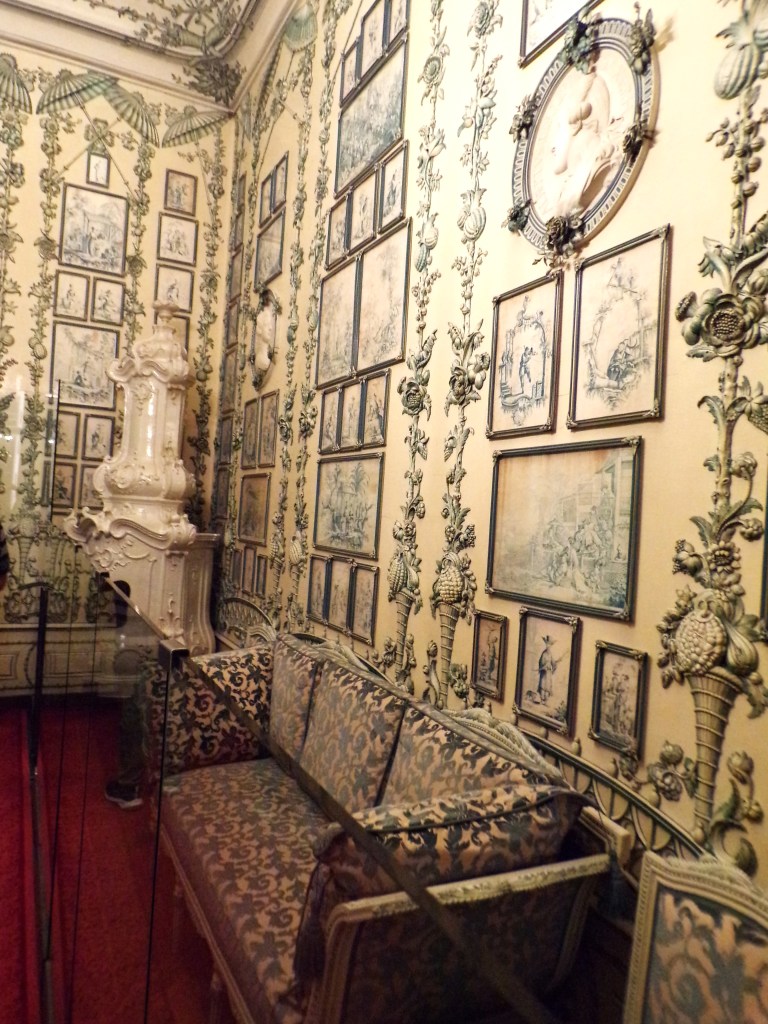
This tiny, very personalized room, was Maria Theresa’s private writing room. Floral garlands articulate the wall paneling. Between them are 212 gouache pictures in blue. Carved wood frames, painted in blue and white to imitate porcelain, cover the walls. The semi-sculptural parasols below the cornice reveal her love of the fashionable chinoiserie. Four framed portrait medallions note family members who contributed genre paintings to the decor.
P.C. Cher B 30 May 2025
Who owns the Schonbrunn?
Grand palaces and gardens with rich and long histories dot the landscapes of countries all over Europe. I often wonder how the ownership of these vast estates has been passed on. Such is the case with Schonbrunn Palace and Gardens! Here is what I discovered.
- 1569: The site was in the possession of the Habsburg dynasty beginning with Maximilian II.
- 1978: as former court property, the palace passed to the ownership of the Republic of Austria at the end of the monarchy.
- Until 1992, it was administered by a local government body (the Schlosshauptmannschaft Schönbrunn).
- In 1992, Schloss Schonbrunn Kultur- und Betriebsges.m.b.H. was founded and entrusted with the administration of the palace as a limited-liability company solely owned by the Republic of Austria. The company’s corporate mission embraces the tasks of preservation, utilization and finance: the funding for the preservation of the historic fabric of the palace and garden monuments, together with the revitalization of the entire Schonbrunn complex, has to be generated from the company’s own resources without recourse to state subsidies.

P.C. Cher B 30 May 2025
Visit
To fully appreciate all that Schonbrunn has to offer, like a visit to Versailles, one should allow at least a full day. There are the main points, like the palace and immediate gardens, but the whole site offers so much more. Additional time would allow for exploration of more of the vast acres of parks and gardens, lined with classic mythological statues. At the far end of the gardens are the impressive Roman Ruins with a Beautiful Fountain. The intriguing Gloriette rises behind this at the summit of the park’s hill. The second largest Baroque orangery in the world and the oldest zoo in the world are in this area in the far regions of the park. The Palmenhaus (glass palm house) looked like a magical place to visit. The Wagenburg (carriage museum) houses the richly decorated imperial coach, so heavy it needed 8 horses to pull it at a walking pace!). The website is very complete and has all the information you need to plan a visit – virtually or in real time: schoenbrunn.at/en/
Sources
In preparation for our visit to Schonbrunn, I first studied the DK Eyewitness Travel guide. On our Viking river boat, I listened to pre-tour educational lectures. In the palace, our Schonbrunn guide explained each room as we passed through. I tried to absorb it all. As we passed from room to room, garden to garden, I took photos to document highlights. Needless to say, I was on overload. With the help of the fabulous Schonbrunn website, I was able to identify the palace rooms, include historically accurate information on Maria Theresa and the Habsburgs, and compile this website. I encourage you to check them out – and even get a Virtual Tour of the Palace to travel vicariously to this sumptuous palace. ~Cher
- austria.info/en-gb/profiles/habsburgs/ – is a great website to learn more about the Habsurgs
- DK Eyewitness Travel: Top 10 Vienna – is my favorite travel book to prepare for this site
- schoenbrunn.at/en – Schonbrunn website home page
- schoenbrunn.at/en/about-schoenbrunn/the-palace/tour-of-the-palace/ – this Schonbrunn website link takes you directly to the palace rooms
- Schonbrunn Tour Guide for our on-site tour of the palace and grounds – we had a great tour guide who introduced our group to the palace; I got specifics from the website. A ticket option includes an audio guide which would be helpful if you are going on your own.
- Viking Tour Guide – she prepared us for the visit and then turned us over to the palace guide
If you enjoyed this blog – or learned something interesting – please let my know by clicking the “like” button below. Thanks! ~Cher
 Charamana Consulting