The Forbidden City
The Forbidden City is China’s most magnificent architectural complex. Pictures do not do justice. The first thing I noticed is that it is overwhelmingly HUGE. It seems to go on forever! And judging from aerial photos, we only visited a small portion. With reportedly 9,999 rooms – I am convinced that there are also just as many stairs! The first stop on our 3 week tour of China, the Forbidden City set the mood for our whole trip with history, culture and architecture.
The Forbidden City, in the heart of old Beijing China, is filled with breathtaking color, texture, shapes and cultural history. The world’s largest palace complex is home to 980 buildings with 9,999 rooms! It is protected by a 32-foot wall and a 20-foot moat. I always included it as an example of great Asian architecture studied by my art history students – and our visit confirmed its status!
The Forbidden City served as the Imperial Palace during the Ming and Qing dynasties. Opened to the public in 1949, 24 emperors ruled here for nearly 500 years until 1912. Today it is a UNESCO World Heritage Site.
P.C. Skip B. 04 Sept 2024
Not the clearest picture, this drawing gives perspective as a layout of the sections of the Forbidden City. The entrance (south) is on left. We moved through the various courtyards to the gardens on the north end.

The Forbidden City is so-named because it was considered a divine place and forbidden to ordinary people. In ancient times, the Chinese emperor was said to be a son of heaven with heaven’s supreme power bestowed upon him.
One of the most important features of the complex is its layout in a south-north axis. The main southern entrance moves through majestic halls to the northern emperors’ quarters. The North Star was thought to be Heaven as it is the only seemingly stationary star in the northern sky. Since he was believed to represent heaven, the emperor was therefore housed in the north.
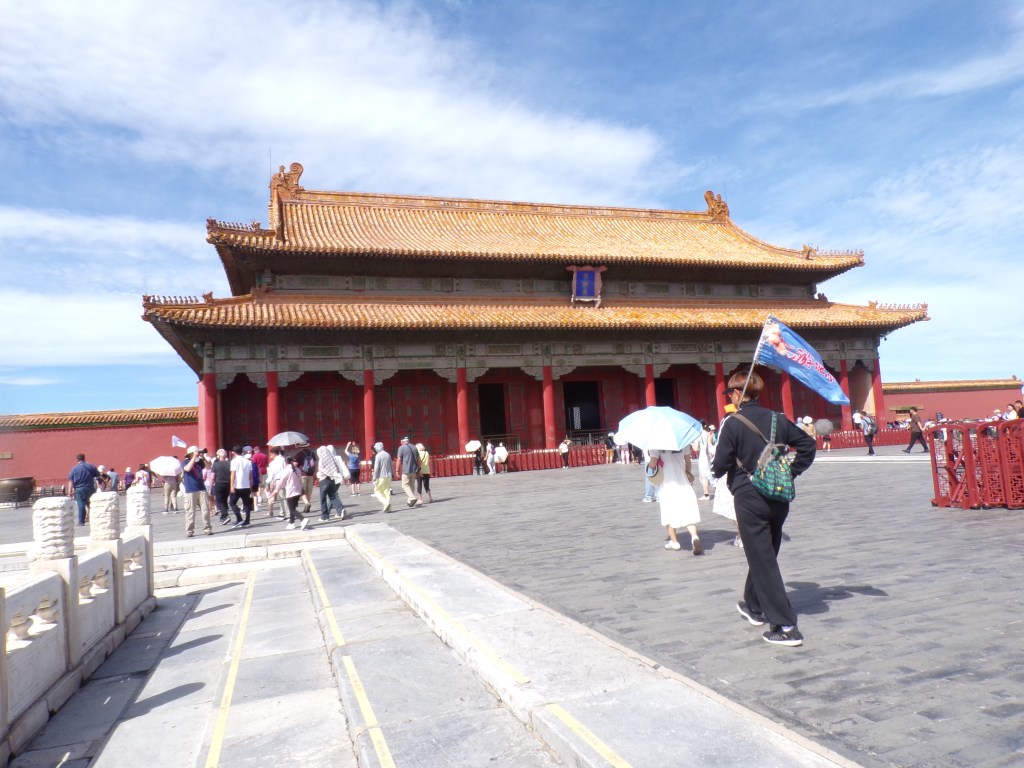
Entrance: Hall of Preserving Harmony
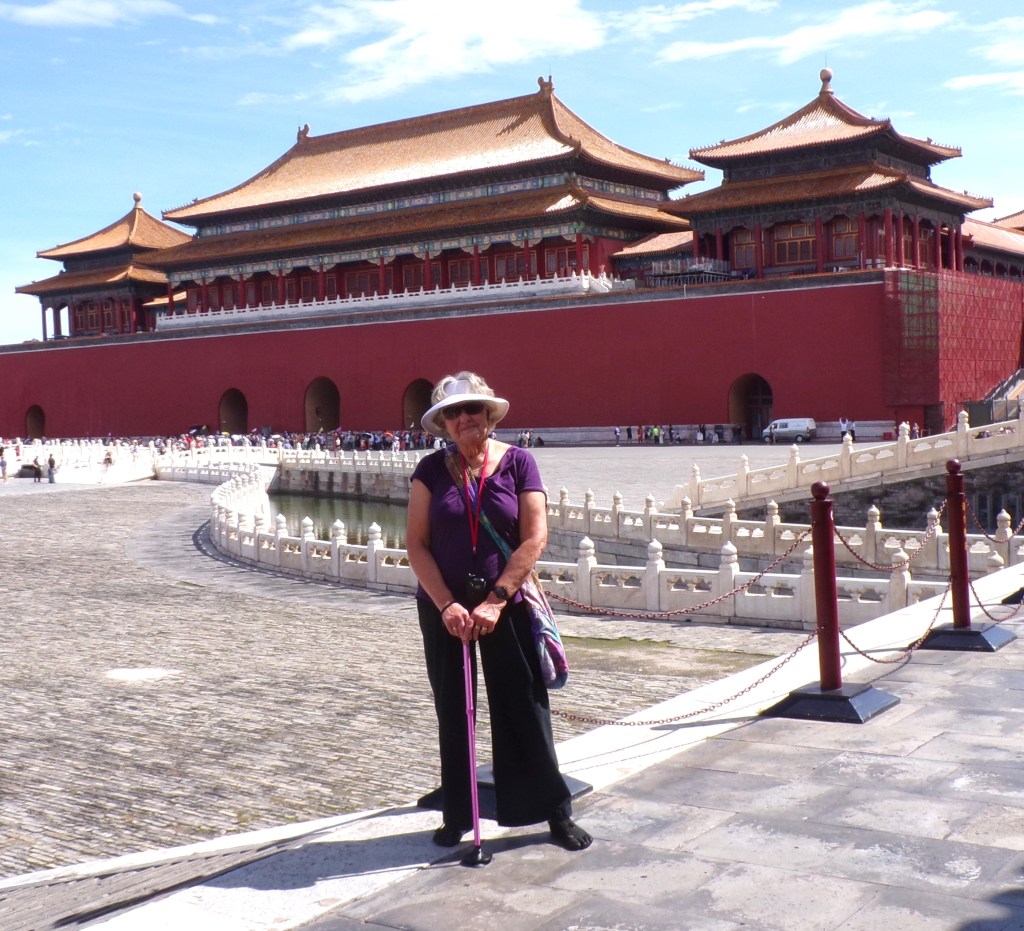
A massive entrance into the Forbidden City leads through the Outer Court (Hall of Preserving Harmony). Walls are plain but imposing – and the roof is spectacular. Security was very tight. Passports were checked along with our ticket to gain entrance. Side note: Passports were checked everywhere in China. And our visas were glued inside our passports. (And… getting a visa to China is another whole story…)

P.C. Cher B. 04 Sept 2024
The Meridian Gate (Wu Men) is on top of the Outer Court Wall. Historically, from this balcony, the emperor would perform ceremonies and review his armies.

P.C. Cher B. 04 Sept 2024
5 Bridges over “Golden Water”
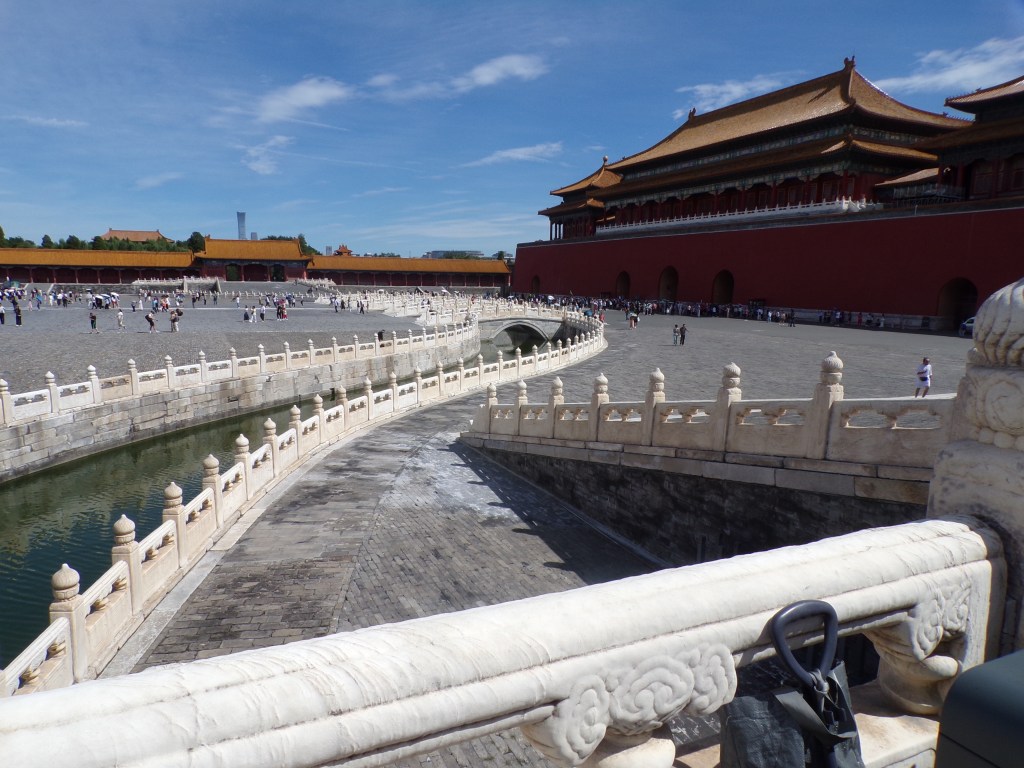
Entering the palace complex, one is first greeted with a curved river of “Golden Water” which runs west to east. One then must cross one of five bridges, symbolizing the five cardinal virtues of Confucianism. Crossing a bridge, one gains entrance to the Gate of Supreme Harmony and the rest of the complex.
This view includes the back of the Entrance/Outer Court. (Check out the people in the courtyard for perspective on the vast size of the area!)
P.C. Cher B. 04 Sept 2024
Gate and Hall of Supreme Harmony
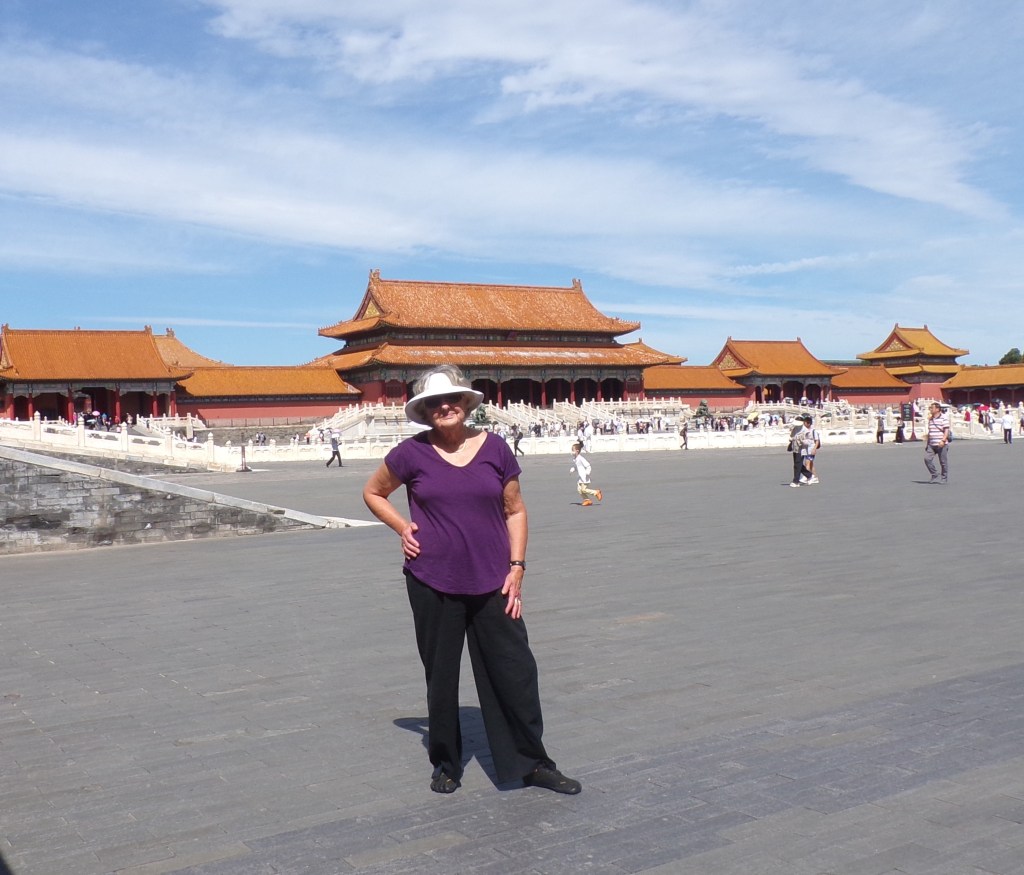
The majestic Gate and the Hall of Supreme Harmony is the first building seen once you enter into the main complex. Entrance to the rest of the complex is through its doors. This 78′ high, double-eaved hall was used for banquets during the Qing dynasty.
P.C. Skip B 04 Sept 2024
Hall of Supreme Harmony
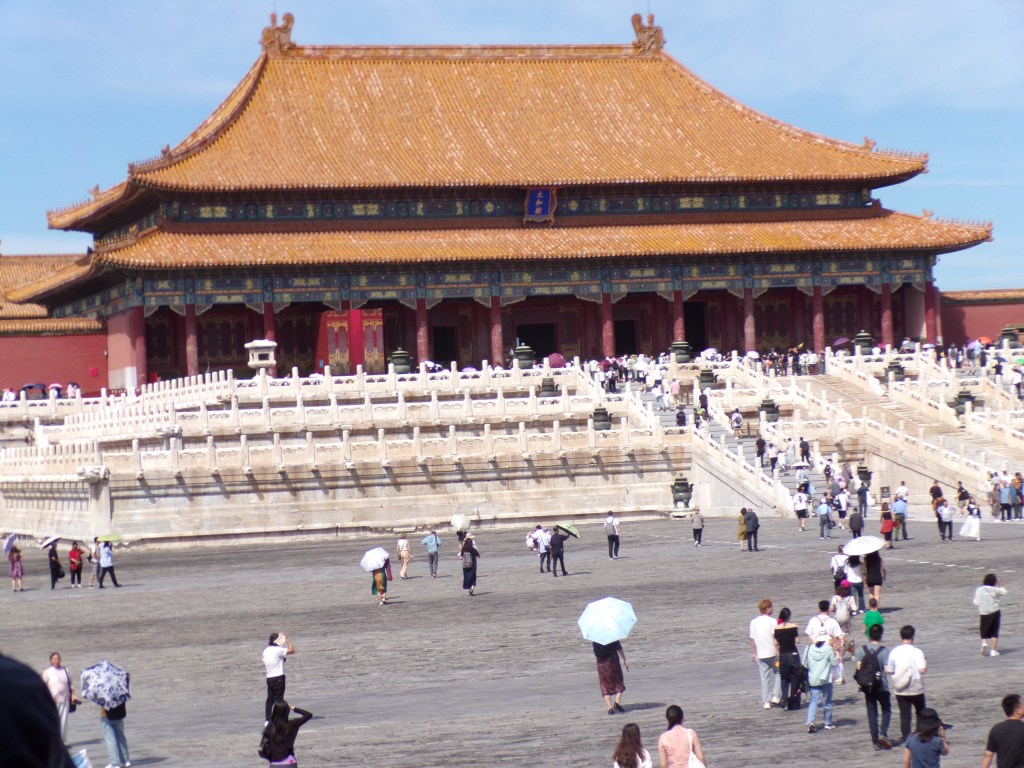
The Hall of Supreme Harmony is not only the largest hall in the palace. it is also one of the largest wooden structures within China. Located at the central axis of the complex, it was used for major occasions such as the emperor’s enthronement. Built above three levels of marble stone base, it is surrounded by bronze incense burners. (This is also the building most often seen in art history books!)
P.C. Cher B. 04 Sept 2024
I was astounded by all the steps and stairways into all the buildings!
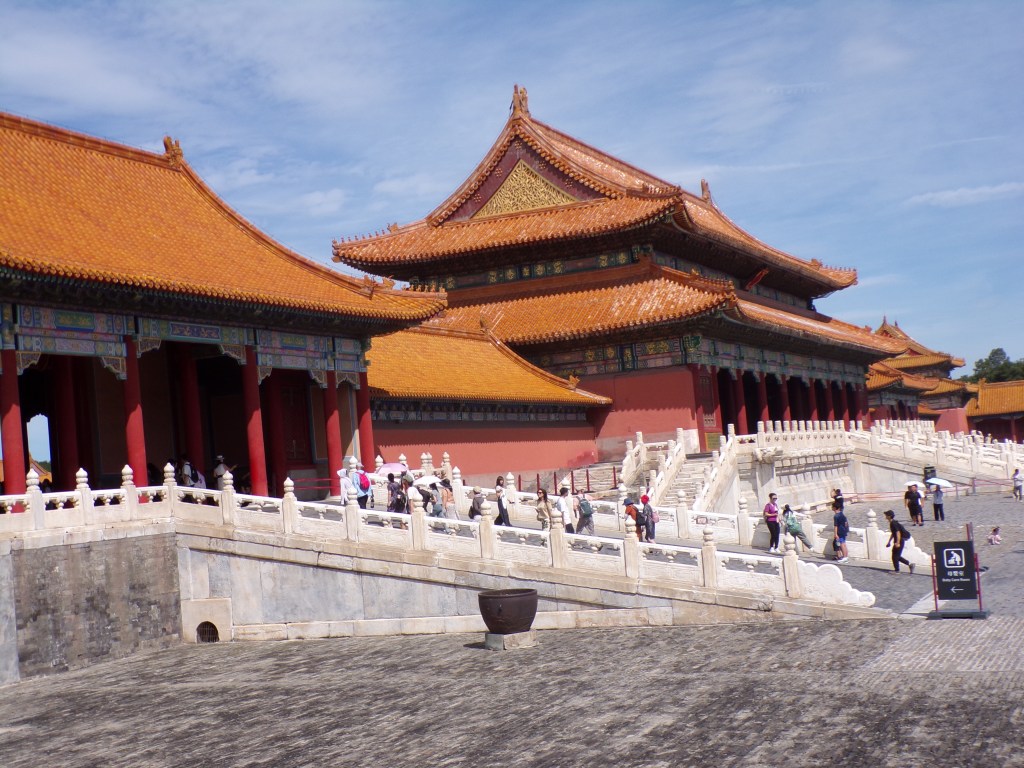
Roof Guardians adorn the Gate of Supreme Harmony. Associated with water, they are meant to protect the building from fire.

P.C. Cher B. 04 Sept 2024
Huge bronze cauldrons, accessible all around the complex, were filled with water in case of fire, which was often the case with all the wooden buildings.

P.C. Cher B. 04 Sept 2024
Color, Palace Doors & Decoration
Red, China’s most auspicious color, is used most often for paint on the columns and window frames. This provides a uniform appearance to the entire area. Oil paint was used not only to provide a decorative glossy feature but also help prevent the wood from deteriorating.
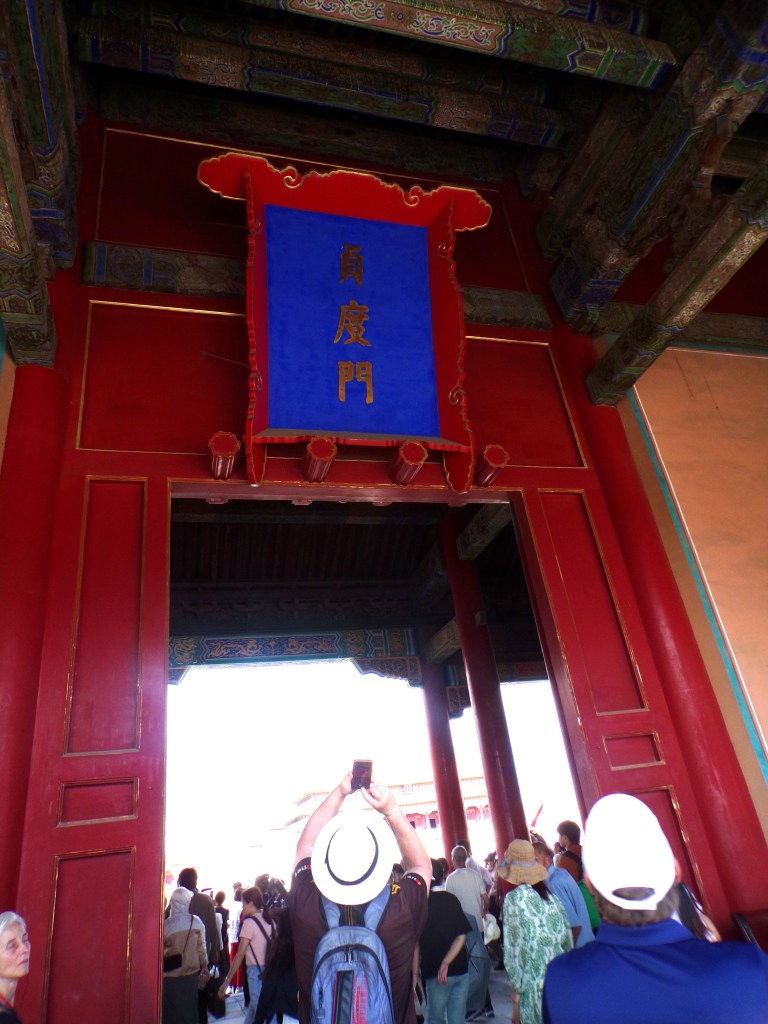
Palace doors like this one have a lucky number of studs. Everything uses the harmonious principle of yin and yang which is the key to Chinese design.
P.C. Cher B. 04 Sept 2024
Notice all the studs on the door at the left (below). The Forbidden City has 9,999 rooms and, as nine times nine is especially fortunate, the doors for imperial use usually contain 81 brass studs.

P.C. Cher B. 04 Sept 2024
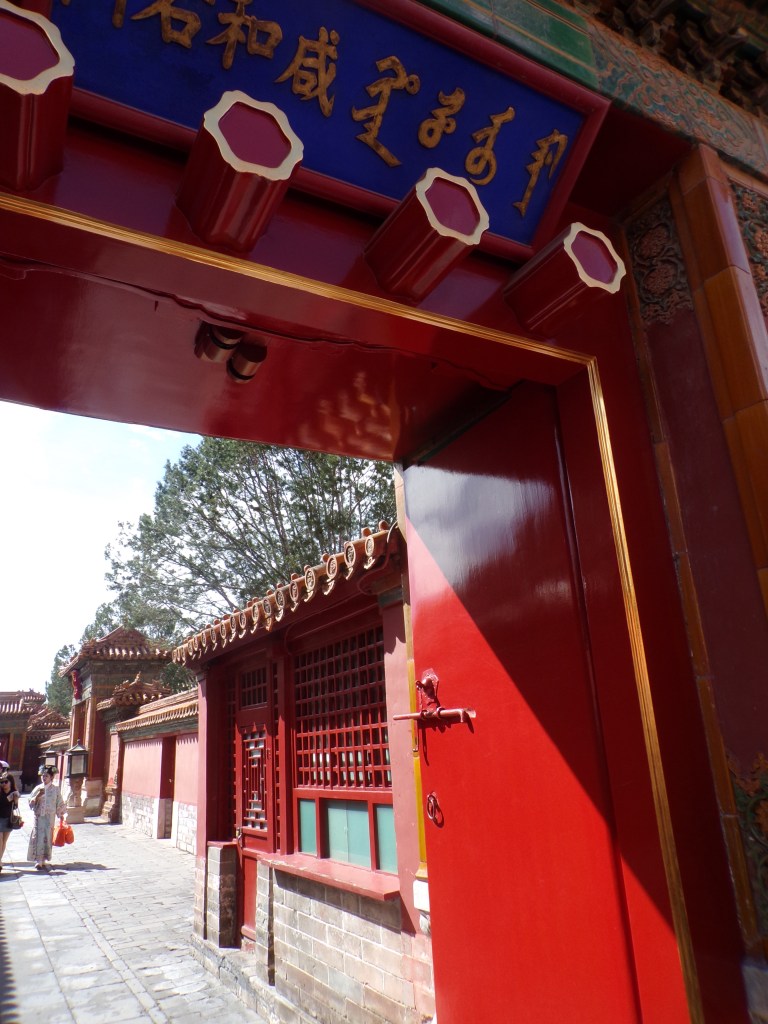
With so much to look at, it was easy for forget to look UP where brightly colored shapes and patterns were everywhere!
P.C. Cher B. 04 Sept 2024
The Hall of Middle (or Central) Harmony is smaller than the other two halls and is square in shape. It was used by the Emperor to prepare and rest before and during ceremonies.
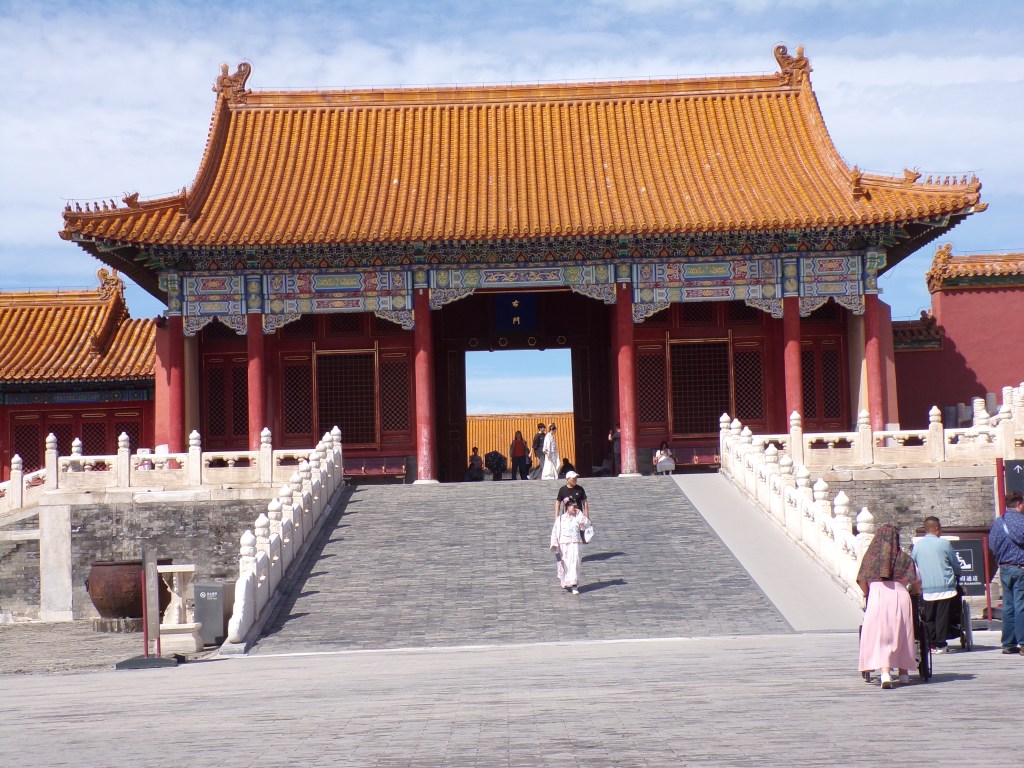
Yellow is also a dominant color. Also said to be auspicious and imperial, yellow is seen on the glazed roof tiles and wall decorations. It was used exclusively by Ming (1368-1644) and Qing dynasty (1636-1912) imperial families.
P.C. Cher B. 04 Sept 2024
Hall of Preserving Harmony is the last of the three main halls. Smaller in scale, it was used for rehearsing ceremonies and a space to rest before important rites.
It was also the site for the final stage of the Imperial examination. This civil service examination system was to select candidates for the state bureaucracy. It was created to ensure a common knowledge among state officials by merit, rather than by birth. Writing, Chinese classics and literary style were areas covered.
P.C. Cher B. 04 Sept 2024
Imperial Garden
Our tour finished with a walk through the Imperial Garden, my favorite part of the Forbidden City. I regretted not being able to spend more time in this picturesque sanctuary.
The Imperial Garden is a masterpiece of Chinese garden design. It blends architecture, nature and symbolism to achieve the goal of perfect harmony. It graces the northernmost point of the complex, north of the three inner palaces and, appropriately, the Palace of Earthly Tranquility.

P.C. Skip B 04 Sept 2024
Wandering through the garden, one experiences a world of delicate beauty. It is complete with winding paths, quaint pavilions, and meticulously landscaped rockeries.

P.C. Cher B. 04 Sept 2024
The Imperial Garden is more than just a pretty place; it is a world of symbolism. Every rock, plant, and architectural element has a deeper meaning, reflecting the philosophical and spiritual beliefs of the imperial court.
Built for emperors and their wives to relax themselves and enjoy beautiful scenery, it was also used for sacrificial rites, keeping fit, book collections, reading, and other purposes.

P.C. Cher B. 04 Sept 2024
The charming Pavilion of a Thousand Autumns is one of the pavilions in the Imperial Gardens.
Located on the west side of the garden, it correlates with the direction in Chinese philosophy correlating with autumn, hence its name. It was constructed in the Ming dynasty (1368-1644),
Square, with a round roof, it has verandas on four sides. I learned that in China, architecture with this format symbolizes earth (square) beneath and heaven (round) above it. Another pavilion on the east side of the garden (Pavilion of Ten-thousand Springs) has the same cross shape and the carved, overhanging eaves and multiple angles.

P.C. Cher B. 04 Sept 2024
One of the visually exciting experiences I enjoyed in China was the current interest of local residents in traditional, royal, Chinese costumes. They could be rented in local shops, especially those close to historical landmarks such as the Forbidden City. Photo shoots were everywhere and for every occasion, such as this one to which we were privy!

Scholar’s Rocks
A highlight of the garden for me was the “discovery” of the “scholar’s rock” at the entrance to the garden – and then revealed in the rockery all around me. I had seen and studied this special rockery for years at the Mia (Minneapolis Institute of Art), my hometown art institute. Admiring them greatly, the purchase of one for my home art collection was on my “want-to-buy” list on our trip to China! However, it was not a simple nor easy task. No one I asked in China knew what I meant by “scholar’s rock.” Nothing like it was available in shops. In the end, I did purchase one (on the right), thanks to this garden photo (left)- and the sleuthing and purchase power of our Viking cruise customer service manager!

P.C. Cher B. 04 Sept 2024

P.C. Cher B. 01 Nov 2024
As noted in my introduction, our visit to The Forbidden City set the tone for our entire 3-week visit. History, culture, color, design were all here! Once again, our time was too short and I could have spent hours (days?) exploring the side rooms, pathways and gardens. It was good to have a local guide to explain details and little things I might have otherwise missed.
Sources
- All photos by Cher B and Skip B on -site. 04 September 2024
- Lessons in Asian Art History with Prof Cher B. (1999-2020)
- On-Site Information at The Forbidden City, Beijing, China. 04 September 2024
- Viking Local Tour Guide at Forbidden City, Beijing, China. 04 September 2024
- DK Eyewitness Travel China 2012
 Charamana Consulting