Abu Simbel
A Story of Long Ago & Today!
The art and architecture of Ancient Egypt have intrigued me all my life, beginning with a passionate high school art history teacher!
On this, our second trip to Egypt, we experienced the southern part of Egypt with a cruise down the Nile River with Viking Travel.
When Abu Simbel came up as one of the excursion options, I immediately signed up! It included an early morning plane ride from our ship, along with a hefty price tag, but it was well worth it!
Part of the intrigue of Abu Simbel is its recent – along with its ancient – story. More on this later!
The complex includes two temples, the Great Temple of Abu Simbel to honor the great Ramses II and a smaller Temple of Hathor, honoring his favorite wife, Queen Nefertari.
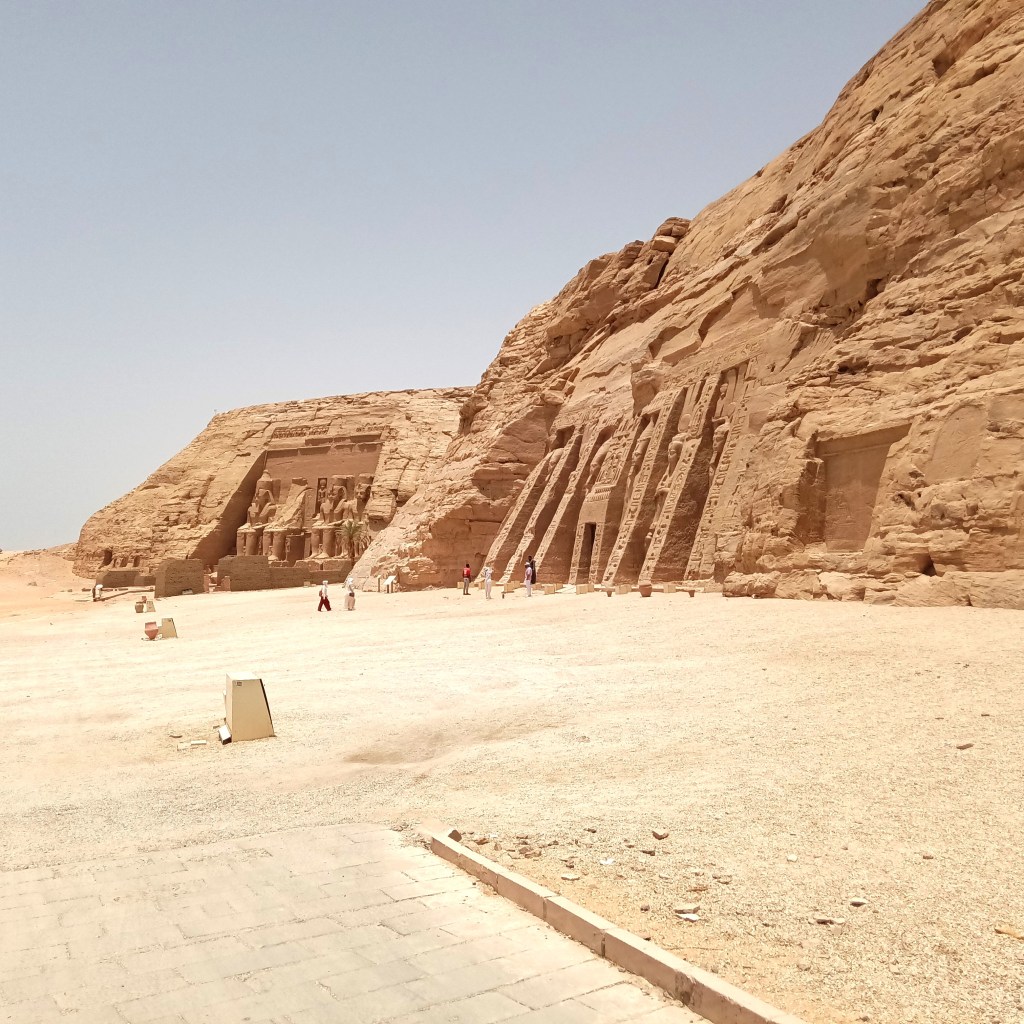
P.C. Cher B 29 May 2024.
Built by Ramses II – to Honor Ramses II
The Abu Simbel temples were hewn into a solid cliff in the 13th century BC. Breathtaking in size, the facade is 108 feet high. Four colossal, enthroned statues of Ramses II overlook and welcome the visitor. He wears the double crown of Upper and Lower Egypt, meant to both impress and to frighten. One enters the temple through massive doors which dwarf the visitor. Inside, one experiences the union of god and king as represented in the interior.
The temple is technically dedicated to the patron deities of the great cities of Egypt (Amun of Thebes, Ptah of Memphis, and Ra-Harakhty of Heliopolis). In reality, it was built by Ramses II to honor Ramses II.
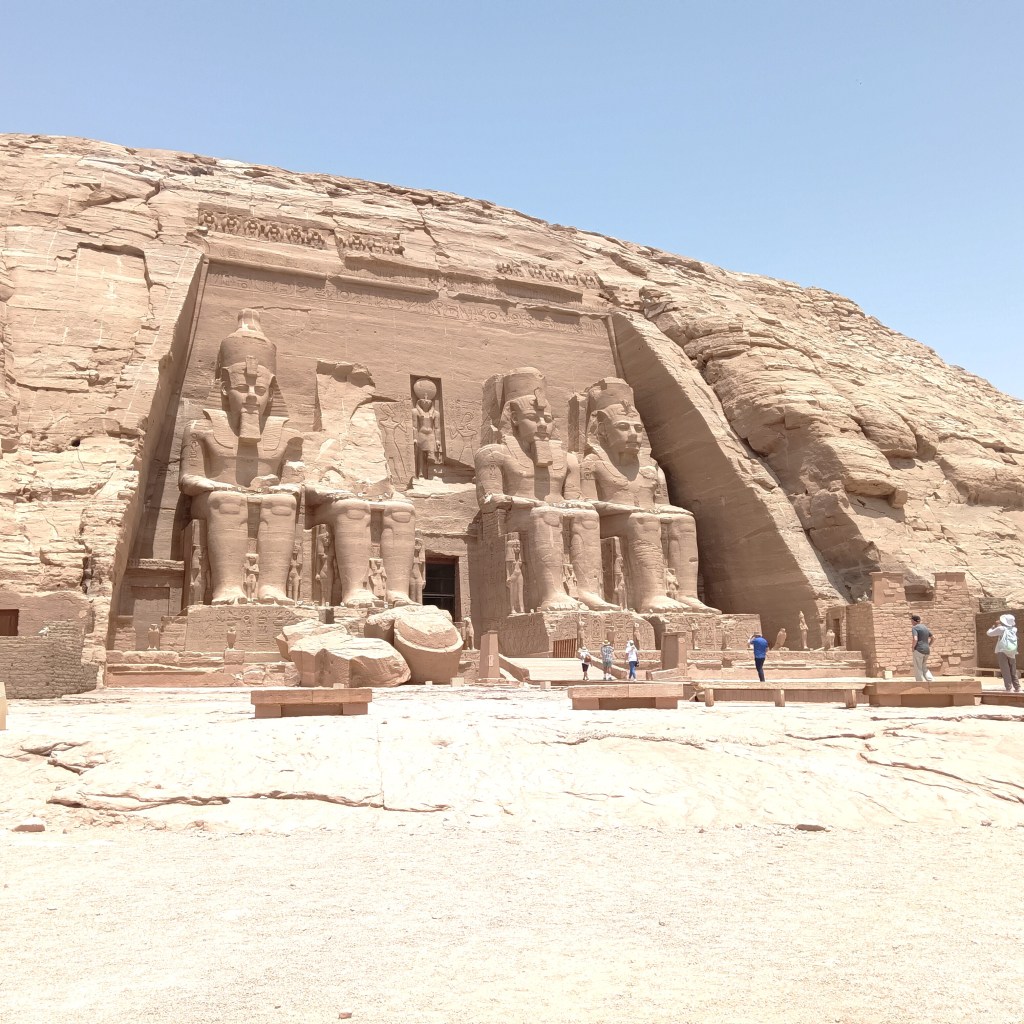
P.C. Cher B 29 May 2024.
Buried in Sand for Centuries
Like much of Egyptian antiquities, the complex was hidden for centuries, buried under the wind swept Egyptian sand. Its secret was revealed in 1813 when Abu Simbel was discovered by the Swiss traveler/explorer, Jean-Louis Burckhardt. (Calling him an “explorer” is hardly adequate! His life is a fascinating story, including his other major claim-to-fame, the discovery of the ancient city of Petra, Jordan!)
Impending Doom & Deliverance in 1960s
Jump ahead 130+ years to the mid-20th century. Egypt was becoming modernized; its population growing. During the 1960s, in an effort to accommodate their needs for power (i.e. electrical), the Egyptian government decided to build a dam on the Nile. Known as the Aswan High Dam, a large body of water named Lake Nasser was created.
However, the creation of this lake resulted in the potential of a tragic consequence. The new body of water would have submerged many priceless, ancient structures, including the Abu Simbel complex.
This impending, irreversible catastrophe brought about an unprecedented, historical worldwide initiative. It was spearheaded by UNESCO, along with a multi-national team of archaeologists, craftsmen, engineers, and countless others. The temples were ultimately rescued; they were painstakingly moved from their impending doom to a new residence up the hill.
After much deliberation, the final decision was to build an artificial cliff onto the plateau 213 feet above and 688 feet back from their original position. The mountain was erected to create the impression of the temples cut into the rock cliff, exactly as it had been in its original site.
In record time, both temples were painstakingly dismantled and relocated between 1964 and 1968. The temples and complex were meticulously and methodically placed in exactly the same direction as before. (More on this below)

P.C. Cher B 29 May 2024.
I was happy to learn that the United States heard the call to action and got actively involved in the project. Besides manpower, expertise and promotion, it also contributed the astounding price of 40 million USD (in 1960s dollars) to the project.
This plague at the Visitor Center provides a good overview of the layout – before and after. One enters from the left side, walks down the hill toward Lake Nasser, and comes face to face with the great temple. The sketch on the lake shows where the original complex was before the lake was flooded.

P.C. Cher B 29 May 2024.
P.C. Cher B 29 May 2024.
What can one see Today?
The temples are breathtaking! The first thing that impresses one is the sheer size!
As one approaches the temple, one is immediately dwarfed by the four colossi on the temple facade which boast of a unified Upper and Lower Egypt. The Ramses II Colossi is on the left. The names of Ramses II in cartouche form adorn the thrones along with carved images of captives from the north and south. Baboons greet the sunrise across the top. Unfortunately, the broken colossus next to the door lost his head in an earthquake in 27 BC.
The Great Temple

P.C. Cher B 29 May 2024.

P.C. Skip B 29 May 2024.

P.C. Cher B 29 May 2024.
Inside the Great Temple
One enters the temple and into the grand Hypostyle Hall. Each side of the hall is flanked by four colossi. Meant to impress, the 59 feet long and 55 feet wide hall accomplishes its goal. Supported by 8 massive pillars which depict the deified Ramses, he is linked to the god Osiris. The southern pillar colossi wear the crown of Upper Egypt. The northern ones wear the double crown of Upper and Lower Egypt. The walls are covered with multiple representations of Ramses II making offerings to his deified self.

P.C. Cher B 29 May 2024.
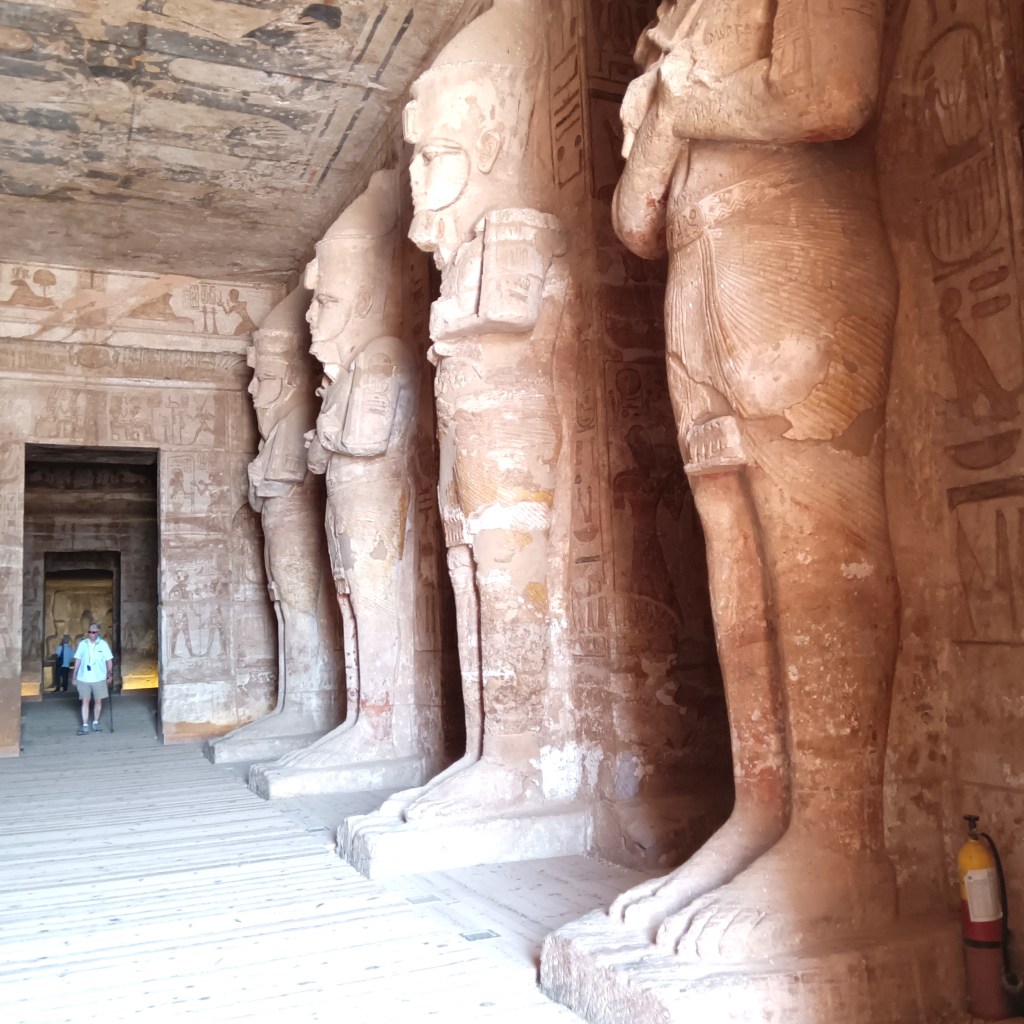
P.C. Cher B 29 May 2024.
Impressive engravings decorate the interior walls representing Ramses and Nefertari pay homage to the gods. Ramses fights the Hittites in the Battle of Kadesh.

P.C. Cher B 29 May 2024.
The Inner Sanctuary
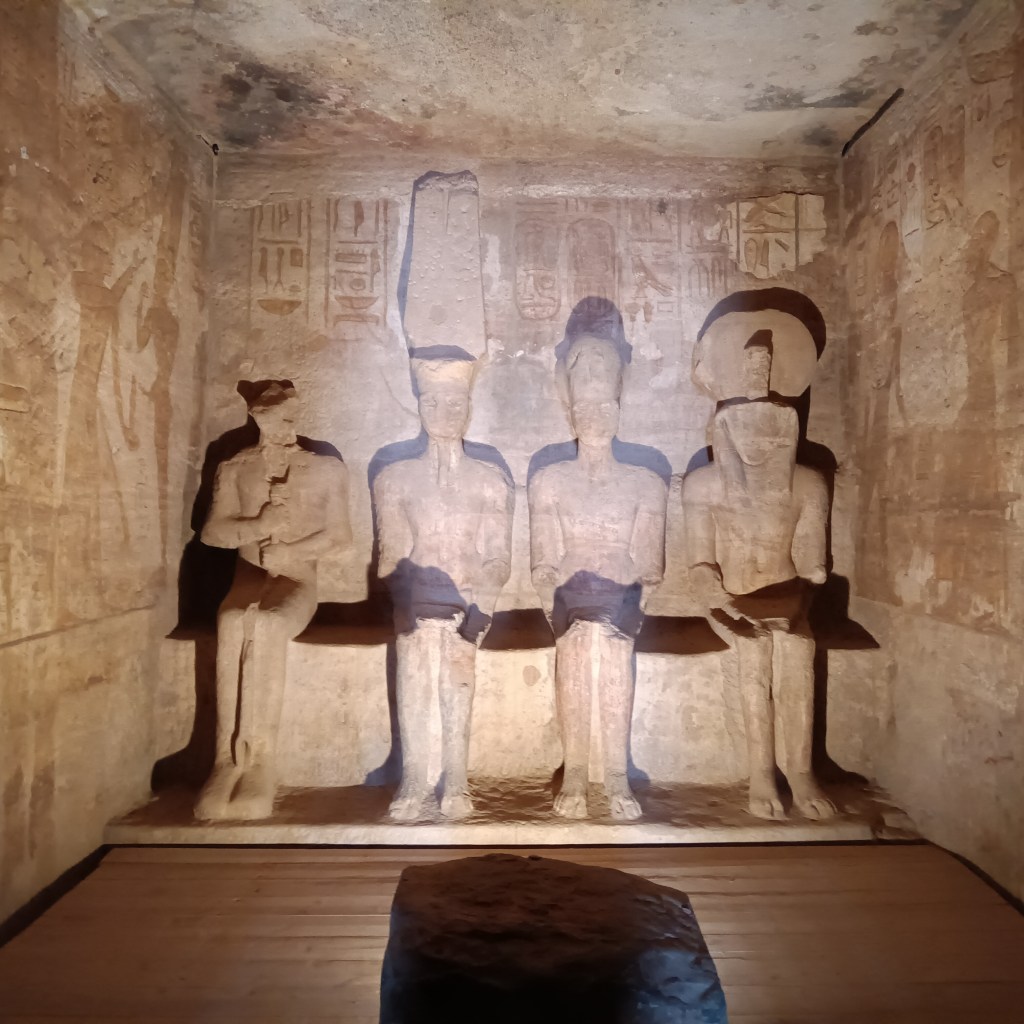
The Inner Sanctuary lies at the far end of the hall. More impressive than the actual sculptures is its location and what happens on its walls.
Here, once covered in shiny gold, Ramses II sits with the Egyptian gods Amon-Ra, Ptah and Ra-Harakhty. The brilliance of the original ancient Egyptian architects is evidenced here as to where they ingeniously aligned the temple with the sun.
On two days of the year, October 21 and February 21, the sun’s rays enter the sanctuary and illuminate the once gold-covered sculptures on the wall! (That is, all except for Ptah, the god of the underworld, who would remain in shadow.) This phenomenon is true today as it was when it was built.
P.C. Cher B 29 May 2024.
This phenomenon occurs 61 days before and 61 days after the winter solstice. Visiting in May, I could not witness this in person, but our guides told us that the relocated temples perfectly mimic the original temple position and dates.

P.C. Cher B 29 May 2024.
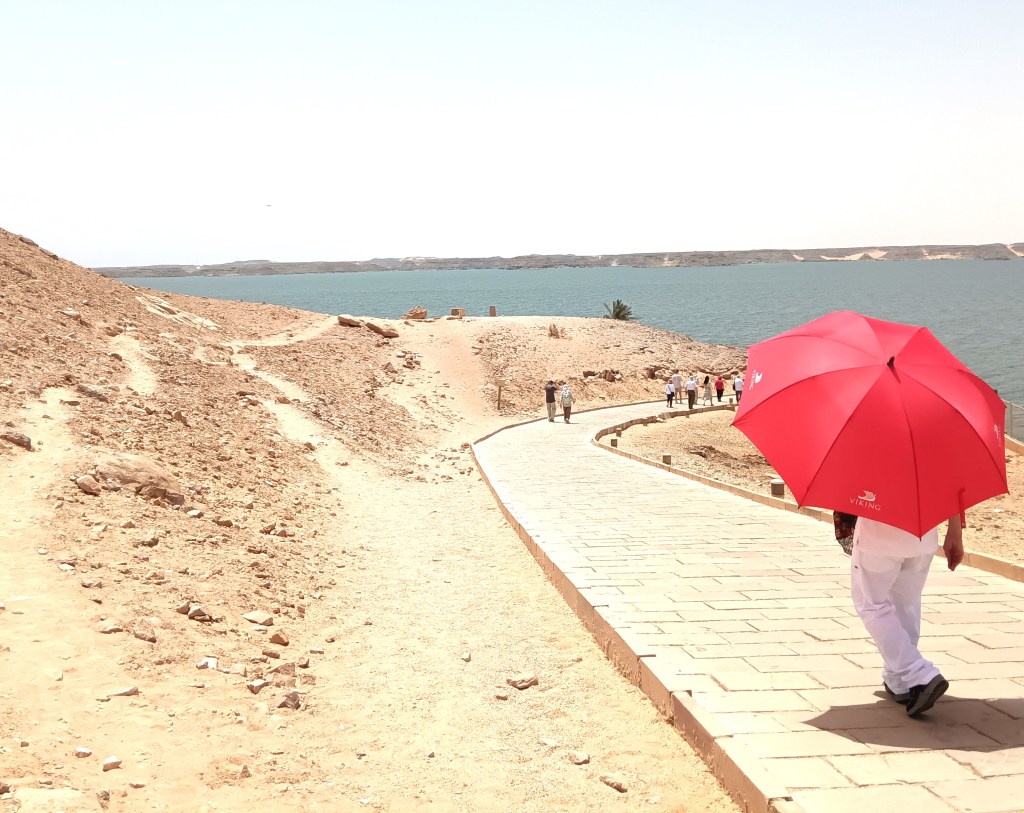
View of Lake Nasser can be seen out the doors of the temple. It is from under these waters that Abu Simbel was wondrously rescued.

P.C. Cher B 29 May 2024.
The Small Temple: the Temple of Hathor
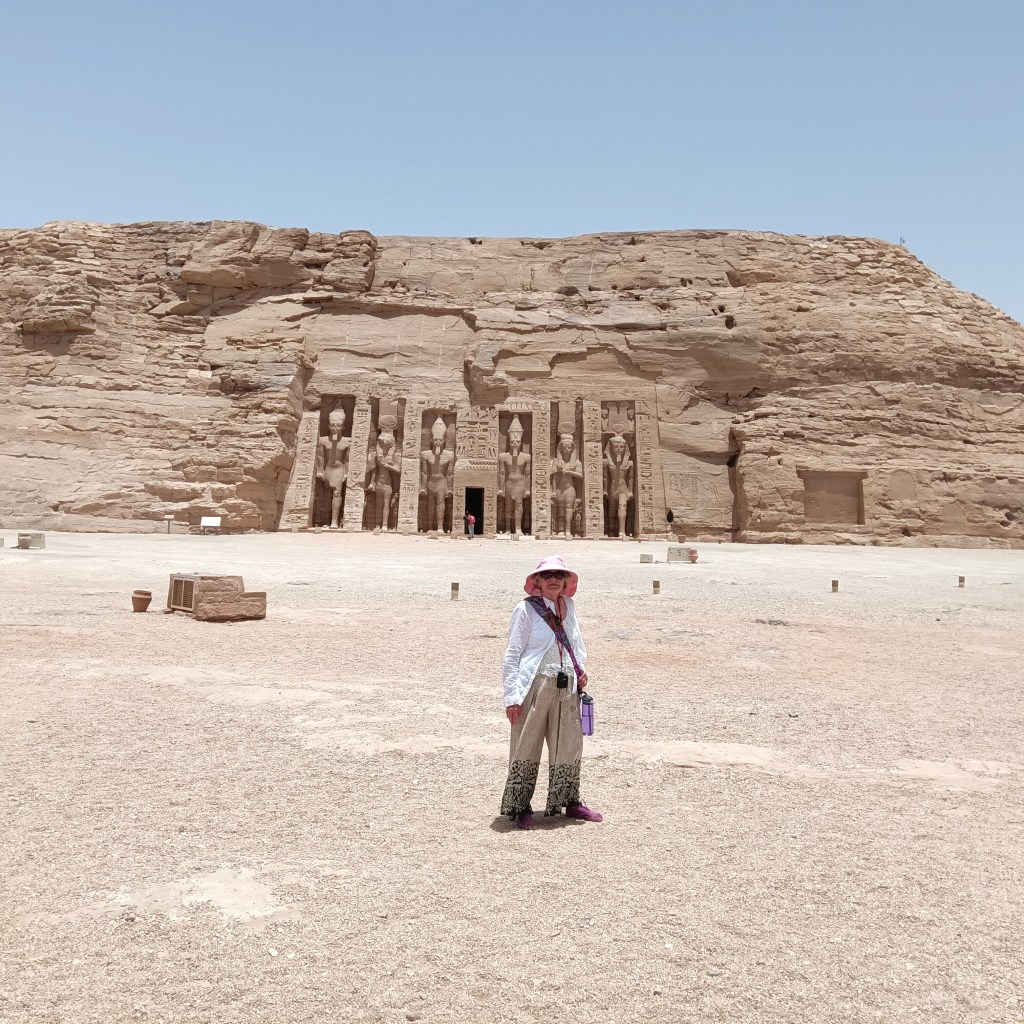
The smaller temple, dedicated to the goddess Hathor, is next door. It was built by Ramses II to honor his favorite wife, Nefertari (not to be confused with Nefertiti). It reaches a height of 40 feet and length of 92 feet. Four colossi, statues of Ramses and two of Nefertari, are depicted in front of the temple, three on each side of the doorway.
P.C. Skip B 29 May 2024.
The Small Temple: Why is it Notable?
First, it is only the second time in ancient Egyptian history where a ruler dedicated a temple to his wife. The first time was when Pharaoh Akhenaton (1353-1336 BC) dedicated a temple to his queen, Nefertiti.
Second, at Abu Simbel, the queen is rendered the same size as Ramses. Typically, in Egyptian representations, the queen is usually on a smaller scale than the king and apparent as a female.

P.C. Cher B 29 May 2024.
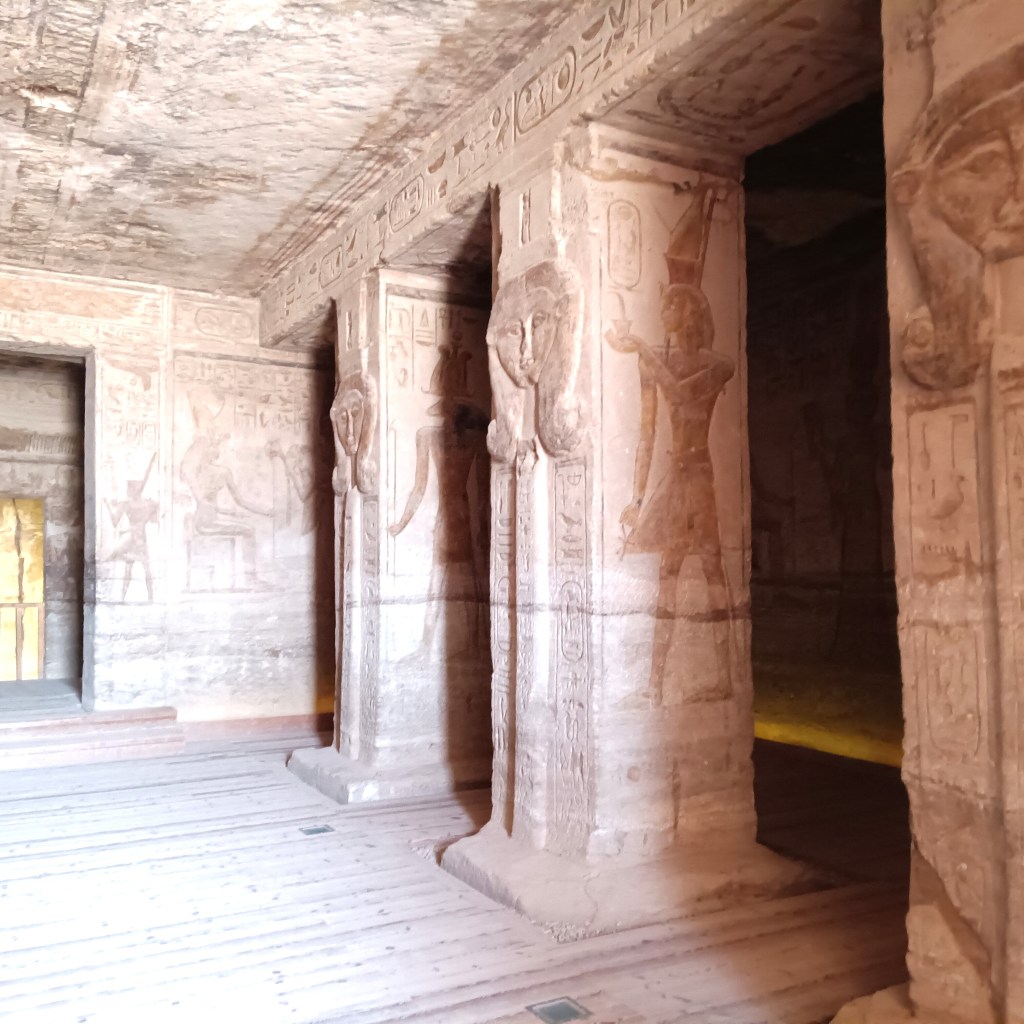
In this much smaller, more intimate hall, images dedicated to Ramses and Nefertari making offerings to the gods line the inner walls. We see her as she watches as Ramses slays the enemies of Egypt.

P.C. Cher B 29 May 2024.
Both the hypostyle hall and the inner sanctuary include pillars depicting the goddess Hathor in the form of a cow.
P.C. Cher B 29 May 2024.
The realization that these two temples have been relocated and restored is absolutely amazing. Had I not known their story, and its magnitude, I would not have believed it.

P.C. Cher B 29 May 2024.
Appreciation of this project was enhanced by having read a phenomenal book prior to my visit. I highly recommend it both in preparation for a visit to Abu Simbel – and on its own merit.
Arm Chair Travel: “Empress of the Nile”
Sharing this experience would not be complete without sharing the book that was instrumental in my full appreciation of Abu Simbel. In this book, Lynne Olson, writes about the intervention of French Archaeologist, Christiane Desroches-Noblecourt, in the preservation and relocation of this ancient treasure. Impossible to summarize, I quote the book jacket and encourage everyone to read it to full appreciate what went into saving Abu Simbel:
Empress of the Nile:
The Daredevil Archaeologist Who Saved Egypt’s Ancient Temples from Destruction

“In the 1960s, the world’s attention was focused on a nail-biting race against the international campaign to save a dozen ancient Egyptian temples from drowning in the floodwaters of the gigantic new Aswan High Dam. But the coverage of this unprecedented rescue effort completely overlooked the daring French archaeologist who made it all happen. Without the intervention of Christiane Desroches-Noblecourt, the temples—including the Temple of Dendur, now at New York’s Metropolitan Museum of Art—would currently be at the bottom of a vast reservoir. It was an unimaginably complex project that required the fragile sandstone temples to be dismantled and rebuilt on higher ground.
“Willful and determined, Desroches-Noblecourt refused to be cowed by anyone or anything. As a member of the French Resistance in World War II she survived imprisonment by the Nazis; in her fight to save the temples she defied two of the most daunting leaders of the postwar world, Egypt’s President Abdel Nasser and France’s President Charles de Gaulle. As she told one reporter, “You don’t get anywhere without a fight, you know.”
“Desroches-Noblecourt also received help from a surprising source. Jacqueline Kennedy, America’s new First Lady, persuaded her husband to help fund the rescue effort. After a century and a half of Western plunder of Egypt’s ancient monuments, Desroches-Noblecourt helped instead to preserve a crucial part of that cultural heritage.”
Thanks for letting me share my adventure with you. If you enjoyed it, please let me know by clicking the “like” button below. It will keep me encourage to keep sharing! Thanks!

P.C. Skip B. 29 May 2024
Sources
- DK Eyewitness Travel Guides: Egypt. ed. 2013. Abu Simbel pp 214-215.
- Olson, Lynne. Empress of the Nile (see above)
- Viking tour guides in preparation to and on site at Abu Simbel
 Charamana Consulting