Hatshepsut & Her Temple
Hatshepsut – the person and her legacy – came into my radar during a college class in Old Testament Bible Archaeology. A visit to her temple was high on my To Do list as we traveled to Egypt’s Valley of The Kings (and Queens!) on our 2024 Viking Nile River Cruise.
In its setting at the foot of a sheer limestone cliff-face, Hatshepsut’s Temple is an imposing and stunning sight. Photos in travel and art history books do not begin to do it justice.

P.C. Skip B 27 May 2024
Who was Hatshepsut?
Hatshepsut holds a unique place both in Egyptian history and biblical history.
I like the quote of Egyptologist James Henry Breasted who hailed her as “the first great woman in history of whom we are informed.” (see Sources below uasvbible.org)
Hatshepsut ruled Egypt during the 18th dynasty, from 1515 BC until her death in 1458 BC. But hers was not the reign of a typical Egyptian pharaoh.
Hatshepsut was the daughter of the pharaoh Thutmose I and Ahmose, his Great Royal Wife. She ascended to prominence in the Egyptian timeline first as the Great Royal Wife of Thutmose II. Upon his death, as the closest eligible, living descendant, she began her political career as the regent to Thutmose III, her two year old stepson, the official (but too young to rule) male heir to the throne.
Hatshepsut’s role was initially meant to govern until Thutmose III came of age to take the throne. But as history reveals, this did not happen. Her position and ambition dramatically evolved over the years and thrust her into a unique place of prominence in Egyptian history!
For biblical scholars and archaeologists, she holds a unique role as well. Depending on when one sets the dating of the Israelite Exodus from Egypt, (that’s another topic!) – Hatshepsut is convincing as the Egyptian princess, daughter of pharaoh, who pulled Moses from the bulrushes and raised him as her son. (More on that later!)

P.C. Cher B 23 May 2024
Early Egyptian rulers were primarily male. Female queens typically held no recognized power; they were just consorts of the pharaoh. Hatshepsut, however was a major exception. On record, she co-ruled with her stepson, but in reality, she held the power. She did not relinquish power when he came of age but ruled for 22+ years.
The cause of her death in 1483 has been disputed by Egyptologists. Hatshepsut is recorded to have died in one of two ways: of natural causes – or more likely, murder. Thutmose III, who wanted to finally claim his right to the throne, is historically the most likely suspect.
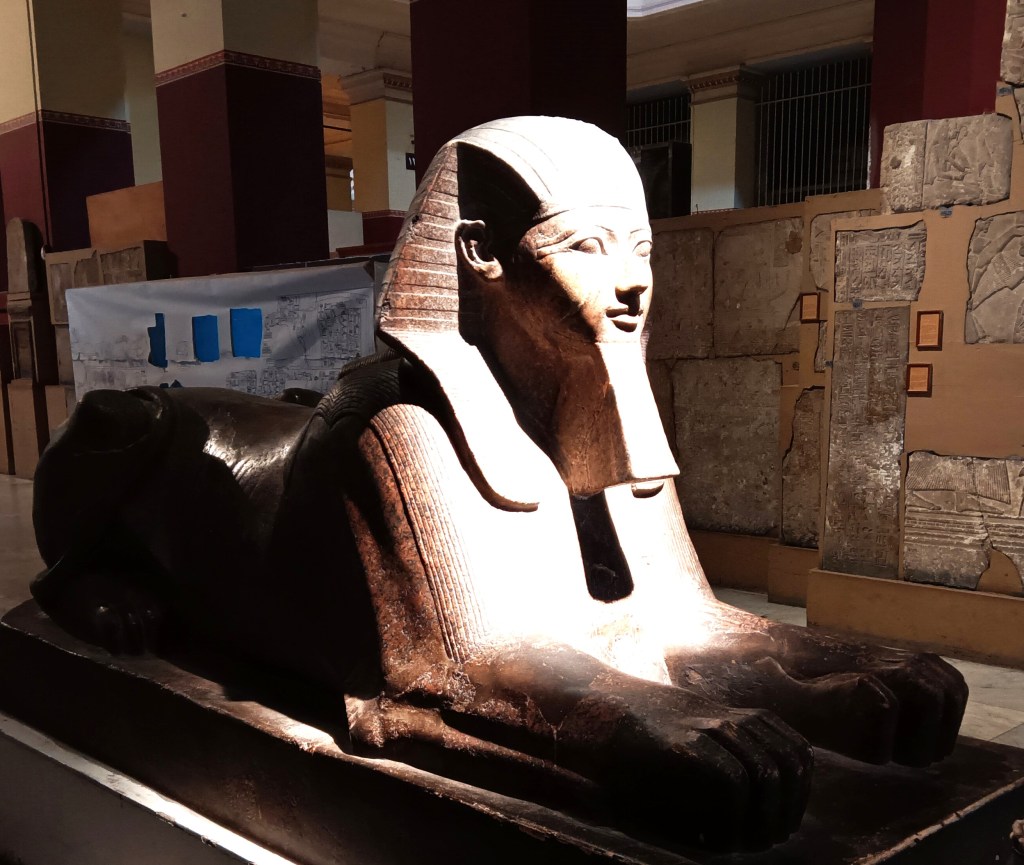
The False Beard
Unprecedented for a female, Hatshepsut ruled as an authentic “pharaoh,” not only as an official “queen” but as king. To publicly display this position, she assumed full pharaonic regalia. This included adding the Khat head cloth, shendyt kilt and false beard. The false beards were symbols of authority and divine kingship; they also projected rank and power.
P.C. Cher B 23 May 2024
Hatshepsut’s Temple
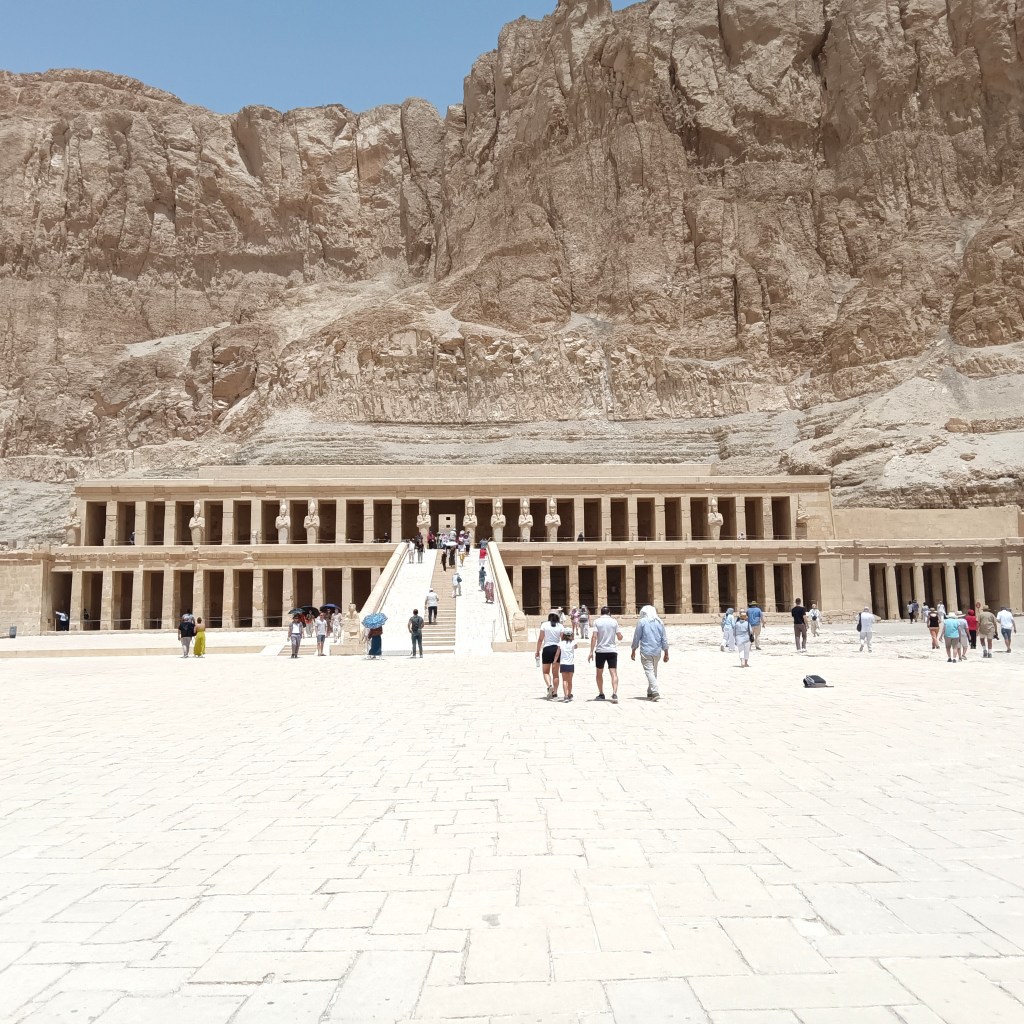
Hatshepsut’s reign is remembered positively. It was one of peace, prosperity and effective leadership. It was a period noted for sculptural, architectural and cultural advancements. Her mortuary temple at Deir el-Bahari, Thebes, is often cited as an example of how she managed the complexities of ruling as a woman in a traditionally a male role.
Hatshepsut’s temple is a breath-taking sight. This partly rock-hewn monument is set against the backdrop of a stark, limestone mountain cliff-face. In Thebes, southern/upper Egypt near the Valley of the Kings, the temple rises from the bleak desert in a series of imposing terraces. Stone steps – lots and lots of stone steps – ascend from the desert to the first and subsequent terraces. We were told that a row of statues once lined the Avenue of Sphinxes that led the visitor toward the grand entrance.
P.C. Cher B 27 May 2024
Hatshepsut’s Osiride/Osirian Statues
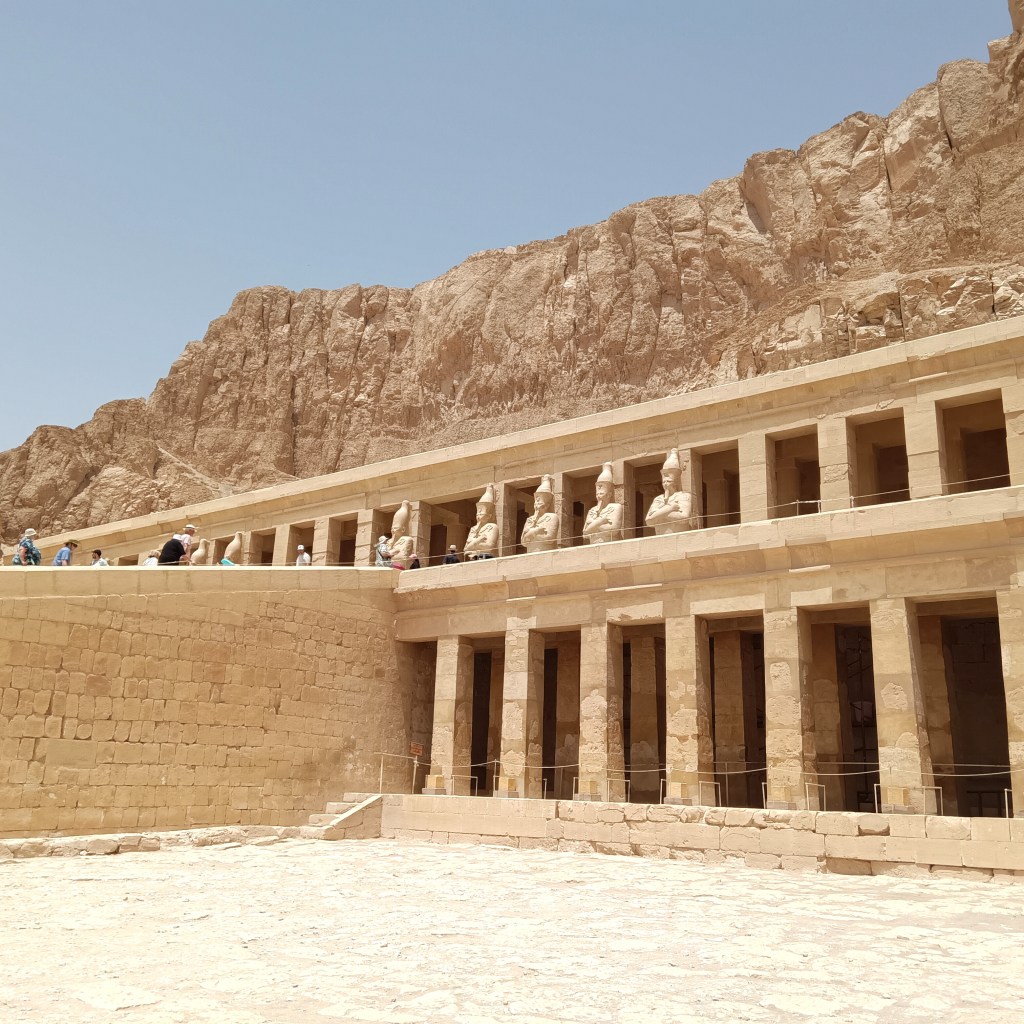
Statues of Hatshepsut line the columns of the portico around the upper terrace. In these figures, she is depicted in the mummiform pose of the god Osiris, god of the afterlife. They were intended to emphasize her divine association and role in the afterlife. The concept of renewal and rebirth reinforced themes in Egyptian kinship for her.
These statues also represent Hatshepsut with the false beard, as noted were typically worn only by male rulers. Thutmose III and later pharaohs destroyed many of the original. We were able to enjoy and appreciate the ones that have been reconstructed by their fragments.
P.C. Cher B 27 May 2024
The upper terrace of the temple is impressive, even without its roof. Wandering through the halls and columns, one can get some perspective on the scale and complexity of the building and architecture.

P.C. Cher B 27 May 2024
The Chapel of Anubis
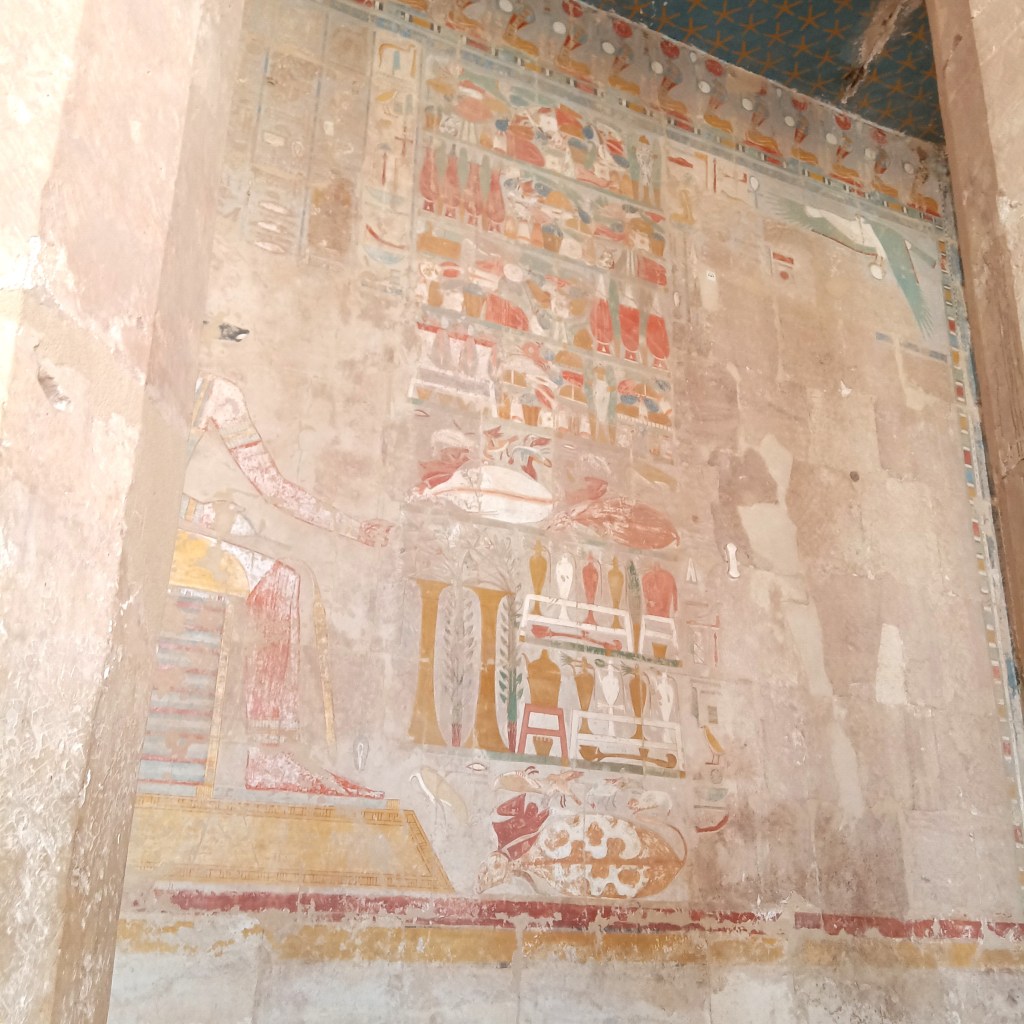
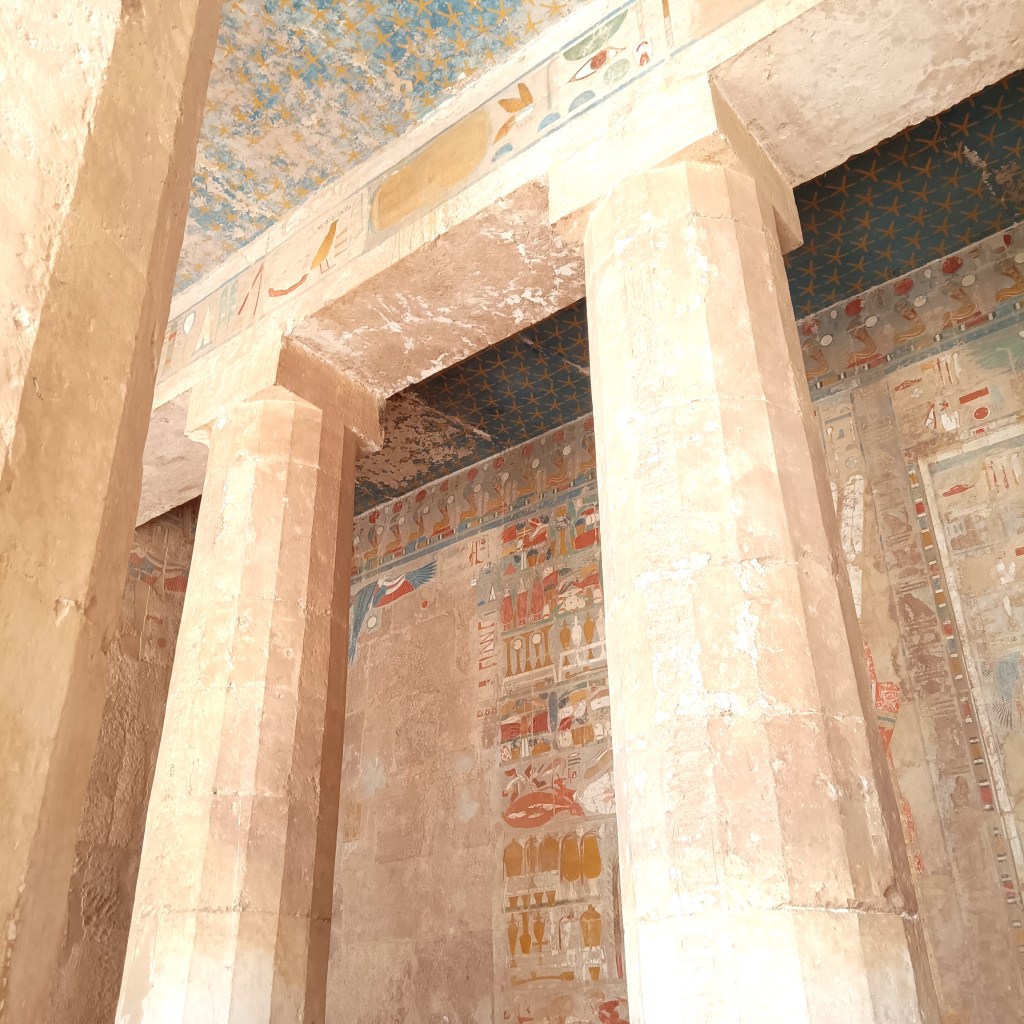
The Chapel of Anubis is one of what were once many smaller, more intimate chapels in this temple. Tucked along one of the side terraces, it contains beautiful, brightly colored murals. This includes a well-preserved relief of Thutmose III making offerings to the sun god Ea-Harakhty. (It was not destroyed, of course, because it does not include Hatshepsut!)

P.C. Cher B 27 May 2024
Unfortunately, Thutmose III held a huge grudge against Hatshepsut. Upon her death, he proceeded to attempt to obliterate any memory of her existence. Many of these obvious erasures are seen in this chapel.
P.C. Cher B 27 May 2024
However, the fascinating and beautiful murals overall provide detailed information and insight into Egyptian culture and religion during this time.
P.C. Cher B 27 May 2024
Erasure of Hatshepsut in History
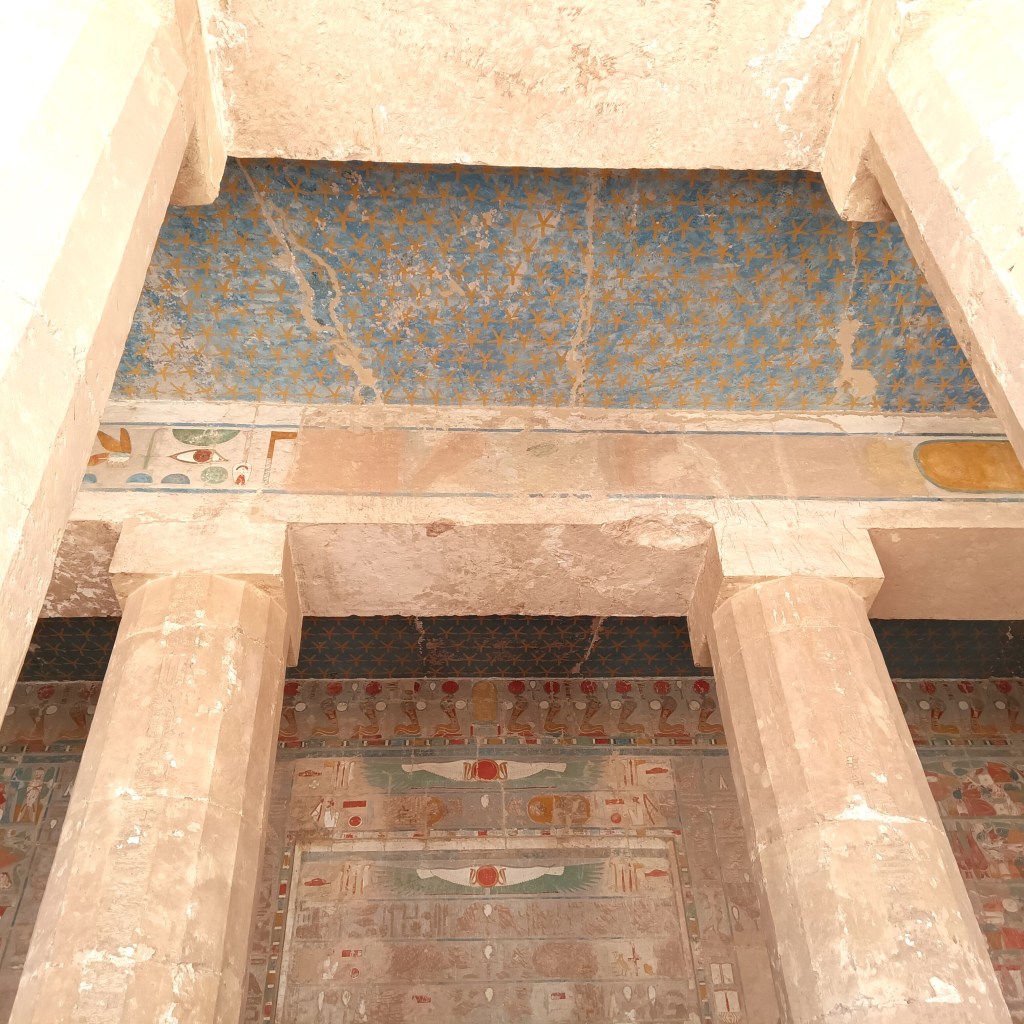
Hatshepsut’s name, along with her images and representations from temples and monuments, were meticulously removed after her death. This erasure began with Thutmose III and continued into the reign of Amenhotep II. Fortunately a few shrines, cartouches and images were left untouched, preserved in places tucked away from the public eye to keep her legacy alive.
P.C. Cher B 27 May 2024
The Egyptian Princess & Moses
I developed a fascination with Hatshepsut while taking (and later teaching) a college course on Old Testament Archaeology. Significant course material was spent exploring the role of Egypt in the Bible. This included the lives of the Patriarchs (Abraham, Isaac and Jacob), Joseph, Moses and ultimately The Exodus of Israelite from Egypt.
Enter Hatshepsut, who is not directly named, but is critical in the narrative. The biblical account in Exodus 2 describes how Moses, the male baby of an Israelite family enslaved in Egypt, is discovered along the banks of the Nile River. He is rescued from the bulrushes by “Pharaoh’s daughter.” She adopts, raises and educates him in the House of Pharaoh. Moses grows up and eventually leads the Israelites in their epic Exodus from Egypt. Biblical scholars believe that this Egyptian princess, known as “Pharaoh’s daughter,” was the historical Hatshepsut. The argument is convincing. It is a fascinating, compelling story that is best left told by the experts. I encourage you to check it out! (See Sources biblearchaeology.org below)
Travel Tips
TRAVEL TIPS: During our time in the area of Luxor, southern Egypt, there was a lot to take in. We of course did not want to miss a thing! Hatshepsut’s Temple was paired with our visit to the Valley of the Kings and King Tut’s Tomb. The two visits made up a very full day. (Remember it is HOT and everything is a bit slower!) I would recommend going with a guided tour to navigate the landscape and get the insight and expertise of a local guide, vs. going on your own. It is your preference whether it is a larger group (ours was an included excursion with our Viking cruise, led by Egyptologist guides) or a smaller, more individualized group. But they will make the process seamless, purchase timed tickets for you to guarantee admittance and navigate potential cultural language challenges.
HEAT & MOBILITY ALERT: The 115 degree temperatures with minimal shade, along with many steps and inclines, made Hatshepsut’s Temple a challenging place to navigate if one has any mobility issues with walking or climbing stairs. It was well worth it, but be sure to take your time, drink plenty of water, wear good walking shoes, and dress in light, airy clothing. If needed, bring your walking cane – but it is not a place conducive to walkers or wheelchairs.
Sources
- Cher B personal info from travels to Egypt, May 2024.
- DK Eyewitness Travel. Egypt. ed. 2013 pp 196-197.
- HIS 3115 Old Testament Archaeology, University of Northwestern, St. Paul, MN, USA. 2001 ed.
- biblearchaeology.org/research/exodus-from-egypt/3090-moses-and-hatshepsut/
- uasvbible.org/2024/05/10/the-reign-of-queen-hatshepsut-1507-1458-bc-establishing-her-legacy-as-pharaoh/
- Viking Travel Guides and Egyptologists on our tour to Egypt, May 2024.
Like this article? Let me know! Click on the “LIKE” button below. And better yet – I love your comments! Thanks!

P.C. Skip B 27 May 2024
 Charamana Consulting