Karnak
Egypt is filled with ancient temples, many of which line the shores of the Nile River. They were easily accessible from our riverboat on our Viking Nile River cruise.
I’ve spent years poring over photos of Karnak and other temples in my art history books. Like all travel experiences, I discovered that photos of Egypt’s temples cannot begin to compare to visiting them in person! The sensory experience of walking through the dusty, massive courtyards, gazing heavenward to the towering columns, and viewing ancient hieroglyphics is made complete by the feeling of hot, bright Egyptian sun.
Where is Karnak & Why is it Significant?
Karnak is Egypt’s most important Pharaonic site, second only to the pyramids of Giza. It is Egypt’s largest religious complex. Its Egyptian name was Ipetisut – “Most Select of Places.”

P.C. Cher B 25 May 2025
Just north of Luxor, Karnak covers a vast area and was built over a period of 1300 years and by many rulers. Built during Egypt’s New Kingdom, the largest of its kind in Egypt, it testifies to the importance of Thebes.
It was largely the work of 18th Dynasty Pharaohs: Thutmose I and III, and Hatshepsut. Ramses II (19th Dynasty) added his touch, along with some as late as the 26th Dynasty.

The 100 acre site comprises a massive array of temples, chapels, pylons (an open court with colossal statue pillars) and obelisks. Over time, pharaohs added to, restored and/or rebuilt Karnak.
In recent years, excavations have slowly uncovered the original temple complex structure. Today, the visitor can easily experience the grandeur of the original buildings.

P.C. Cher B. 25 May 2025.
Many deities are worshiped at Karnak. The complex consists of three precincts for the gods Amun/Amun-Ra (the most important Egyptian deity worshiped here), Mut and Montu. Each precinct contains a main temple and smaller temples and chapels. Foundations of and blocks from Akhenaten’s temple at Karnak have also been discovered and scholars are studying its structure.
Traveler Tip: When visiting Karnak, I recommend – GET A MAP! Mark it up while you are in the complex. I did not have one during our tour and wish I had one to refer back to. The complex is easy to navigate. The challenge has been, both on the tour and as I attempt to compile this blog, to figure out which area belongs to which god and which of my photos go with which temple, where the pylons and precincts start and stop, etc. — OR — if it more your style, just do as I did while there and enjoy it for its awesome beauty, its massive size, and magnificent Egyptian art and architecture at its best! (But somehow mark your photos as you go to ID them when you get home.)
Karnak Temple Layout
The three temple complexes are in North-South alignment.
- Amun’s precinct is in the center and the largest.
- Mut’s precinct is the second largest and the southern-most.
- Montu’s precinct is the smallest and the highest north.
Temple of Amun
The first pylon lead us to the temple of Amun.
There are several entrances to the complex. We entered through the main one into the first pylon. This was the one which lead from the Ticket Office/Gift Shop and was probably used the most in ancient times as it lead to the Nile.

P.C. Cher B 25 May 2025
Ram-Headed Sphinx
We strolled along the grand avenue, comprised of ram-headed sphinx. The ram was the sacred animal of the god Amun. The small statues beneath the rams head date from the time of Ramses II.

P.C. Cher B 25 May 2025
Inside the first pylon, we encounter the Temple of Amun and more ram-headed sphinx lining the walls.

P.C. Skip B 25 May 2025
Temple of Seti II
The Temple of Seti II is within the pylon of the Temple of Amun.

P.C. Cher B 25 May 2025
Temple of Ramses III
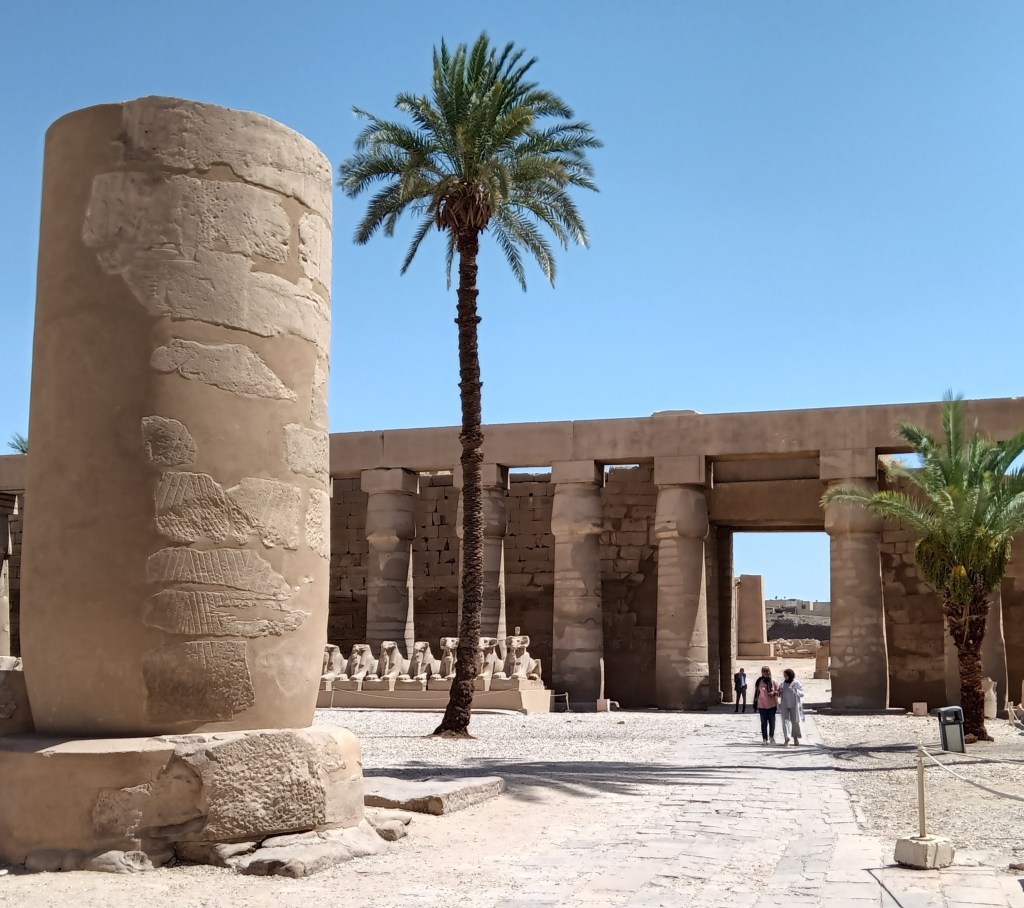
The Shrine of Ramses III is opposite the Temple of Seti II. Nearly 200-foot-long, it has the size and shape as that of a small temple. It includes a small pylon, a hypostyle hall with 8 columns, and a sanctuary.
Side note: A hypostyle hall, in architecture, is an interior space whose roof rests on pillars or columns. It literally means “under pillars.” The design allows for construction of large spaces without the need for arches: temples, palaces or public buildings. The Karnak Temple of Amun is a great example.

P.C. Cher B 25 May 2025
P.C. Cher B 25 May 2025
P.C. Cher B 25 May 2025
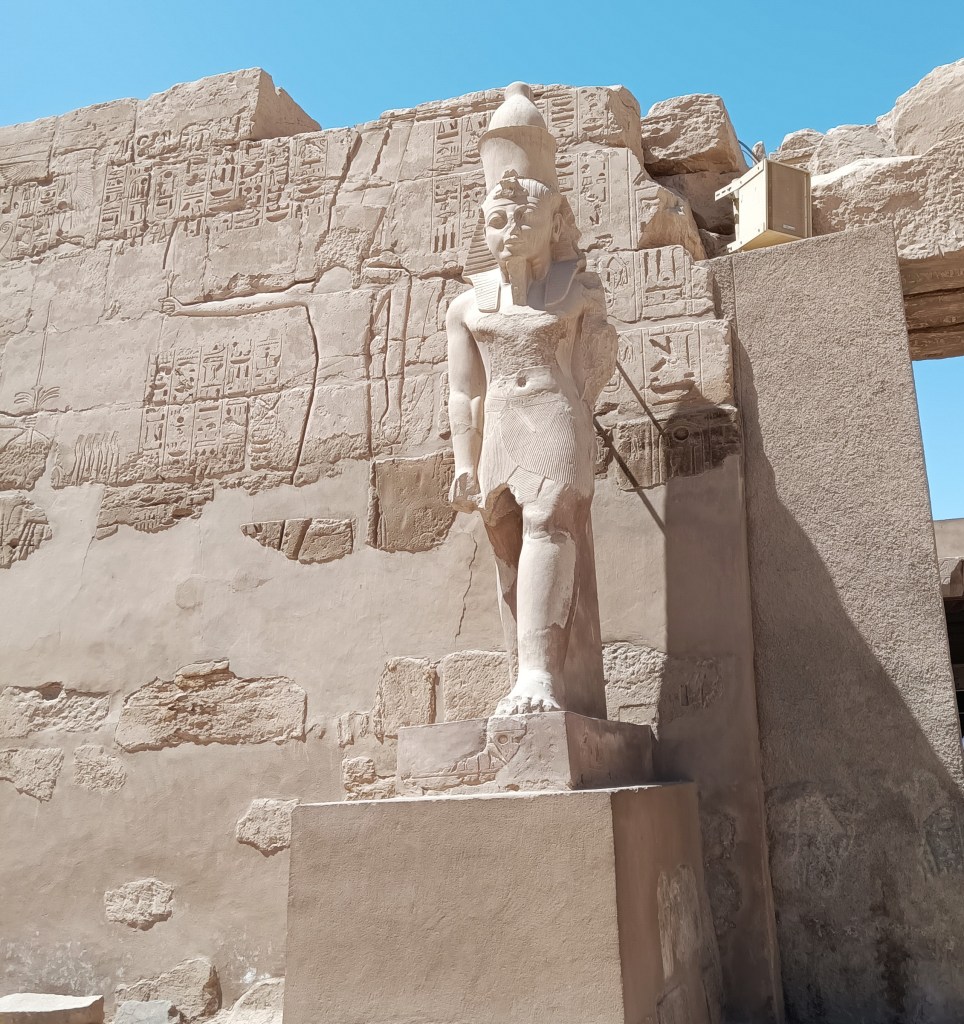
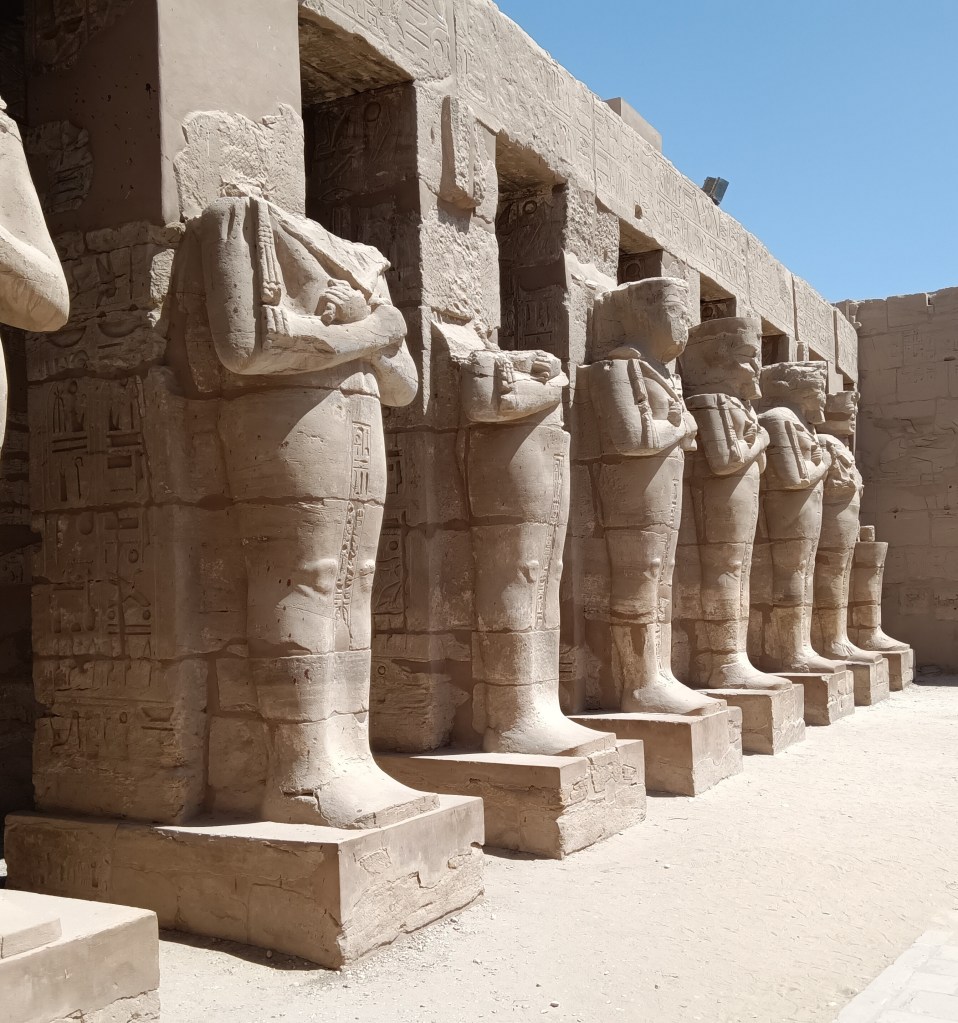
Our Egyptologist reminded us to pay attention to how statues are posed. Feet placed side by side, like these below, signify that they are of a deceased person. Feet which are posed apart (as shown above) and appear to be walking indicate that the person was still alive when the sculpture is created.
P.C. Cher B 25 May 2025
Great Hypostyle Hall
The second pylon opens into the Great Hypostyle Hall. This large area boasts of 134 massive columns topped by papyrus capitols. The twelve center columns are the largest. A true example of a pylon, this area once had a roof with small windows letting in some light. (Interestingly, the spacious, airy, lit area we enjoy today was likely fairly dark when first built!)

P.C. Cher B 25 May 2025
Obelisk of Hatshepsut
In a narrow court at the end of the Great Hypostyle Hall are several obelisks (photo above). This one remaining obelisk is of Hatshepsut, standing 30 meters (98+ feet) high. In their deliberate effort to obliterate her name, later kings blocked out the view of this from ground level, and constructed walls around it. Hatshepsut’s companion obelisk lies, broken, by the sacred lake. (For more on the life, legacy and temple of Hatshepsut, see my blog post)
Perspective and scale of the site can be seen in this photo taken inside the inner columns along the Great Hypostyle Hall.

P.C. Cher B 25 May 2025

P.C. Cher B 25 May 2025
Open Papyrus Umbel Capitals
Open papyrus umbel capitals on top of the columns of the Hypostyle Hall. Each column is massive and our Egyptologist shared that it is large enough for several dozen people to stand on top of the largest ones.

P.C. Cher B 25 May 2025
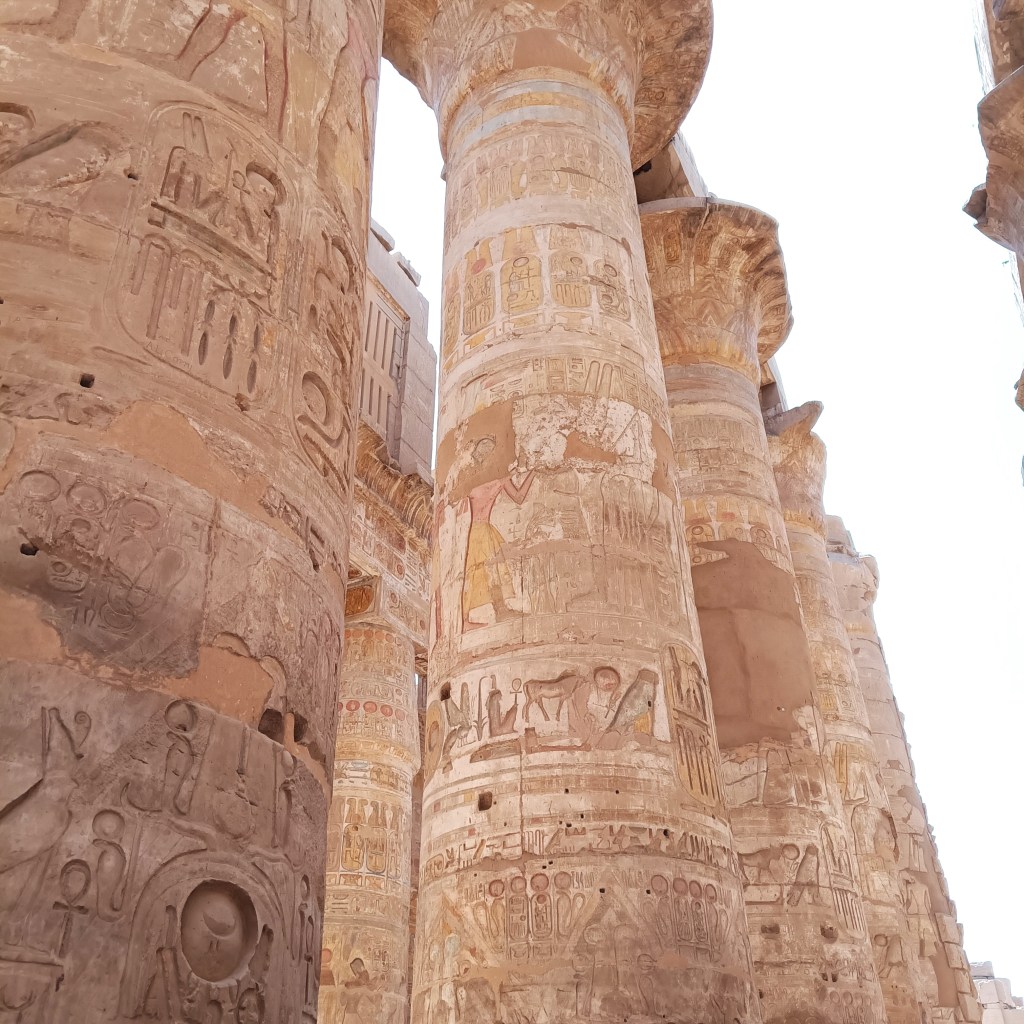
Once brightly painted, some of the columns have retained a bit of their color over the centuries.
P.C. Cher B 25 May 2025
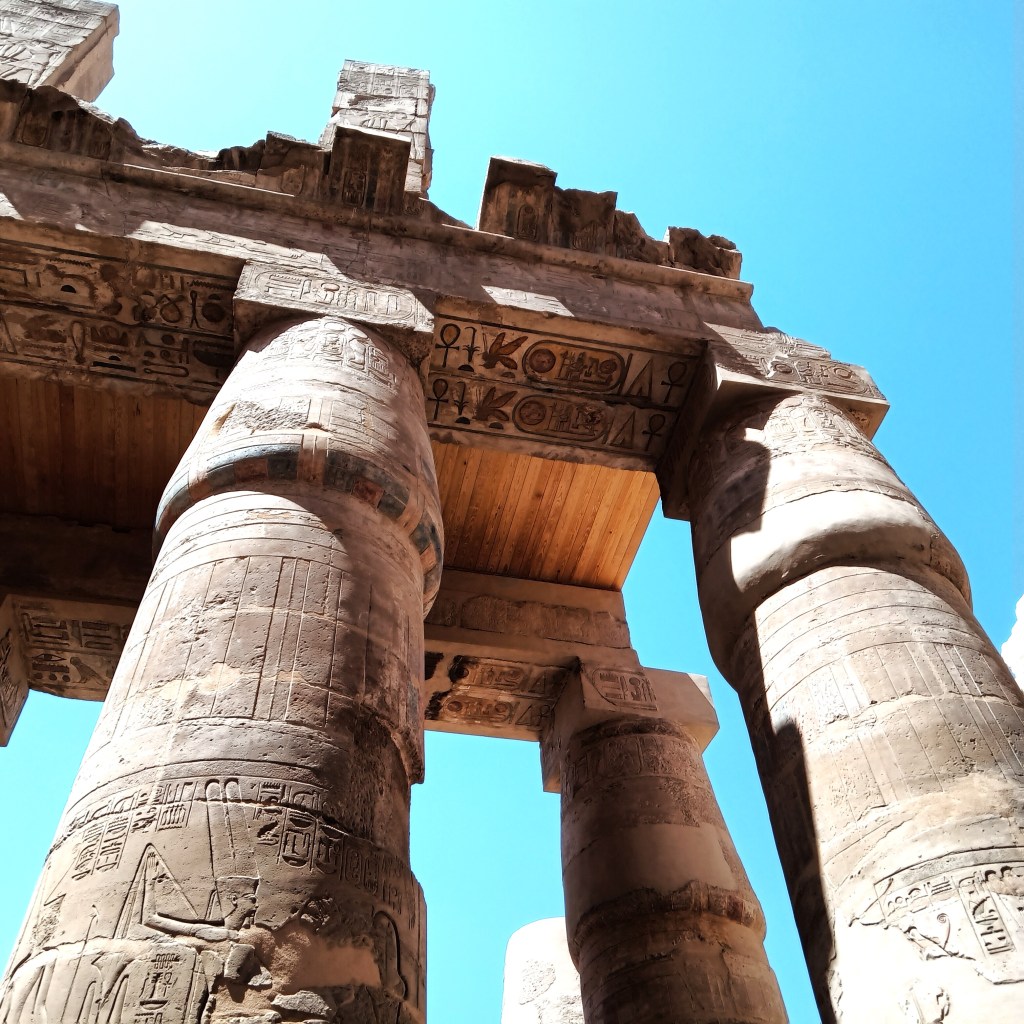
Closed Papyrus Umbel Capitals
Also in the Hypostyle Hall are columns with closed papyrus umbel capitals.
P.C. Cher B 25 May 2025

P.C. Cher B 25 May 2025
Sunken Reliefs
A variety of scenes done in sunken reliefs decorated the walls and columns of the temples. Rituals or festivals conducted in a specific area of the temple are often portrayed. Other inscriptions provide details such as the dedication of a building or an object. The military exploits of pharaohs decorate some of the walls. These decorations were once brightly colored; color which has mostly been worn away with the ravages of time.

P.C. Cher B 25 May 2025
…
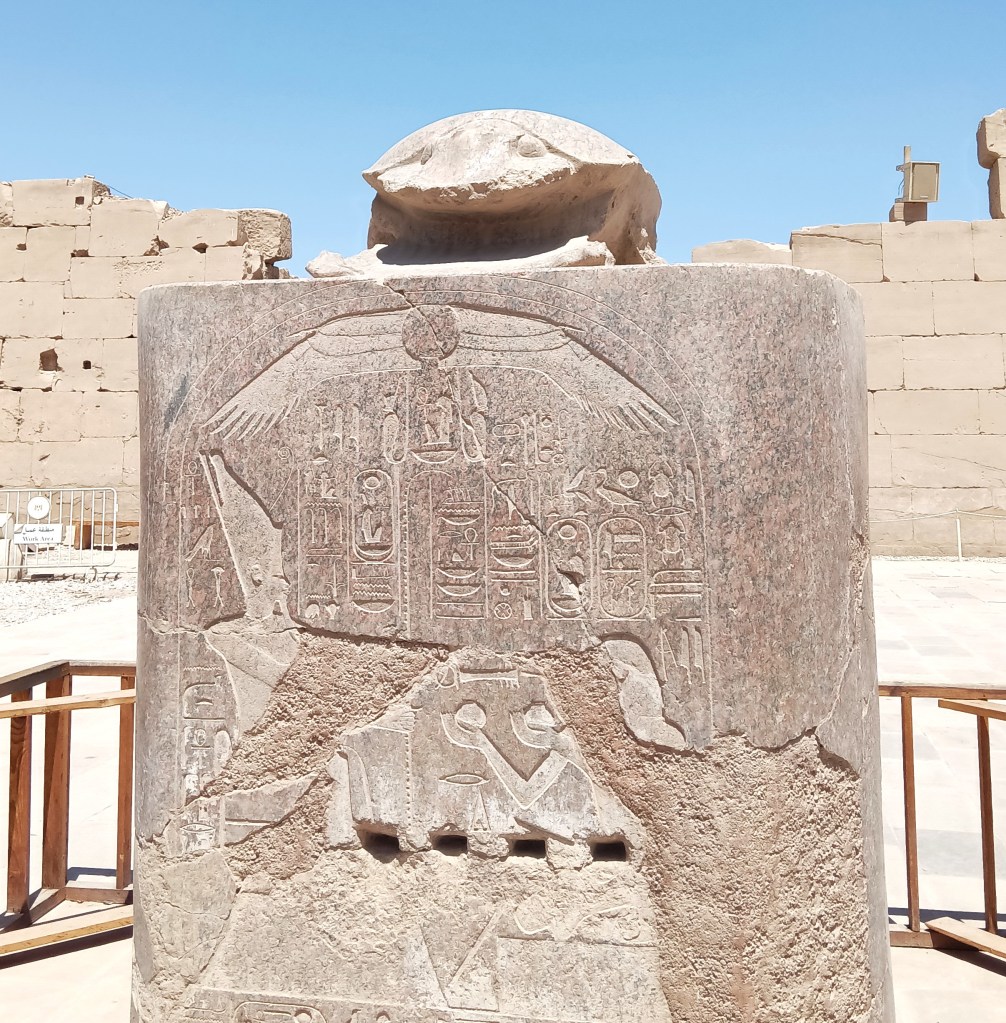
The Karnak Temple Giant Scarab
What is it? Why is it Important?
The Karnak Temple Giant Scarab can be found in the Eighth Pylon, near the Sacred Lake and Hatshepsut’s obelisk. It is a large, impressive stone-carved sculpture of a scarab beetle. Measuring several meters in length, it stands out due to its size and symbolic importance. It is one of the largest and most significant religious sites in Egypt.
The Giant Scarab holds significant symbolic value in ancient Egyptian culture. Scarabs were associated with the deity Khepri, the god of creation and rebirth. Egyptians believed its behavior of rolling dung balls was like the sun being rolled across the sky. This symbolized the cycle of creation and rebirth. Consequently, the Karnak Temple Giant Scarab represented both the divine protection and the perpetual renewal of life.
P.C. Cher B 25 May 2025
Side note: Today, visitors are encouraged to make a circular walk around the statue to achieve good luck and success in their lives. Our guide told us that walking around the statue three times brings good fortune. Some people also left coins. A fence surrounding the statue prevented people from touching and rubbing it.
TRAVEL TIP: One can visit the Karnak temple complex in a couple of hours or the better part of a day. We had a guided tour with an Viking Egyptologist tour guide with time on our own to explore at the end. A self-guided tour (with a good map) or audio tour (not sure if it is available) might provide more flexibility than being herded around in groups. Going at times when it is less crowded is also recommended, if possible. But it is a grand experience and worth the stop. We did not have time budgeted to check out the gift shop, so I can’t speak to that.
Sources
- ancient-egypt-online.com. 20 June 2025.
- DK Eyewitness Travel: Egypt ed. 1013. pp 188-189
- Egypt: Then and Now. Past and Present: an Illustrated Guide (no ed. posted). pp 16-20
- Kleiner, Fred S. Gardner’s Art through the Ages, a Global History. 14th ed. pp 72-73
- Viking Egyptologist Tour Guide. 25 May 2025
Related Posts
Thanks for letting me share this travel adventure with you! If you enjoyed it, please let me know with a “LIKE” below! Encouraging comments are also always welcome. ~Cher

P.C. Cher B 25 May 2025
Coming Soon: Other Egyptian Temples
- Luxor
- Dendara
- Edfu
- Kom Ombu
- Philae
 Charamana Consulting