Cher Visits Cologne/Köln, Germany
May 2025
Cher Visits Cologne/Köln
When introducing Cologne, Germany, travel expert, Rick Steeves, says it best: “Romance isn’t everything. Cologne/Köln is an urban Jacuzzi that keeps the unromantic Rhine churning. It is home to Germany’s greatest Gothic cathedral and its best collection of Roman artifacts, a world-class art museum, and a healthy dose of German urban playfulness.” (Rick Steves’ Germany & Austria 2007, p 290)
Cologne was one of the stops on our Viking Grand European River Cruise. (Officially, the German spelling is Köln if one is locating it on a map.)
The name “cologne” is associated with a familiar item for which the city is famous: Eau de Cologne, toilet water first made here in 1709 by an Italian chemist. (Not on my “to-buy” list – but interesting just the same!)
Sailing on the Rhine River, we had the good fortune to dock close to the city. My favorite river cities are those where I can just step off the boat and walk into the city center. Cologne was such a place.
I was most excited to experience the magnificent cathedral I had studied in my art history classes.

P.C. Cher B 20 May 2025
Germany’s 4th largest city, Cologne is a very walk-able city. Clustered within two blocks of the TI (Tourist Information) and train station are three important sites: the Cathedral, the Roman-Germanic Museum and the (Art) Museum Ludwig.
The Imhoff-Stollwerck Chocolate Museum is a 10-minute walk south of the cathedral on the riverfront, near where our ship docked. Billed as the “MMMuseum,” I understand it is a must for chocoholics. Sadly, our schedule did not allow time for a visit…but, as a chocoholic myself, it is on my “must-see” for another time!
History of Cologne
Cologne’s history dates back 1700 years ago to the Roman Empire.
Constantine, the first Christian emperor, made the city the seat of a bishopric. 500 years later, under Charlemagne, it became the seat of the archbishop This history is reflected in the size and significance of the Cologne Cathedral, a major site today for both locals and tourists.

P.C. Cher B 2025
In more recent times, Cologne as we know today is a testament to survival and remarkable recovery. World War II bombs destroyed 95 percent of the city. Today, it is an active commercial and colorful cultural city.
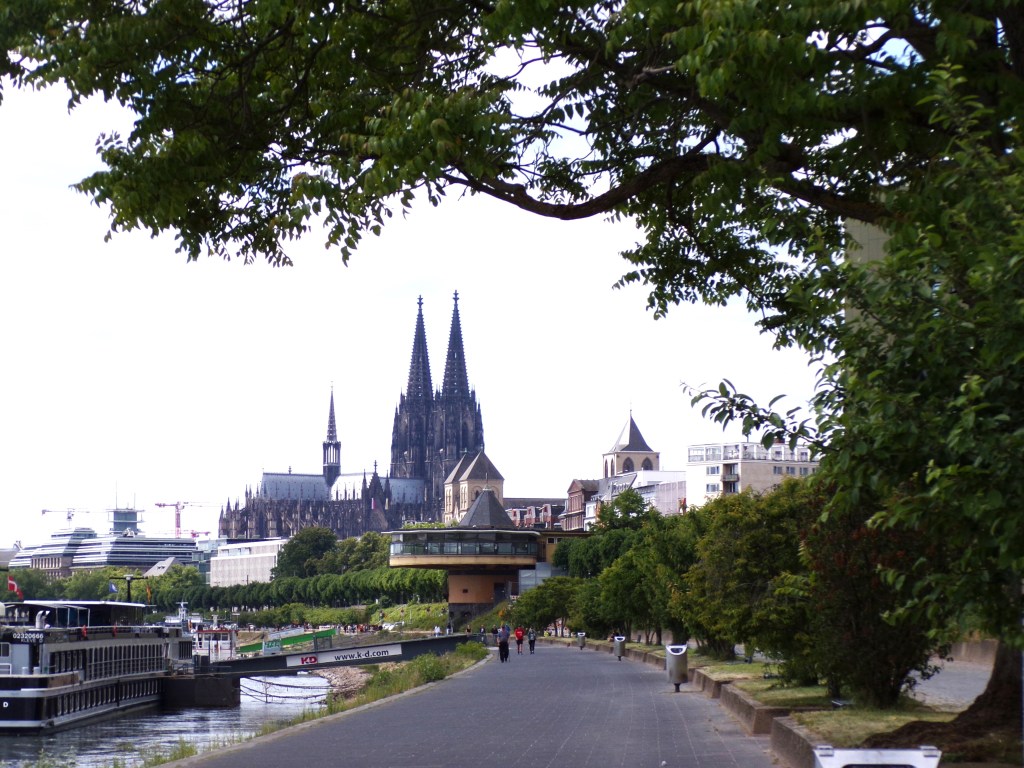
A welcoming pedestrian walk and bike path lines the riverfront. The silhouette of the cathedral dominates the skyline.

P.C. Cher B 20 May 2025
Traveling with a group has both advantages and disadvantages. When planning a trip, these need to be weighed out. Cologne is one such place; we only had one all-too-short morning to try to take in all the city has to offer.
This was our first visit to the city so I selected the “Cologne Walking Tour” Viking excursion for a broad overview. I wanted to get the lay-of-the land of the city, which it did.
Our tour included a stop at the Cologne Cathedral, a must-see on my itinerary. I was glad to get into the cathedral (Free Admission). I was sad that I did not have more time to explore it. I realized too late that I really needed a guide to provide the details I yearned for about its rich treasures. If I had taken the exclusive cathedral tour… I’d have missed the rest of the city. Choices… Choices… I discovered too late that by not doing a special guided (and expensive) cathedral tour, I missed at least one must-see work of art. This one also required exclusive entry from the outside: the Gero Crucifix. It would have been ideal to have had at least a full day in the city to fully appreciate all it has to offer. (I understand from fellow travelers that the Chocolate Factory was also a great stop!)
But, as in all travel adventures, I believe some time in Cologne – even a few hours – is better than none!
Cologne Cathedral
The Cologne Cathedral was a highlight of the city for me – and I am not alone! It is one of the oldest and most important pilgrim sites in Northern Europe. I was intrigued to learn that today it is the most visited landmark in Germany with an average of 6 million people a year.
The Cathedral is both a religious center and a symbol of Cologne’s rich history. The cityscape is shaped by its impressive silhouette, visible from many points.
A World Heritage Site, it is host to the Shrine of the Three Kings, reliquary of the alleged bones of the biblical Christmas Magi.
P.C. Cher B 20 May 2025
UNESCO site
Recognized as a culturally important site, the cathedral was added to the UNESCO World Heritage List in 1996.
However, in 2004, it was placed on the “World Heritage in Danger” list (I never knew this existed until now!). Plans were in place to construct several high-rise buildings nearby. This would have had a major and disastrous visual impact on the site. To their credit, city authorities decided to limit the heights of buildings near and around the cathedral.
Ultimately, in 2006, the cathedral was removed from the “in danger” list. Today, we can all enjoy a magnificent view of the cathedral from the surrounding area. (Only the telecommunications tower is higher than the cathedral.)

P.C. Cher B. 20 May 2025
The Cathedral was built in the shape of a Latin cross, the usual shape for Gothic churches. Also typical of many medieval cathedrals, it took centuries to complete. Fortunately, unlike many Gothic churches which ended up with a hodge podge of ever-changing architectural styles, the original medieval plans of uniformity in style were respected.
The Cathedral sits in the middle of the city, surrounded by buildings and trees. Despite its visibility on the broad cityscape, it is rare to get a good view, close up.

P.C. Cher B 20 May 2025
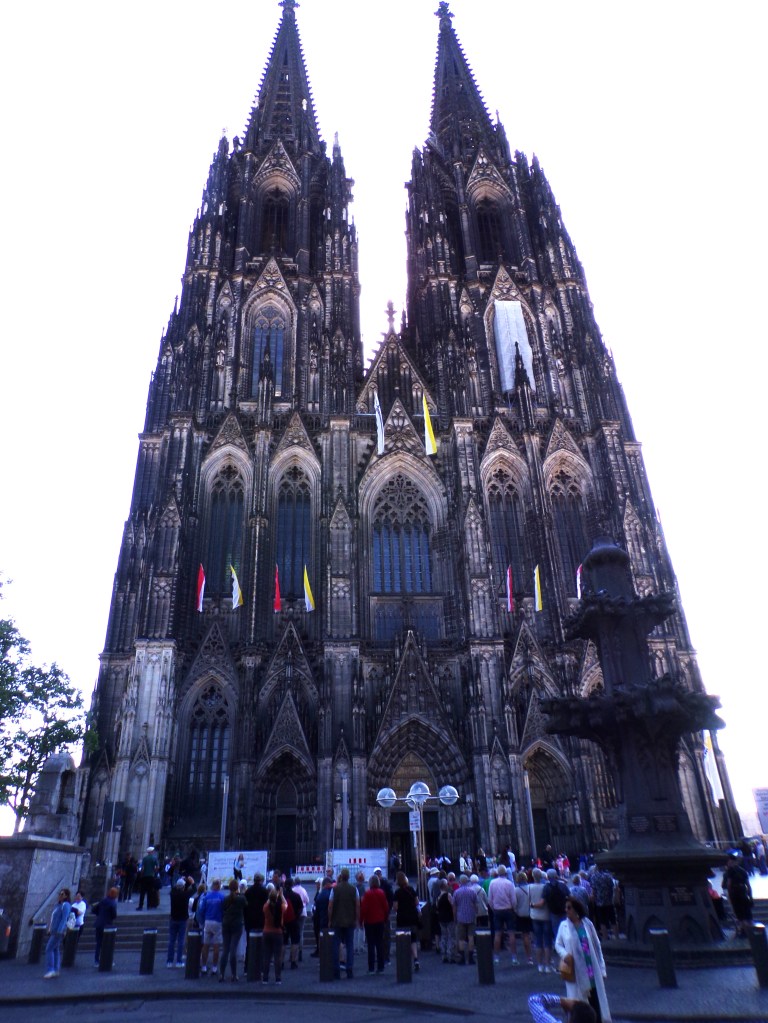
The broad square in front of the cathedral has been a busy civic meeting place since ancient Roman times. A Roman temple once stood on the spot where the cathedral stands today. The spires loom high overhead, 515 feet above the square. This makes it the tallest twin-spired church in the world and the second tallest church in Europe.
P.C. Cher B 20 May 2025
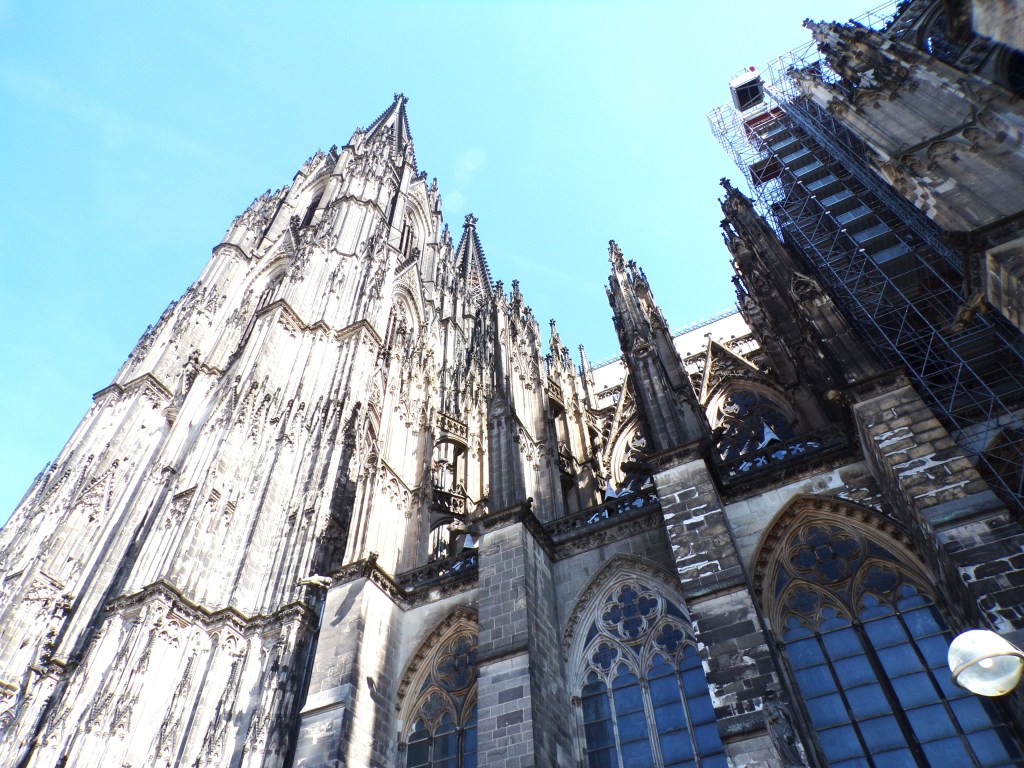
(Traveler Tip: For those who love to climb, one can get tickets to climb the 533 stone steps of the spiral staircase to a viewing platform about 330 feet above the ground. I can only imagine the view from the top!)
P.C. Cher B 20 May 2025
World War II was rough on Cologne. 95 percent of the city was destroyed by WW II bombs. Miraculously, the structure of the cathedral survived. In wise anticipation of the bombing, the glass and art treasures were saved by being taken to shelter.

P.C. Cher B 20 May 2025
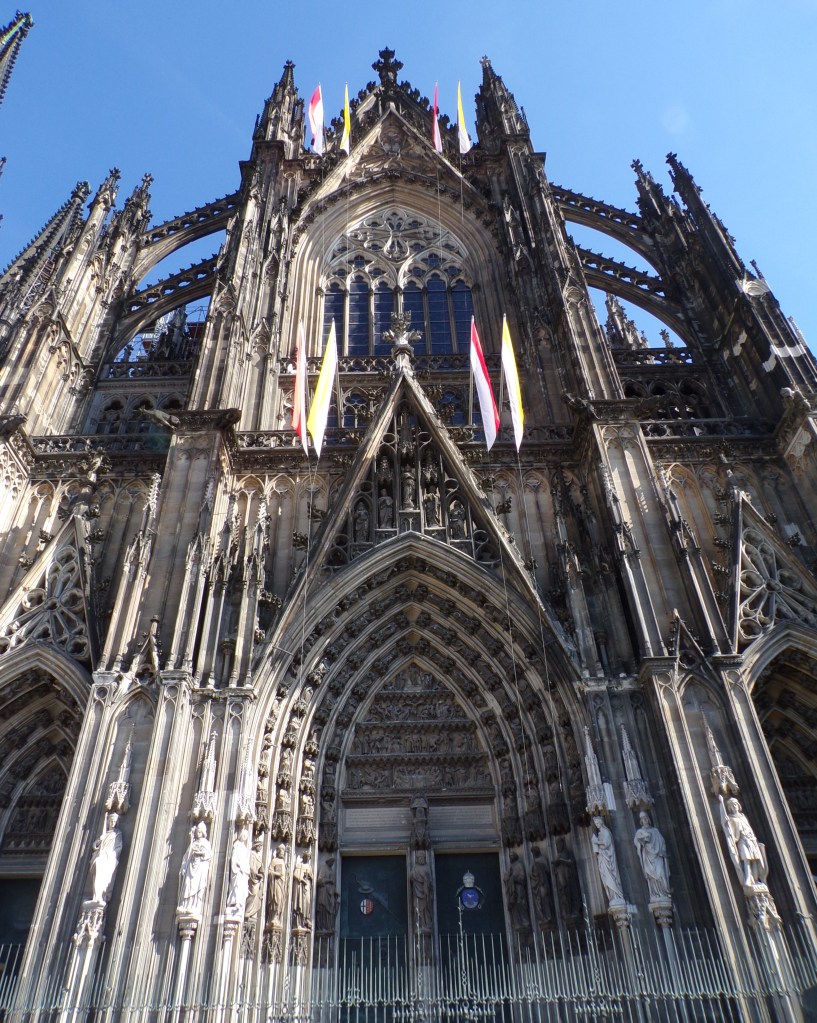
The impressive entrance to the cathedral is typical for Gothic art.

P.C. Cher B 20 May 2025
Flying buttresses, synonymous with Gothic architecture, support the entire bulk of the cathedral.
P.C. Cher B 20 May 2025
The nave of the cathedral boasts a ceiling 140 feet tall! It has one of the highest vaulted naves in the world! Unlike most naves, it has two side aisles.

P.C. Cher B 20 May 2025
Its ultimate goal of the cathedral is to be a place to represent God by filling the church with light. To achieve this goal, the walls are covered with stained glass windows. I was stunned to learn that there is enough stained glass in the windows to cover 3 football fields! And even more impressive to consider their meticulous removal to safety during the World War II bombings!

P.C. Cher B 20 May 2025
Three Kings Reliquary
The medieval builders of Cologne had two things in mind. First, the cathedral needed to be a grand structure to house the Reliquary of the Three kings. Second, it needed to fit its role as a place for worship for the Holy Roman Emperor. Ultimately it is acclaimed as a powerful testimony to the persistence and strength of Christianity in both medieval and modern Europe.
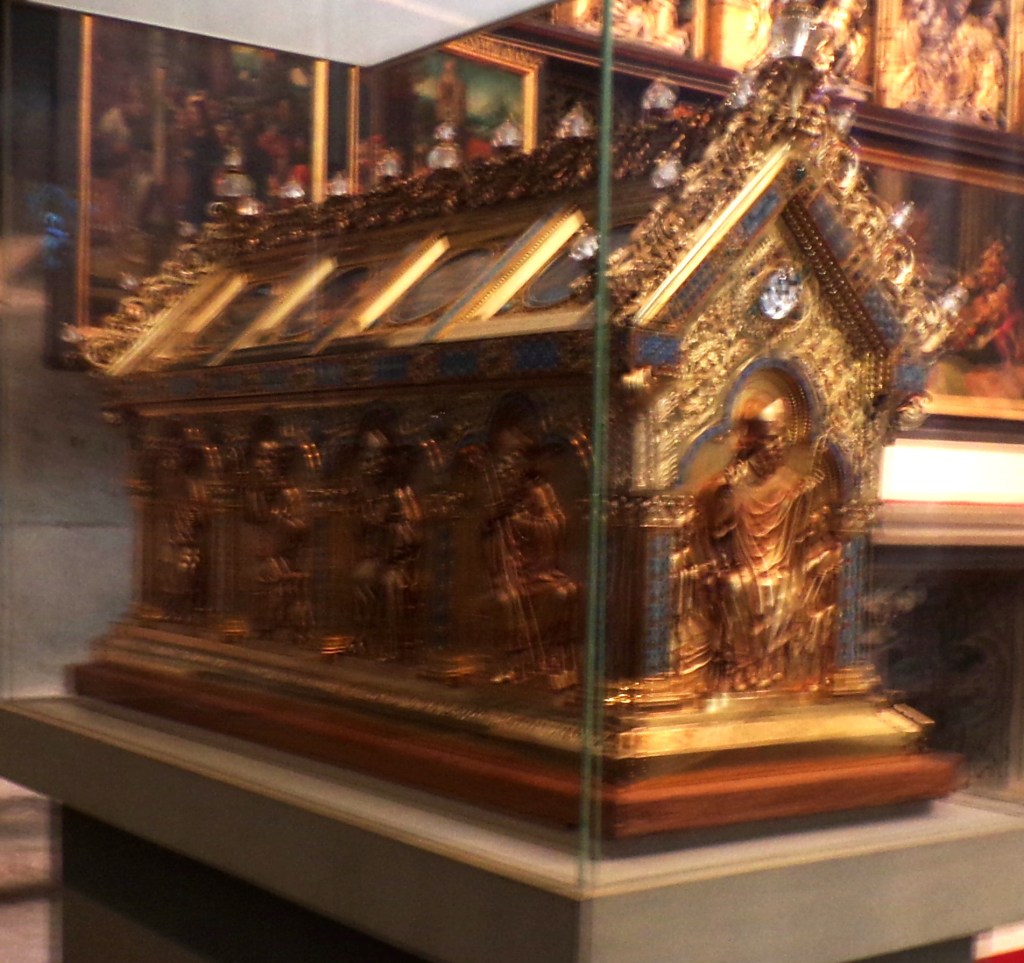
P.C. Cher B 20 May 2025
Other Notable Cathedral Artworks
The Cologne Cathedral is home to many notable works of art. My regrets of not getting a guided tour are evidenced in the fact that (1) I was not able to identify the highlights during our brief visit and (2) I did not get my own photos of them. For prospective travelers to the Cologne Cathedral, I want to include the list for you – so you don’t miss them as I did…
- The Gero Crucifix, the oldest large crucifix north of the Alps. Located in the Crucifix Chapel, accessible from an outside entrance, is one of the “must-see” items on my list and was most regrettably missed…
- Milan Madonna, a beautiful 13th-century painted wooden sculpture of the Virgin Mary with the Christ Child, is located in the Sacrament Chapel.
- Altar of the City Patrons, a triptych of the Adoration of the Magi, St. Ursula, and St. Gereon, the patron saints of Cologne.
- Choir Stalls, carved between 1308 and 1311, feature intricate wood carvings depicting biblical scenes and saints.
- Baptismal Font is a magnificent black marble font from 1200, depicts the Apostles decorated with intricate relief carvings. (Not sure how I missed this one…)
I did get photos of some impressive items – and hope I’ve identified them correctly…

P.C. Cher B 20 May 2025

P.C. Cher B 20 May 2025

P.C. Cher B 20 May 2025
Magi in Cologne
The Three Magi from the Birth of Jesus Christ are significant in the history of Cologne, Germany for several reasons.
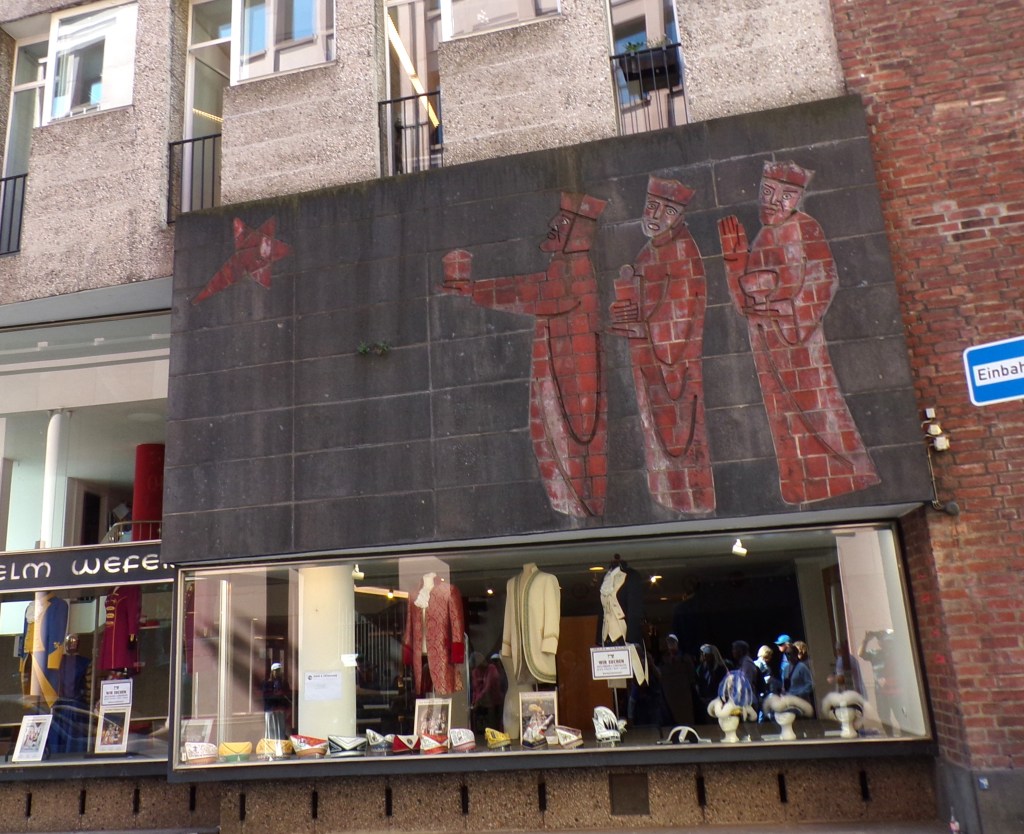
- Relics of the Magi are believed to be housed in the Cologne Cathedral, attracting pilgrims and tourists
- As a cultural symbol, Magi symbolize the universality of Christianity; Gentiles are acknowledging Christ.
- The economic impact of pilgrims and tourists on Cologne’s economy has historically boosted their economy
- Art and architecture inspired by the Magi have enhanced its cultural heritage
- The historical significance of the arrival of Relics in the 12th century marked Cologne as a major religious center in Europe
- The Feast of the Epiphany, celebrating the Magi, contributes to local traditions and community identify
Crazy Clock Tower Character
Cologne has other interesting sites. Near the Cathedral, on the historic Cologne City Hall, is the Tower Clock. It strikes every hour on the hour. When it strikes, an odd wooden creature below the clock sticks out its tongue at viewers. This wild-looking man with black hair, wide eyes and a floppy hat has an equally odd name: Platzjabbeck.

P.C. Cher B 20 May 2025
Greco-Roman History & Art in Cologne
Roman presence in Cologne is seen next to the cathedral at the Romisch-Germanisch Museum. German’s best Roman museum includes a fascinating display of Roman artifacts: glassware, jewelry and mosaics. Time did not allow a visit during our tour, but it will definitely be on my Must-Visit list when I visit Cologne another time!

P.C. Cher B 20 May 2025
Dionysus Mosaic
The Dionysus Mosaic is the highlight of the museum. Inspired by Greek mosaics, it was designed for the dining room of a magnificent Roman town house. It was created with 1.5 million stone cubes made of limestone, glass, and ceramics.
Dionysus, the god of wine and good times, stands in the center. Surrounded by his entourage, he leans on his companion.

P.C. Cher B 20 may 2025
The mosaic was discovered during the construction of an air raid shelter in 1941 in the middle of World War II. It remains in its original location; the museum was built around it. A visitor can view the masterpiece free from the street and not need to go inside the museum. (Good for us; not good for museum admission tickets!)
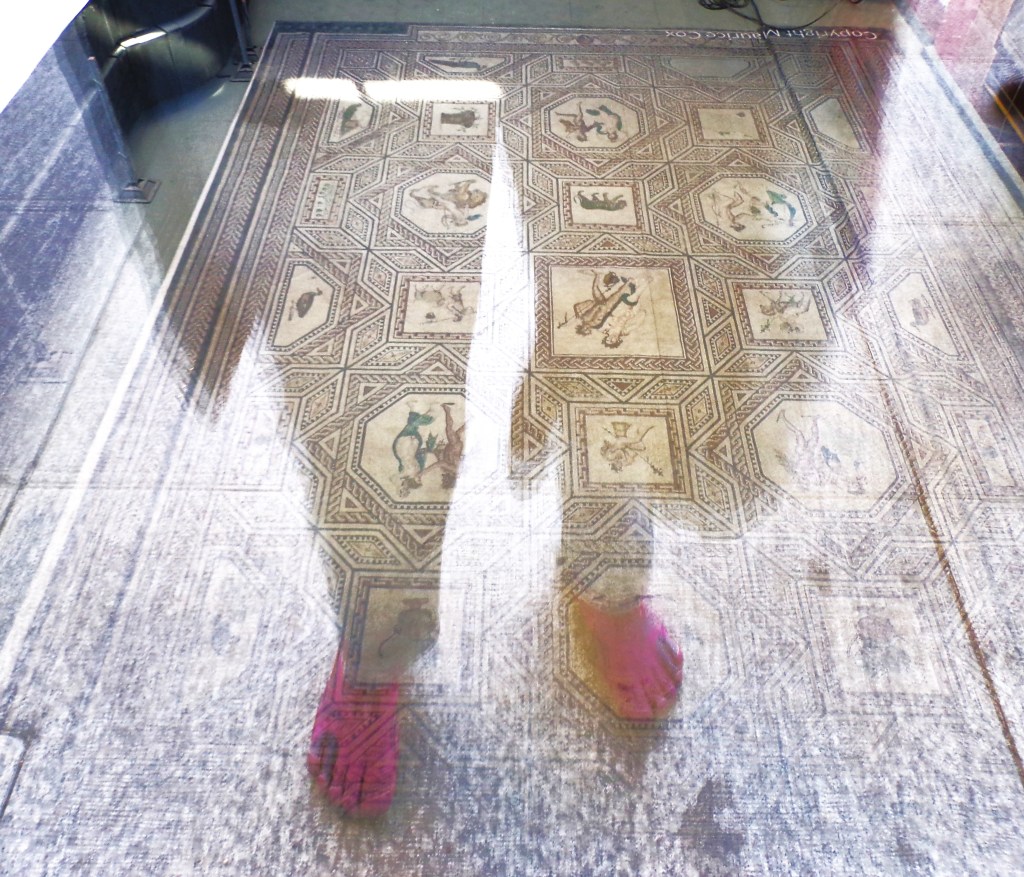
P.C. Cher B 20 may 2025
Romans in Cologne
Cologne’s Roman era is seen in cobblestone pavement in spaces around the city. Widespread in medieval times, it was durable and easy to maintain. Reconstruction after World War II lead to the restoration of cobblestone pavements throughout the city.

P.C. Cher B 2025
Beer in Cologne – Brauhaus-sion
We quickly learned that Germans are very proud of their local beer. It is common for a region or city in Germany to specialize in a specific type of beer. Generations of brewers have mastered their unique craft and precise flavors.

Nowhere is this pride more prevalent than in Cologne with their local beer: Kölsch. In and around the Cologne, Kölsch is ubiquitous. Locals will drink almost no other kinds of beer. We were told that trying some Kölsch is a must-do activity! We did. It definitely had its own unique and wonderful flavor!
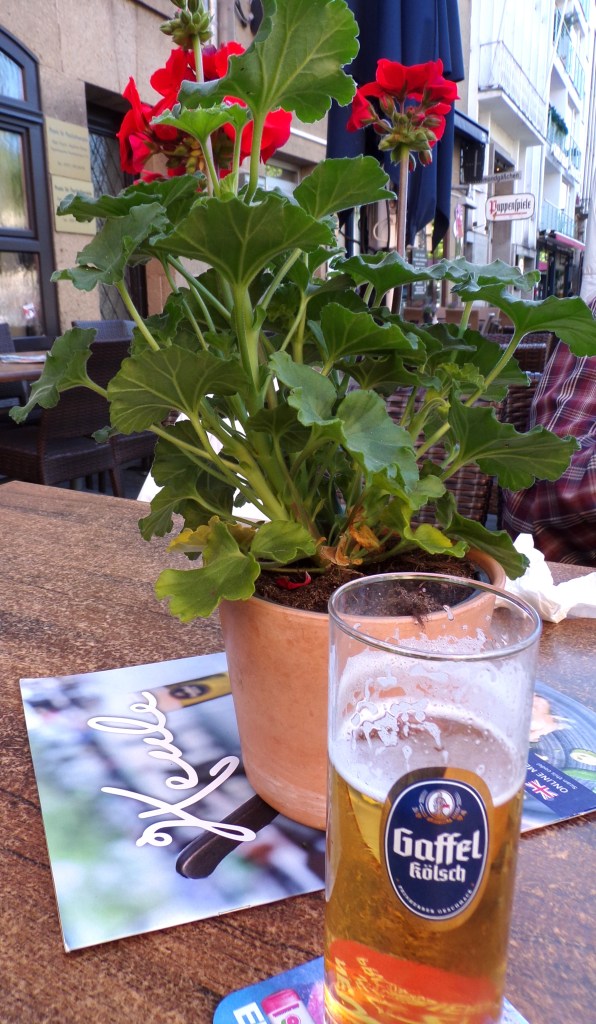
Another tradition we found intriguing is that one’s “tab” and refill order is a coaster placed on one’s table. If the coaster remained with one side up, our glass never went empty! When we were done, ready to leave and pay our tab, we simply flipped the coaster over! It was a great system!
We took a leisurely stroll on the pathway along the river back to our ship. With the cathedral spires looming on the skyline, we continued to enjoy our local German beer with lunch on the deck of our ship!
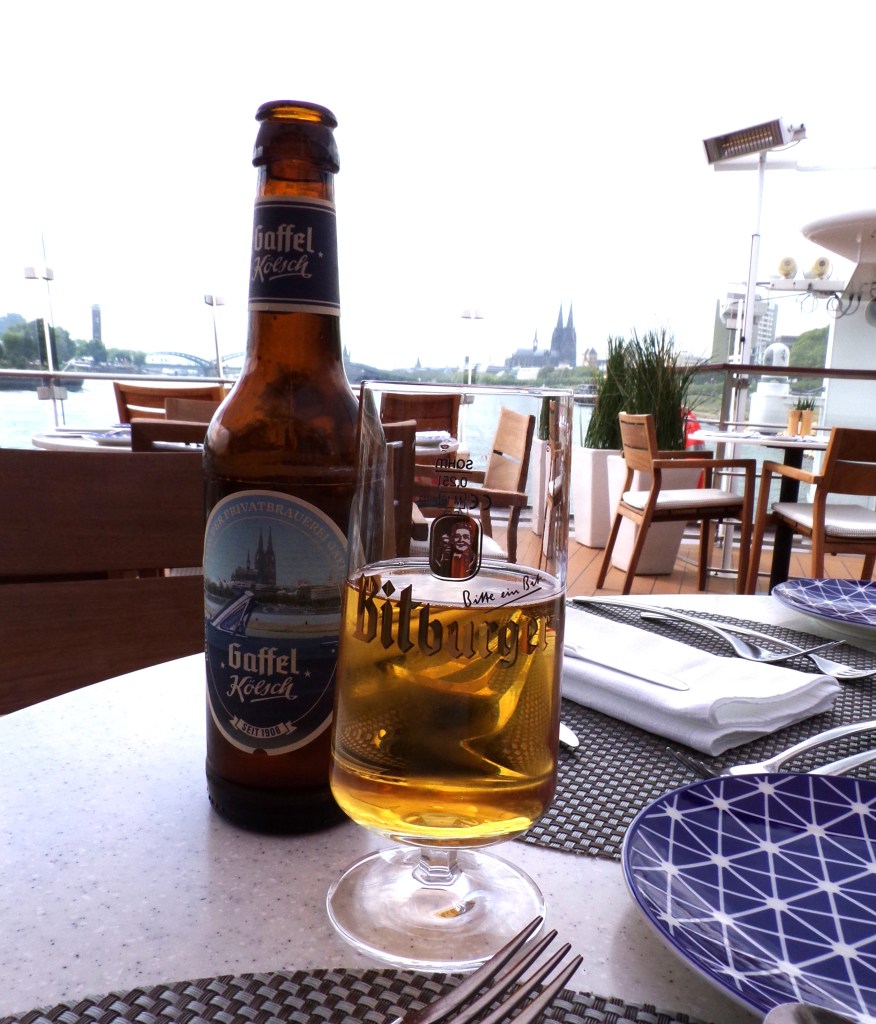
P.C. Cher B 20 May 2025
Sources
- colognecathedral.de/ 16 Sept 2025
- DK Eyewitness Travel Germany ed. 2003
- Rick Steves’ Germany & Austria 2007
- Viking Tours Group Guide in Cologne May 2025
- Viking Tours Lecture & Printed Information on Cologne May 2025
 Charamana Consulting