More than Castles . . . Prehistoric Scotland
Scottish Archaeological Sites
Our trip around the British Isles took a unique turn! We moved away from Medieval Castles and on to the distant Prehistoric Past with our stop at the Orkney Islands.
Would I have put this on my Top Ten List to visit in Scotland? I am not sure if I’d have scheduled to stop here, had it not been on the itinerary. However, because we both love history and have visited ancient ruins around the world – and I have studied and taught archaeology – it was a highlight of our trip!
The Top Ten Listing was due to Helen, our tour guide. She was a knowledgeable and articulate archaeologist. With a passion for the area, Helen made the prehistoric monuments of Orkney come to life. She provided her expertise to some of Europe’s most treasured archaeological sites.
In fact, we were fascinated to discover that these are older than both Stonehenge and the Great Pyramids of Egypt!
The remarkable wealth of Orkney’s prehistoric monuments was quickly apparent in the four monuments we visited. Helen’s well planned itinerary made it possible for us to see all of the key sites which make up the UNESCO World Heritage Site known as the Heart of Neolithic Orkney.
Helen and her husband, Mark, also an archaeologist/tour guide (leading the tour bus just behind ours), are so passionate and attached to the area that they not only live in Orkney year-round – but they chose to get married at the Ring of Brodgar.
P.C. Cher B 28 May 2023
The North Sea & Kirkwall
The Orkney Islands and nearby Shetland Islands are in the North Sea, north of Scotland. The islands of the North Sea endure unpredictable and nearly inclement weather. Appropriately, the weather on this stop was the most inclement of our whole trip. Temperatures dipped into the 40’s F. The wind was bitter and harsh. Dark, heavy clouds threatened rain. Again, we were fortunate in that the rain held off until we were comfortably in the bus.
The North Sea is the part of the Atlantic Ocean that lies above and around Northern Europe. It lies between Norway and Denmark in the east. France, the Netherlands, Belgium and Germany are in the south. We experienced it from England and Scotland in the west.
Offshore Drilling Sites
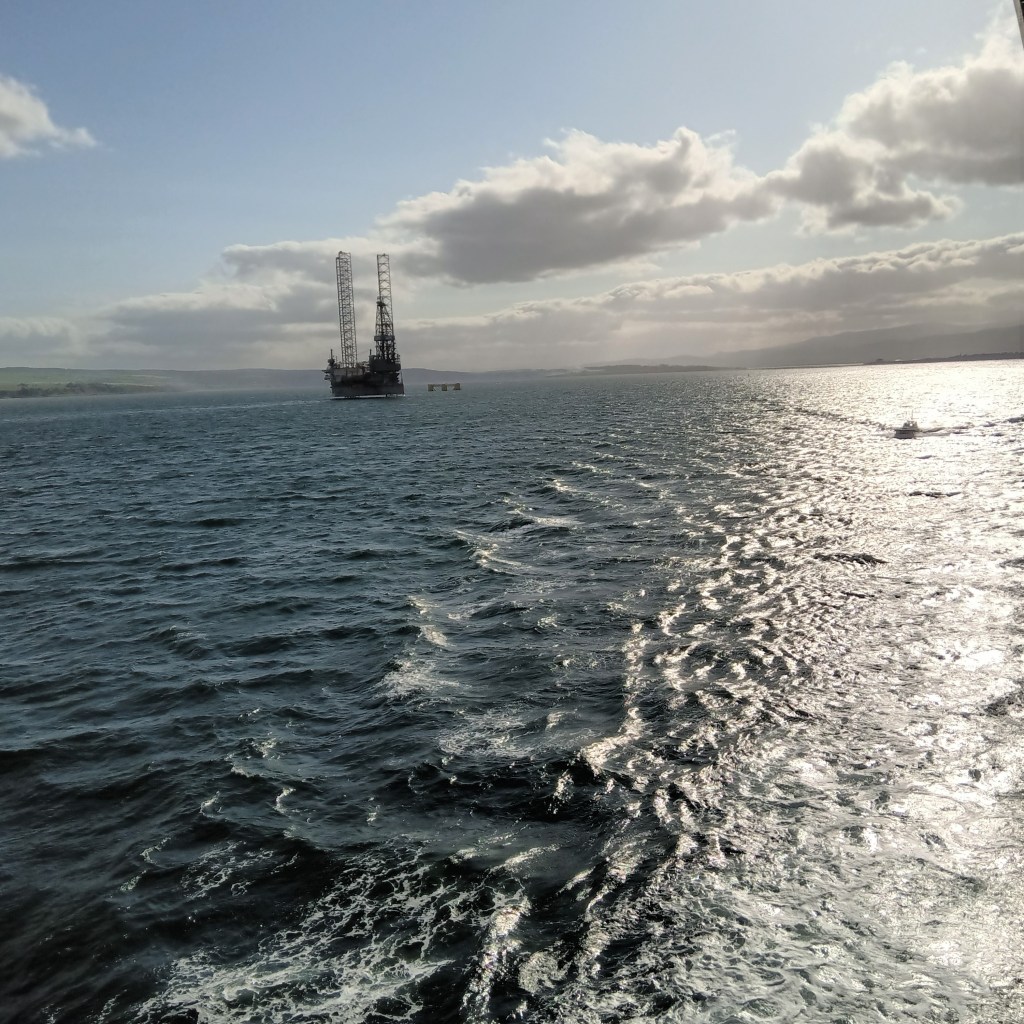
The North Sea is currently home to numerous offshore drilling sites. We saw several off our balcony.
P.C. Cher B. 28 May 2023
Gigantic structures, they are literally floating cities which employ and house hundreds of people. Some rigs also act like small offshore islands which support marine communities that need a hard surface to attract fish, birds and other wildlife.
Bay of Skail in the North Sea
We got a close up experience with the North Sea. We felt the harsh wind and heard the pounding waves beat against the shore in this bay next to the Skara Brae archaeological site.

P.C. 28 May 2023

P.C. Cher B. 28 May 2023
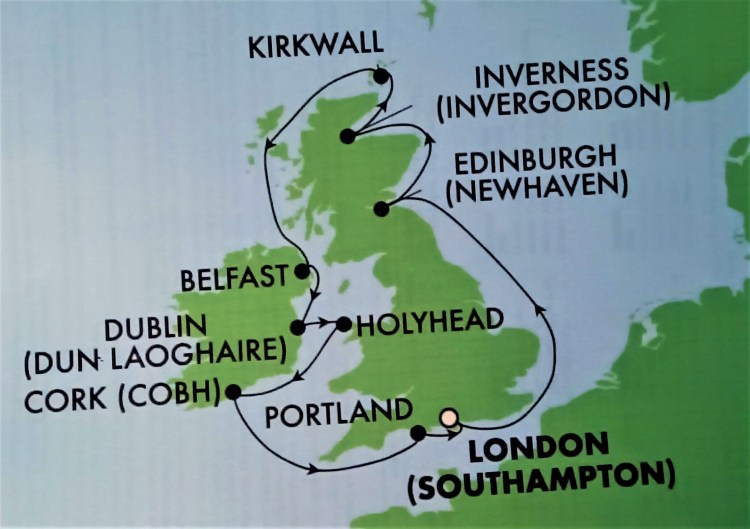
We were welcomed by a colorful collection of flags as our ship docked in the port of Kirkwall on Mainland, Orkney’s largest Island. Here we met Helen who quickly whisked us off to our tour destination.

P.C. Cher B. 28 May 2023
P.C. Cher B. 28 May 2023
History & Geography
The Orkney Isles and the Shetland Islands are located in Britain’s most northerly regions. The Orkney Isles total about 70, of which 20 are inhabited. The Shetland Islands, only six degrees south of the Arctic Circle, total about 100 islands, of which 20 are inhabited.
Until 1469, these islands were part of the kingdom of Norway, still evident today in their heritage and culture, as well as their flag. The Orkney Flag, or St Magnus’ Cross, is a community flag proclaiming the unique identity of this historic Scottish county. It symbolizes the islands’ Scottish and Norwegian heritage. Using the design of the Flag of Norway and blue cross as a base, the blue also represents the sea and the maritime heritage of the islands. We saw it proudly displayed around the island.

P.C. Cher B 28 May 2023
Orkney
The isles of Orkney are remarkable for the wealth of prehistoric monuments. These prehistoric monuments were the focus of our tour.
No Trees…
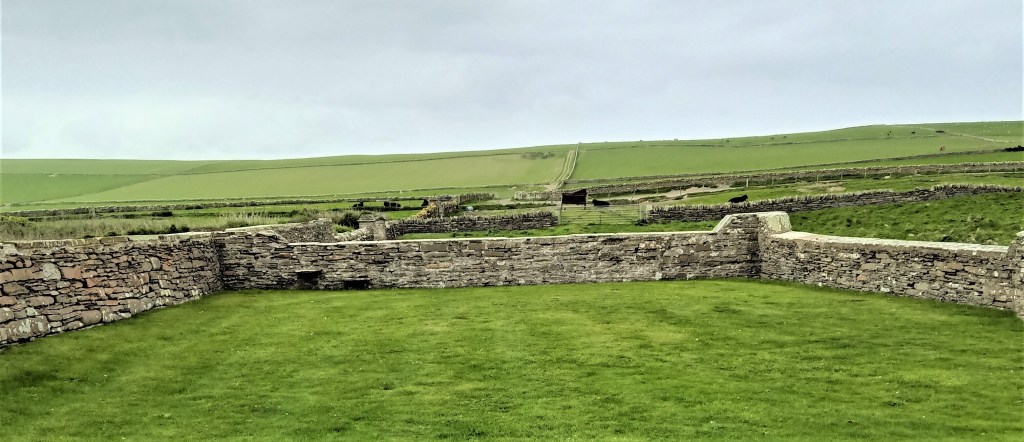
However, these fertile islands were interesting beyond this! Coming from the Woodlands of Minnesota, we were astounded by the fact that there were virtually NO TREES!!
P.C. Cher B. 28 May 2023
The islands are generally low, almost treeless, windswept and wet. Helen indicated a variety of reasons for the lack of trees. Primarily, it is due to human activity and aggravated by a deterioration in the climate. Years of clearance for firewood and the presence of sheep prevented natural regeneration.
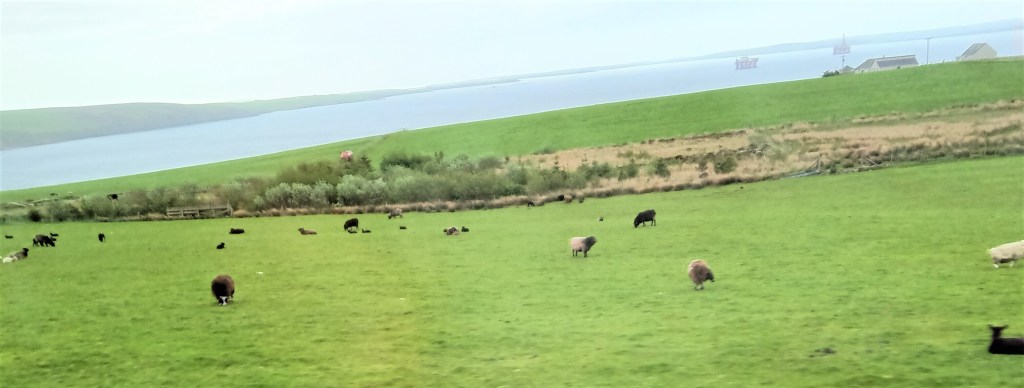
P.C. Cher B. 28 May 2023
Over time, the islands have became colder and wetter. Peat and heather took over the once-fertile high ground. It became impossible for upland cultivation. People were forced onto to the low-lying areas. The shortage of good, fertile soil meant land became precious. It is speculated that trees became a luxury, not a necessity as competition for farmland may have led to a more aggressive society.
Today, there were no trees we could see in the areas we visited, only short scruffy shrubs which served more as low property markers than shade.
Maes Howe / Maeshowe
The Cairn of Maes Howe, just west of Kirkwall, is Britain’s most impressive chambered tomb. A cairn is a man-made pile/stack of stones raised for a purpose such as a marker or burial mound.

P.C. Cher B. 28 May 2023
The finest Neolithic building to survive in northwest Europe, the Maes Howe chambered cairn and grave dates from 2800-2000 B.C. The graffiti decorating its walls is believed to have been left by Norseman returning from the crusades in 1150.
While unable to go into Maes Howe itself, we did get to see it from our bus window.
Standing Stones of Stenness
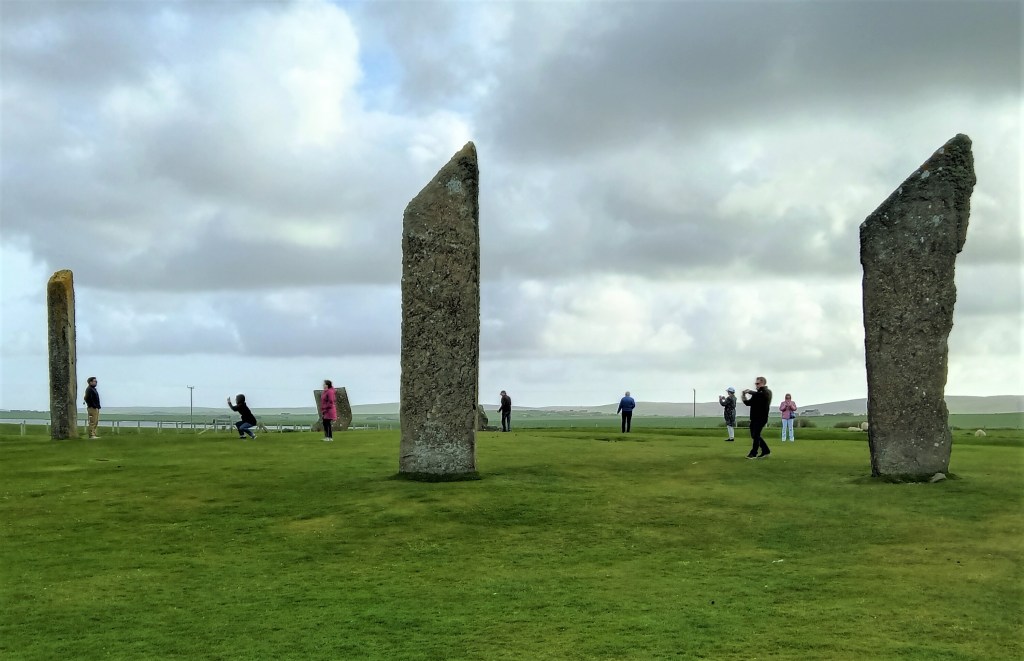
The Standing Stones of Stenness is a Neolithic monument five miles northeast of Stromness and was our first official get-off-the-bus stop. Though still a mystery, the great Standing Stones of Stenness were probably associated with nearby Maes Howe rituals.
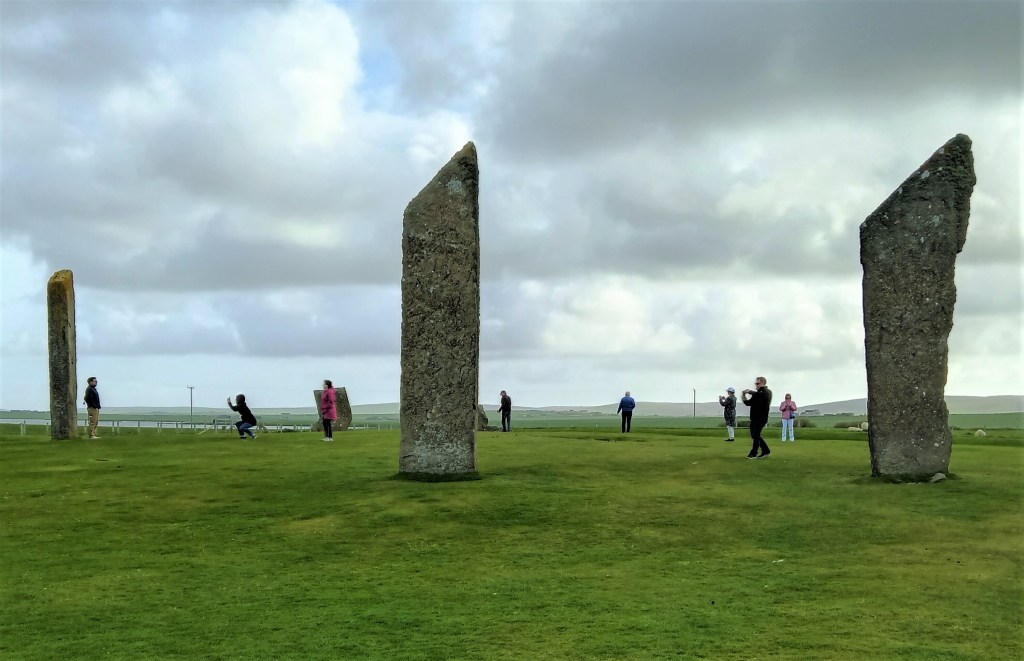
P.C. Cher B. 28 May 2023
The Stones of Stenness, part of the Heart of Neolithic Orkney World Heritage Site, may be the earliest – therefore oldest – henge monument in the British Isles. Built about 5,400 years ago, they are older than Stonehenge in England. Their function is unclear, but the best guess is that they were involved in activities and ceremonies celebrating the relationship between living and past communities.

P.C. Skip B. 28 May 2023
Unlike Stonehenge, where the stones and circle are roped off from most visitor,s the Stones of Stenness are still accessible to walk amongst – and touch!
Ring of Brodgar
The Ring of Brodgar is a Neolithic henge and stone circle. Just down the road from the Stones of Stenness, the Ring of Brodgar is larger in diameter – but we were unable to walk amongst them. They are not buried very deeply in to the group and can easily topple over, hence the cautionary measures, per Helen.

P.C. Cher B. 28 May 2023
This Bronze Age site stands atop a bleak heath – a shrubland habitat found mainly on infertile, free-draining, acidic soils. A heath is defined by open, low-growing wood vegetation, perfect for a site such as this..

P.C. Cher B. 28 May 2023
At 5,000 years old, it is younger than the nearby Stones of Stenness – but the Ring of Brodgar is still older than both Stonehenge – and the Great Pyramids of Egypt!
Interesting side note: Helen, our guide, kept reminding us that the only thing we should be sure to remember was that she and her husband were married here. I discovered a website article written by her sharing details about this personal event: “The Marryers” by Helen and Mark Woodsford-Dean at orkneyology.com/the-marryers.html –
Skara Brae
In the Bay of Skail on the North Sea lies the complete Stone Age village of Skara Brae. Unearthed by a storm in 1850, it had been buried for 4,500 years.

P.C. Cher B. 28 May 2023
Archaeologists have named the site “Skara Brae,” (“Skerrabra”) which designates a mound which buried the buildings of the village, thereby preserving it. The village name used by the original inhabitants is unknown.

P.C. Cher B. 28 May 2023
Today, archaeologists think that the fall of Skara Brae was brought about by two factors — coastal erosion and a change to Neolithic society. A major concern for the future of the site is coastal erosion in an area which has always suffered from sand-blow events.

P.C. Cher B. 28 May 2023
Like the other sites in this UNESCO Heritage complex, Skara Brae is over 5,000 years old and dates back to Neolithic times. Radiocarbon dating suggests that people were living in Skara Brae for around 650 years between 3180 B.C.E and 2,500 B.C.
It is interesting to try to imagine that Skara Brae is also older than Stonehenge and the Great Pyramids of Giza.

P.C. Cher B. 28 May 2023
Although it appears that Skara Brae is an underground village, it is not. The houses, in fact, were built into a large midden – a rubbish-heap. This provided both stability and much-needed insulation against the harsh climate.

P.C. Cher B. 28 May 2023
Model of Skara Brae home
A well-furnished model of the Skara Brae typical home is located en-route to the excavation site, next door to the visitor center and gift shop. Since the actual site could only be seen from above, this real-life example was helpful in grasping the complexity, yet simplicity, of the Skara Brae homes.

P.C. Cher B. 28 May 2023

P.C. Cher B. 28 May 2023
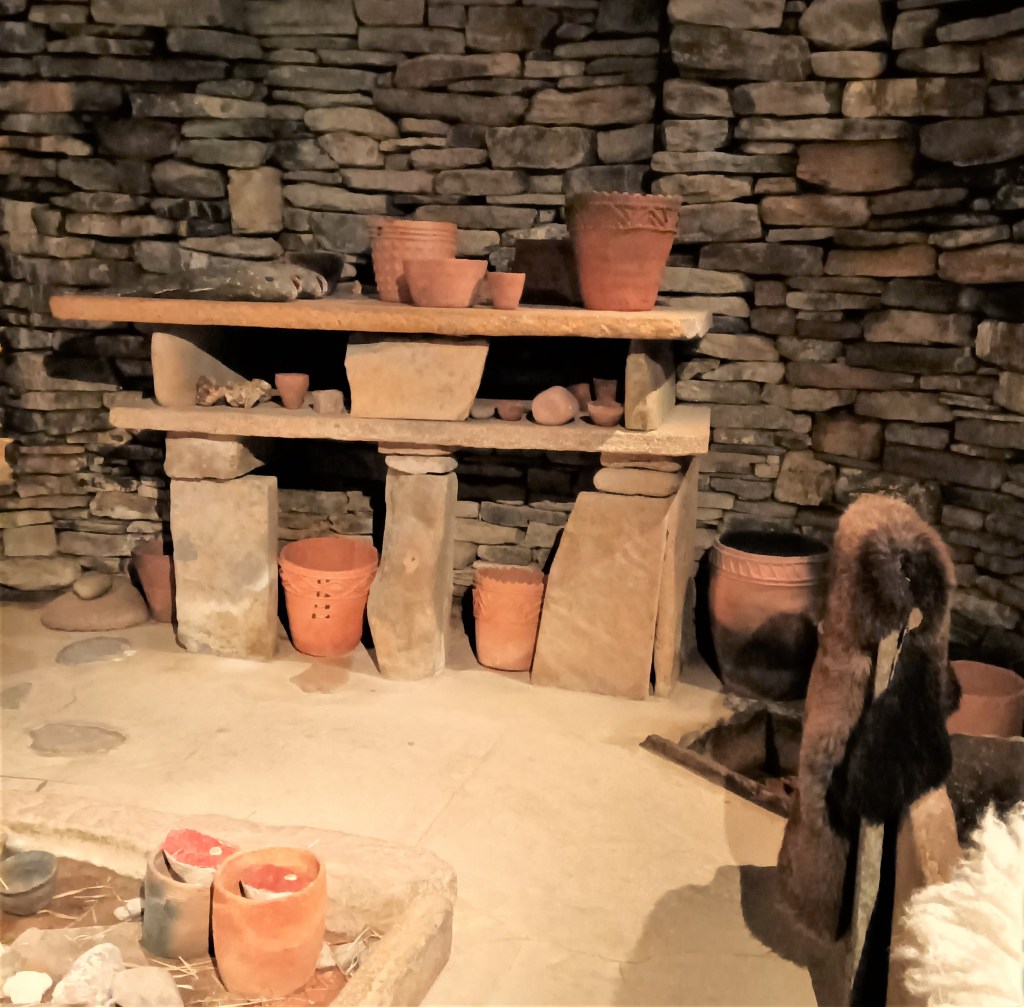
P.C. Cher B. 28 May 2023
Skaill House
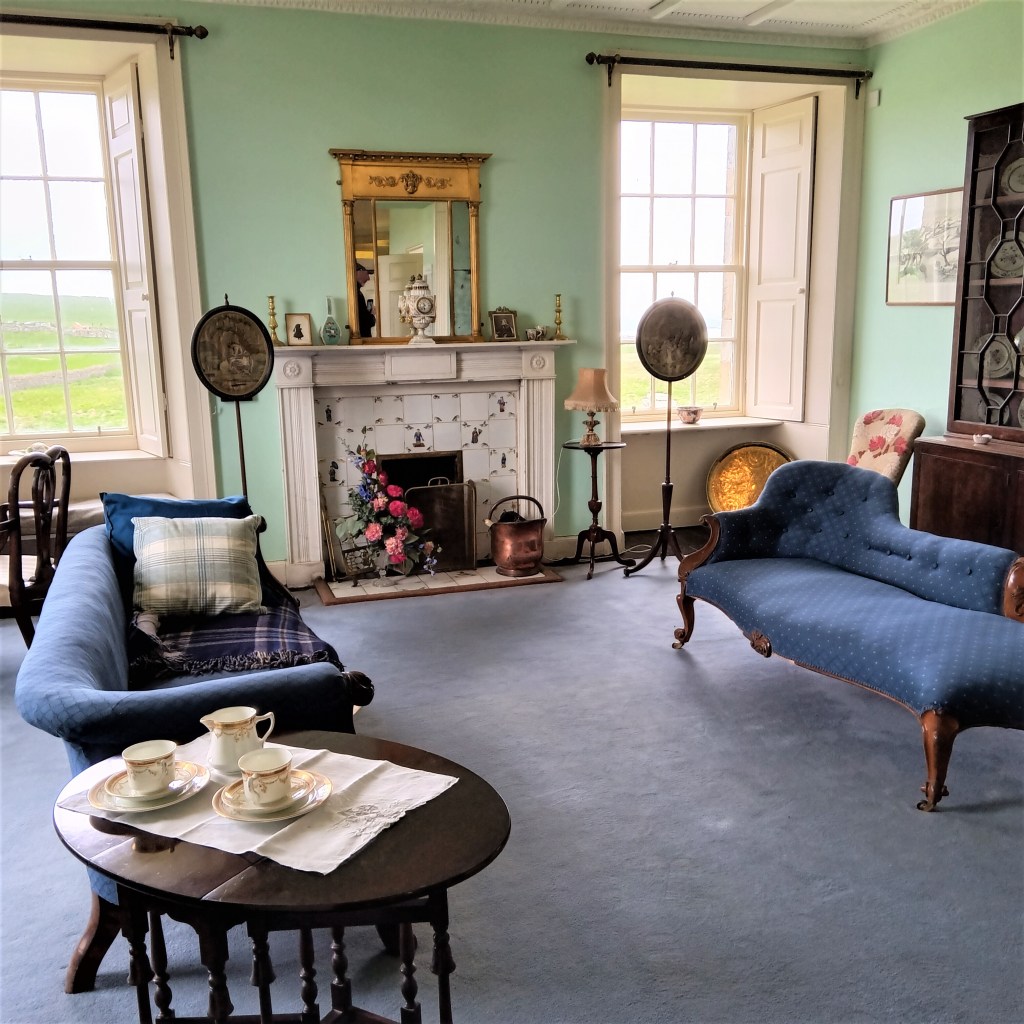
Skaill House, which you can see in the background, is just beyond Skara Brae, across the barren landscape. This historic 17th century manor house overlooks the neolithic site and the Bay of Skaill. Admission to the house is included with one’s ticket to Skara Brae. It is worth the extra time to include it in your visit.

P.C. Cher B. 28 May 2023
Skaill House was originally a simple manor house built in 1620 by Bishop George Graham (Bishop of Orkney 1615-1638) on top of an ancient graveyard. (I couldn’t find much info on this graveyard.) Over the centuries, successive Laird’s have made additions and extensive internal alterations.
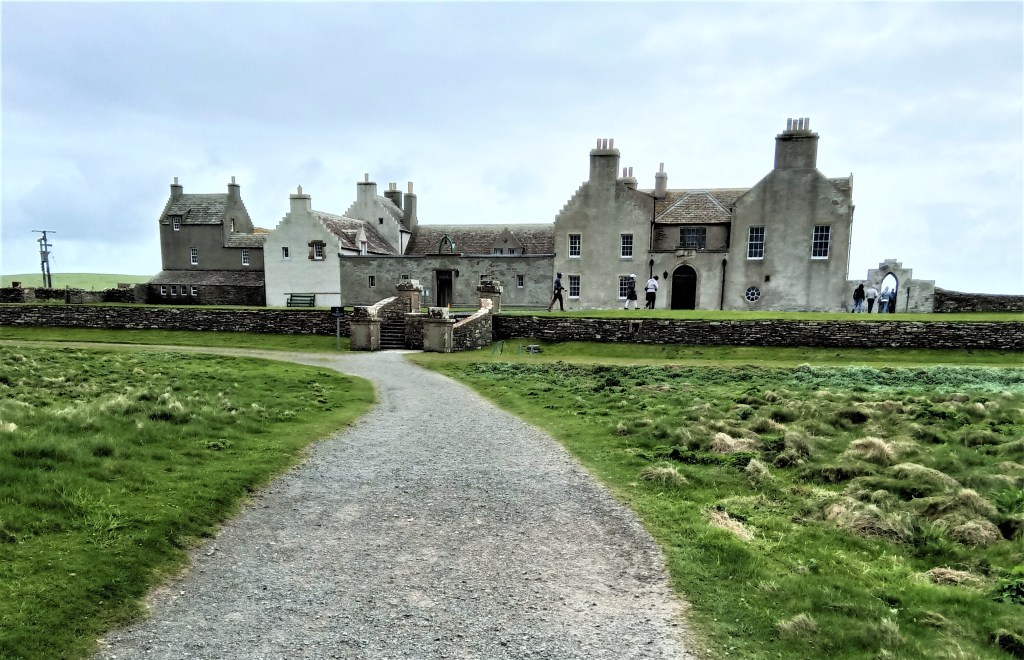
P.C. Cher B. 28 May 2023
The addition of the north tower and wing give the house its characteristic, impressive profile and today’s finished look against the barren landscape.
In 1850, William Graham Watt, the 7th Laird of Breckness, who lived in the Skaill house, unearthed the neolithic village of Skara Brae, which was next to the Skaill House.
P.C. Cher B. 28 May 2023
In 1977, the house was included in the List of Scottish Buildings of Special Architectural or Historic Interest.
Last occupied in 1991, the house was opened to the public in 1997 after 6 years of careful restoration work. Today, it is very much presented as the family home it was in the 1950s.

P.C. Cher B. 28 May 2023
In its 400 year evolution, it has remained in the same family: all 12 Lairds have been related. This legacy greatly contributed to the cohesive history and fascinating collections in the house.

P.C. Cher B. 28 May 2023
Today, Skaill House remains privately owned by Major Malcolm Macrae. In a joint admission agreement in place with Historic Scotland, it is open to the public. The main house is no longer lived in, but I found it interesting that it has two self-catering holiday apartments available to let. (Interested? Check out their website at skaillhouse.org.uk)

P.C. Cher B. 28 May 2023
For perspective, I love this view out the window of the Skaill House to the Bay of Skaill and the Skara Brae archeological site.
St. Magnus Cathedral
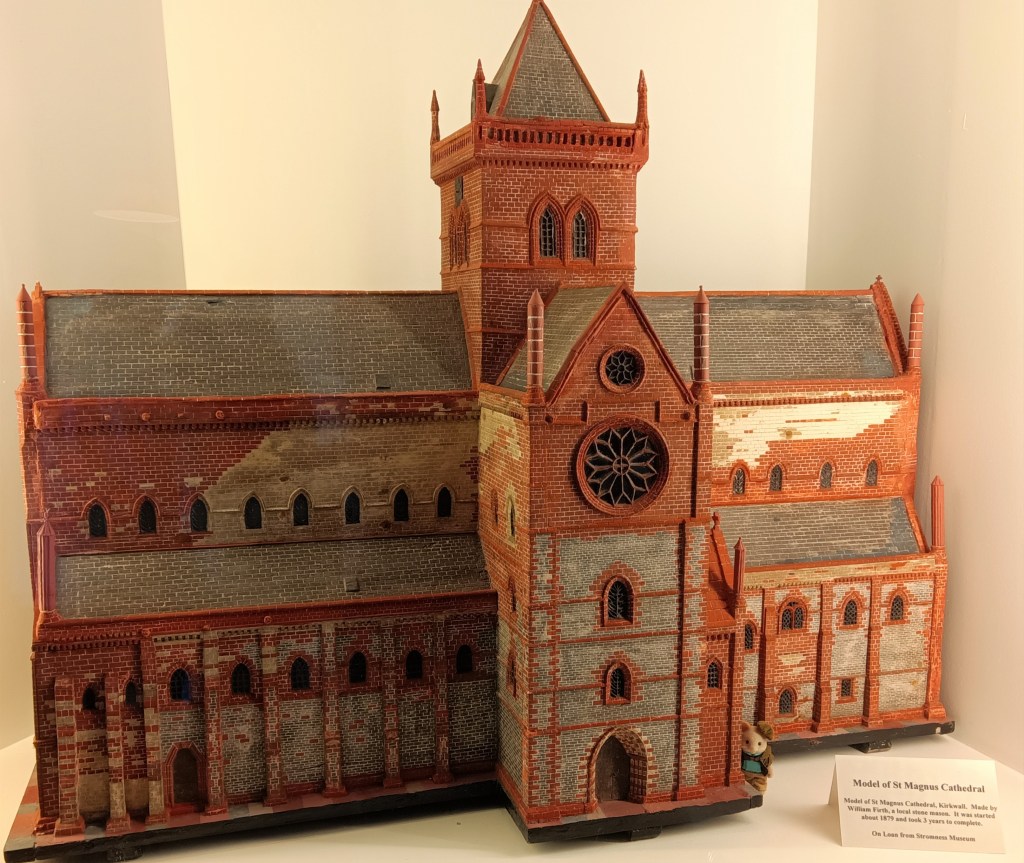
Amidst the narrow, charming streets of Kirkwall stands the sandstone St. Magnus Cathedral, with its Romanesque architecture and Norman facade. Not part of our tour, we only viewed it from the exterior in passing, but it seemed worthy of a visit if time allowed. This photo is of its to-scale model in the Skaill House at Skara Brae.
P.C. Cher B. 28 May 2023
Scapa Flow
Dating to more recent history, we passed by the infamous waters of Scapa Flow on our way back to the ship. Scapa Flow refers to the thin strip of land between Scapa Bay and the town of Kirkwall, where our cruise ship was docked.
The sheltered waters of Scapa Flow have played a significant role in the region’s trade, travel and conflicts that occurred throughout history.
Scapa Flow has been used as a harbor since Viking times. The Old Norse name Skalpaflói (‘bay of the long isthmus’) was given to it by the Vikings.

P.C. Cher B. 28 May 2023
Due to its strategic location, Scapa Flow acted as the naval base of the Royal Navy, carrying out a key role in both world wars.

P.C. Cher B. 28 May 2023
Scapa Flow had a major role in World War I. It was one of the best-known stretches of water in the world. During the month of June 1919, the interned German naval fleet scuttled itself in Scapa Flow. The German commander refused to let his ships become the spoils of war and ordered this deliberate act of sabotage. Not only was it the single greatest loss of warships in history, but the 9 German sailors killed that day were the last to die during World War I.
On a lighter note... Scapa Flow is one of the popular diving destinations in the world. One thing is certain, there are plenty of sunken warships to explore during the dive!
Visit
As noted in my introduction, I might not have visited the Orkney Islands had it not been on the itinerary. But, I’m glad we stopped – and it was an unexpected highlight of our trip!
- Orkneyrangers@hes.cot – this website, listed on sign posts at all the sites, points to more info on visits to the 4 UNESCO archaeological sites.
- skaillhouse.co.uk – this website has for info on the Skaill House to visit or spend the night.
TRAVELER TIP: I can’t recommend lodging or dining recommendations on the island since we did neither, being based on our cruise ship. It was a 4 hour morning tour booked through the ship, so food was not included. In planning a visit, since all sites were close together and not far from Kirkwall port and main city of 10,000, that would be the place to headquarter. The city has an airport. Private and group tours are readily available online.
Sources
The foundational information for the blog came from lectures by our tour guide, Helen Woodford-Dean, on all sites. Confirmation of information on the notes I took on the tour came from other websites listed below.
- Woodford-Dean, Helen. Tour Guide Lectures on all sites
- historicenvironment.scot
- orkneyjar.com
- orkneyrangers@hes.cot
- shetland.org
- shetland.org/blog/treeless-thats-changing
- skaillhouse.co.uk/
 Charamana Consulting