Terra Cotta Warriors
Xian, China
Seeing the Terra Cotta Warriors in person was one of my most anticipated visits during our 3 week visit to China.
These magnificent sculptures have long been a vital part of my Asian Art History lessons.
I saw them close up at a special exhibition at the Mia (Mpls Institute of Art), my hometown art museum, in 2012. This phenomenal exhibition of 120 rare objects included 8 terra cotta tomb warriors and 2 horses. I was able to see them up close and in person.
Viewing them in their entirety, within the actual archaeological site, completed the experience. It was a dream come true!

P.C. Cher B. 08 Sept 2024
Their Discovery Story…
I love their “Discovery Story!” Like many great archaeological discoveries (i.e. Tut’s Tomb, Dead Sea Scrolls, Venus de Milo, Lascaux cave paintings…), the Terra Cotta Army was accidentally discovered by simple, ordinary, common people going about their daily lives – peasants digging a well in their field in 1974.
2,200 years ago, during the Tang Dynasty, the army was created to guard the massive tomb of China’s First Emperor, Qin Shi Huangdi, and protect him in the afterlife. This life-size honor guard, facing to the east and arrayed with military precision, has faithfully and secretly maintained their post.
Today the site is one of the most well-known Wonders of China, right after The Great Wall. A UNESCO World Heritage Site, it is visited by thousands daily. Fortunately, we visited on a fairly “light” day, but it was still crowded.
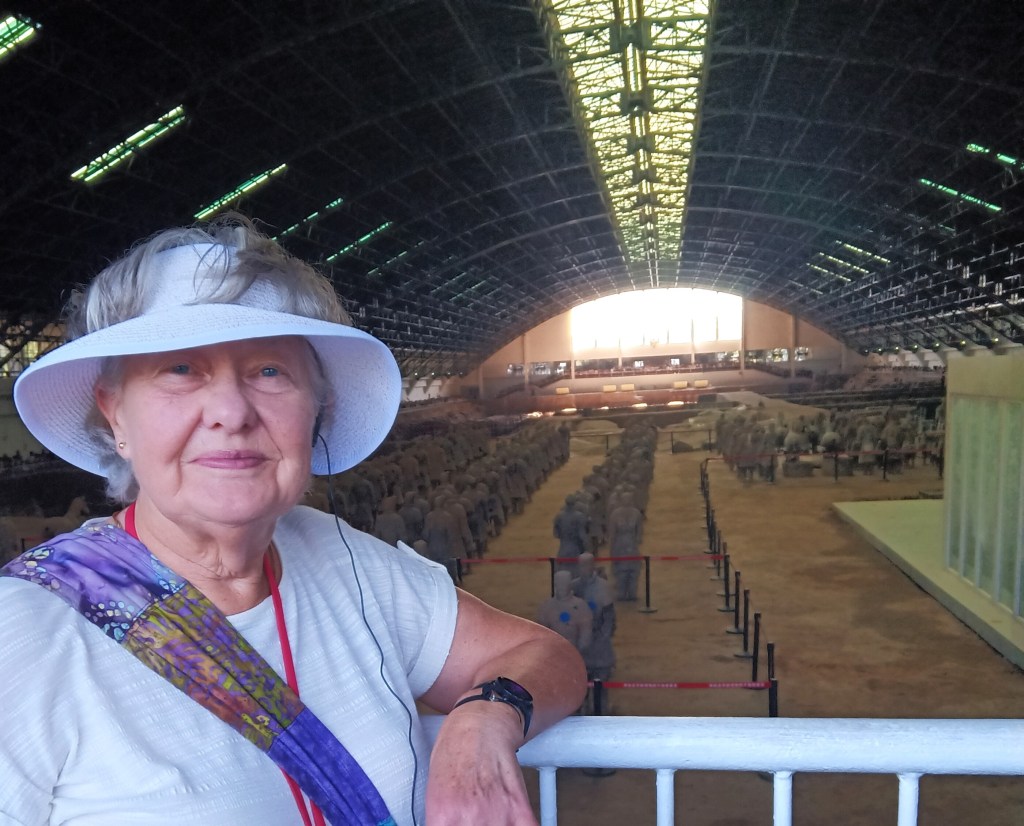
P.C. Skip B. 08 Sept 2024
Their History: Tang Dynasty & Qin Shi Huang
The Tang Dynasty (AD 618-907) presided over one of China’s most glorious periods. Its influence spread through Asia and into Europe and Africa. China’s First Emperor, Qin Shi Huang, was a very wealthy, powerful, and despotic ruler who unified China. Along with his success came his paranoia. Insisting that he be protected from his enemies, even in the afterlife, he created an army to do just that. He ordered thousands of warriors to be sculpted, complete with military regalia, to accompany him after death.
Today, his mausoleum with its massive sea of Terra Cotta Warriors stretches for nearly 20 square acres in Xian, China. Over 7000 life size Terra Cotta Warriors, housed in 3 large buildings called pits, have been uncovered. Speculation is that there are many more underground treasures, including his personal tomb, yet to be excavated.
Pit 1
Pit 1, the most impressive and best known, contains over 6,000 warriors in battle formation. Each warrior is about 6′ tall and weighs 300-400 pounds. The figures were buried in pits 15 to 20 feet deep. The largest pit stretches as far as two football fields laid end to end.
The visitors lining the elevated walkways along the side of the pit provide perspective on the huge size of the building. The walkways provide a bird’s-eye view of the sculptures.

P.C. Cher B. 08 Sept 2024
The life-size Terra Cotta Warriors were modeled from yellow clay. Each one is individual with distinctive, unique facial and body features. Sadly, along with the pottery horses, many soldiers had been broken. They have been painstakingly re-assembled to enable us to view and appreciate them today.
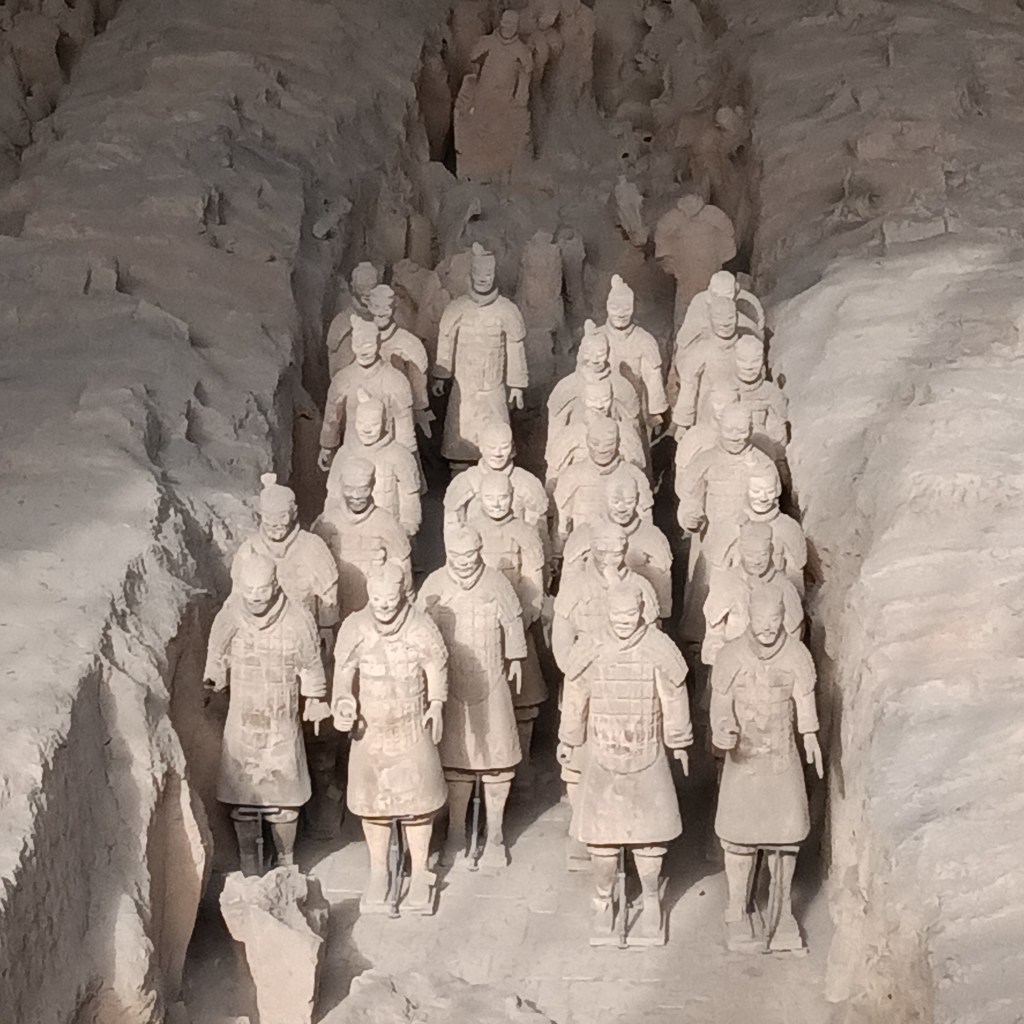
P.C. Cher B. 08 Sept 2024
It has been calculated that it took 800,000 laborers and 38 years to build the Terra Cotta Army. As was typical at that time, Emperor Qin Shi Huang began building his mausoleum when he ascended to the throne at the age of 13. The project was not completed until after his death.
The destruction of much of the Terra Cotta Army occurred soon after they were created. While historians do not know for sure, the destruction is usually attributed to a warlord vying for the throne after Qin Shi Huang’s death. This warlord, Xiang Yu, and his men, reportedly looted the emperor’s tomb, including the weapons within, and left it to burn. Consequently, when discovered, the warriors lay shattered in the dirt.
Pit 1 is a large building, erected to protect the sculptures and their visitors from the elements of the weather.

P.C. Cher B. 08 Sept 2024
Pit 2
Pit 2 (still being excavated) is filled with the infantry of soldiers and cavalry. Earth-walled corridors that house the warriors were originally roofed with wooden rafters.

P.C. Cher B. 08 Sept 2024
Each warrior has an individually crafted facial expression and hairstyle. Likely based on some living person at the time, maybe even the sculptor who created it, each warrior features a unique, realistic human face. Each was originally colored with bright pigment and holding a weapon.
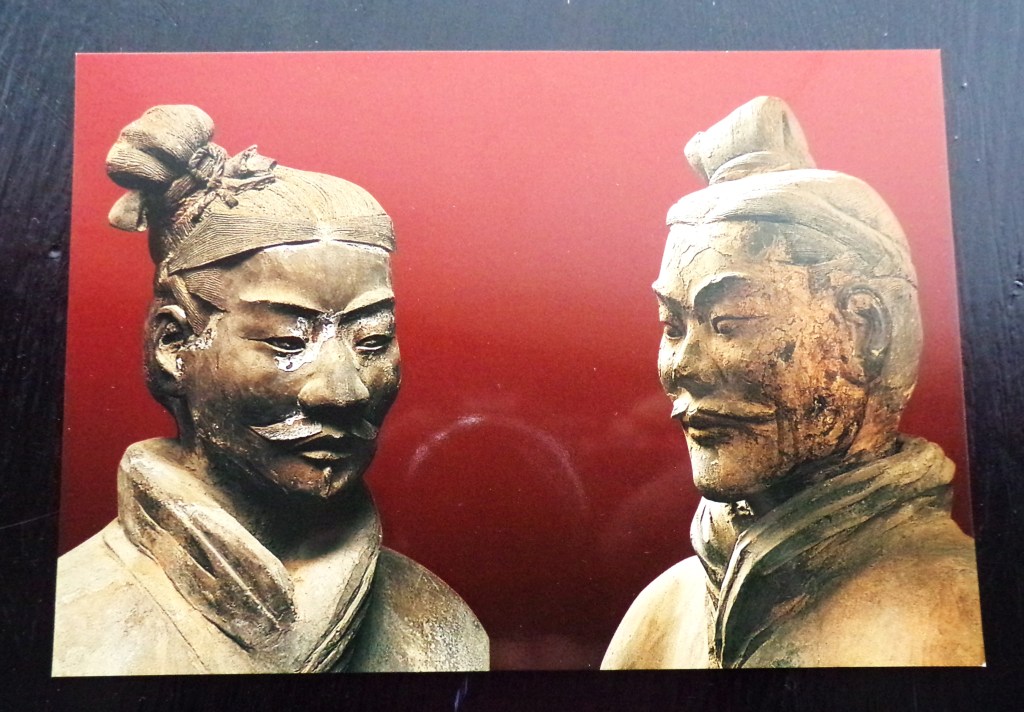
P.C. Cher B 06 Nov 2024
The pottery horses were magnificent! They too, like the warriors around them, have been painstakingly and wondrously reassembled from broken fragments.

Warriors and their horses are lined up and ready for battle. They face east in accordance with the Feng Shui pattern and funeral customs of the Warring States period. Because the sun rises in the east, facing east symbolizes hope and brightness. It represents the responsibility and hope placed on the soldiers.
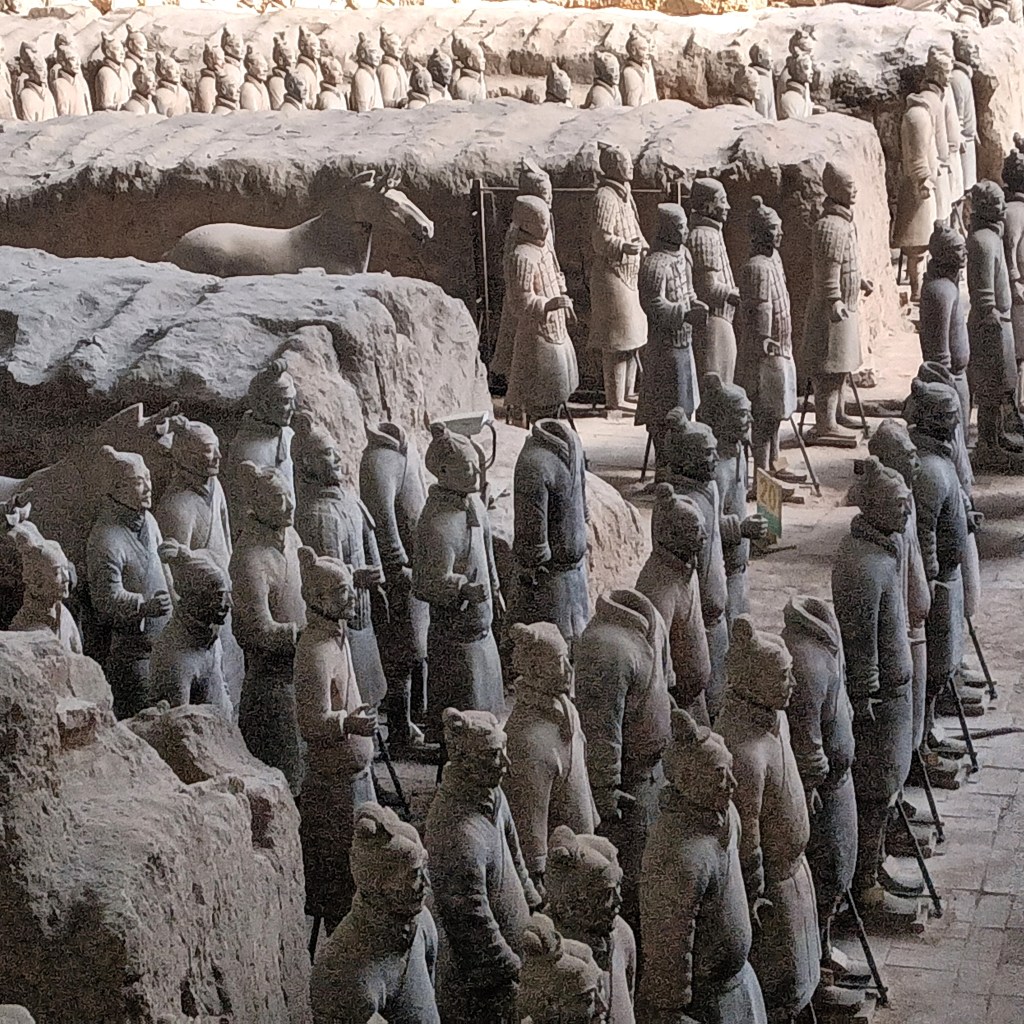
P.C. Cher B. 08 Sept 2024
Great perspective on the size of the army is once again seen by comparing people along the side walkways (top of photo) to the warriors below.

P.C. Cher B. 08 Sept 2024
Entrance to Pit 2: it is lower and smaller

P.C. Cher B. 08 Sept 2024
Pit 3
Pit 3 seems to be the “command center.” Also partially excavated, it has 68 high ranking officers including the chariot and horse chamber, the highlight.
Built in the shape of the Chinese character “凹”, the Pit 3 is smaller than the other two. It is divided into three parts.
The most impressive is the chariot and horse chamber. The northern wing room housed 22 warriors and was thought to be used to pray for victory. The southern wing room included 42 lifelike warriors and was used for collecting military tactics.

P.C. Cher B 06 Nov 2024
The infantry were originally equipped with weapons (swords, spears, bows and arrows) and reins, many of which many have rotted. Reconstruction is ongoing.

P.C. Cher B. 08 Sept 2024
Inside Pit 3, the archaeologists found a lot of well-preserved bronze weaponry. They also discovered gold, stone and bronze decorations. Sadly, many of the warriors are missing their heads.

Entrance to Pit 3: the smallest of the three pits.
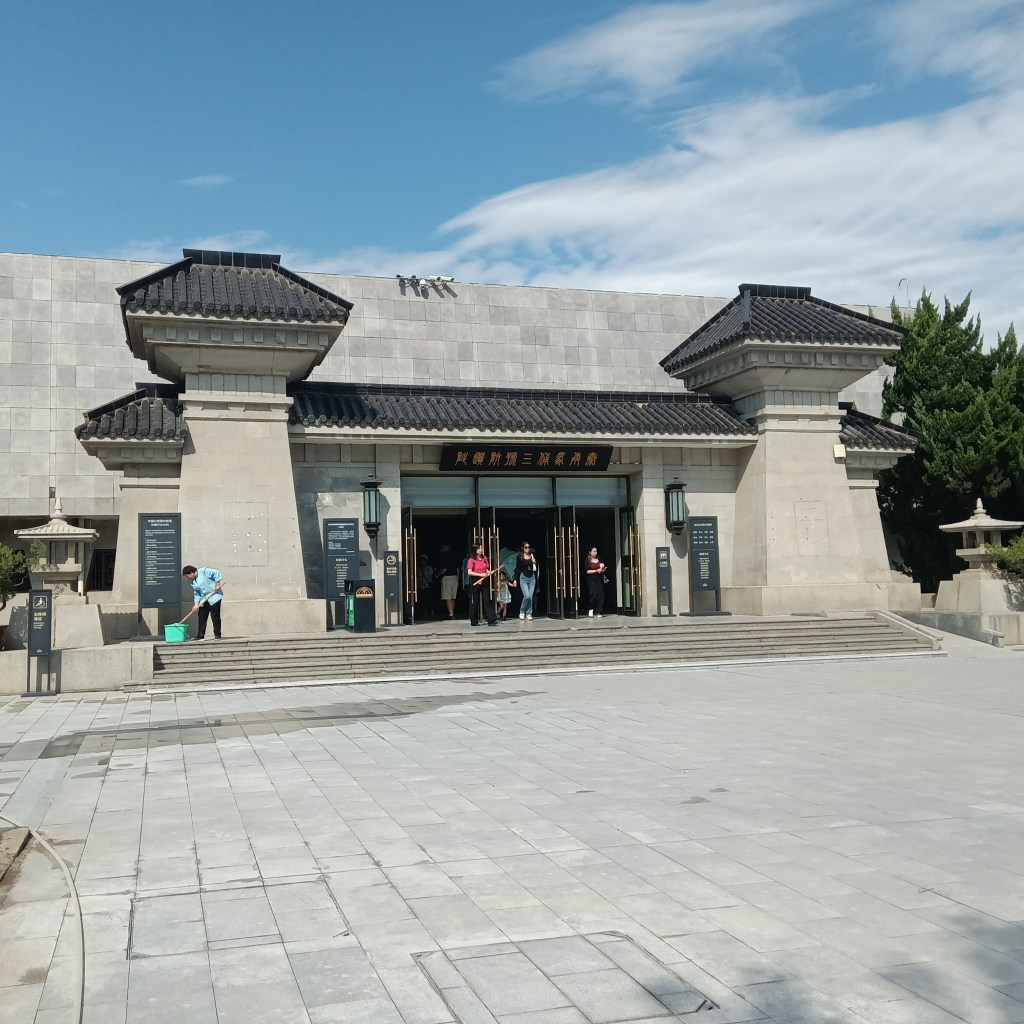
P.C. Cher B. 08 Sept 2024
In Pit 3, several Terra Cotta Warriors were displayed in protective cases for close up viewing. This warrior with his horse is a favorite.

P.C. Cher B. 08 Sept 2024
The “Kneeling Archer” is my favorite. I love his natural pose. He is cloaked in upper-body armor, kneeling in a state of preparation. His square-toed shoes are studded for extra grip.

P.C. Cher B. 08 Sept 2024
Original warriors were created in vivid, full color, traces of which can be seen here. Unfortunately, after being exposed to air, most of the paint flakes off and quickly fades. Experts are working on how to prevent this from occurring in future discoveries.
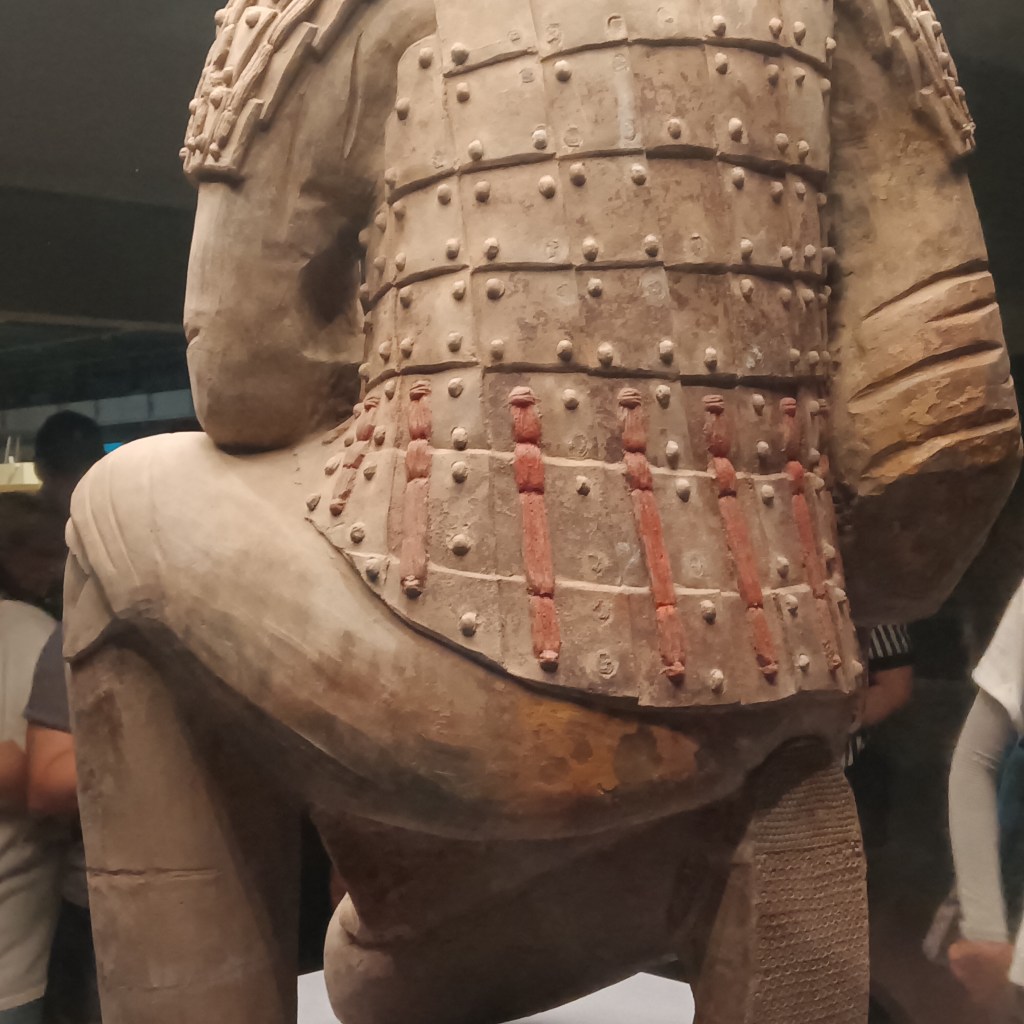
Exhibition Hall: the Bronze Chariots & Horses
The Grand Exhibition Hall is on the grounds next to the 3 pits. It was opened for visitors in October 1983. Celebrating the 50th anniversary (1974-2024) of the discovery of the Terra Cotta Warriors, the Exhibition Hall is host to many of these festivities. Sadly, some of these were on the day of our visit, of course! For this reason, our tour did not include admission to this exhibition hall.

P.C. Cher B. 08 Sept 2024
Housed in this hall are the two large-scale bronze chariots and horses. Their discovery inside the chamber of Pit 3 in 1980 was historic. Encased in large wooden coffins for over two thousand years, they were amazingly preserved without any corrosion. The life-size Bronze Chariots and Horses are the biggest ancient items of bronze-ware ever found in the world. I was able to see the artifacts during my visit when it was at the Mia – and they are spectacular!

P.C. Cher B 06 Nov 2024
Terra Cotta Warriors to take home…
We visited a workshop where copies of the clay army were created in various sizes. Visitors can purchase them and other related items. For only a few thousand dollars, you can purchase a life-size one and have it shipped directly to your home! (A friend has one by her front door entry!)

P.C. Cher B. 08 Sept 2024
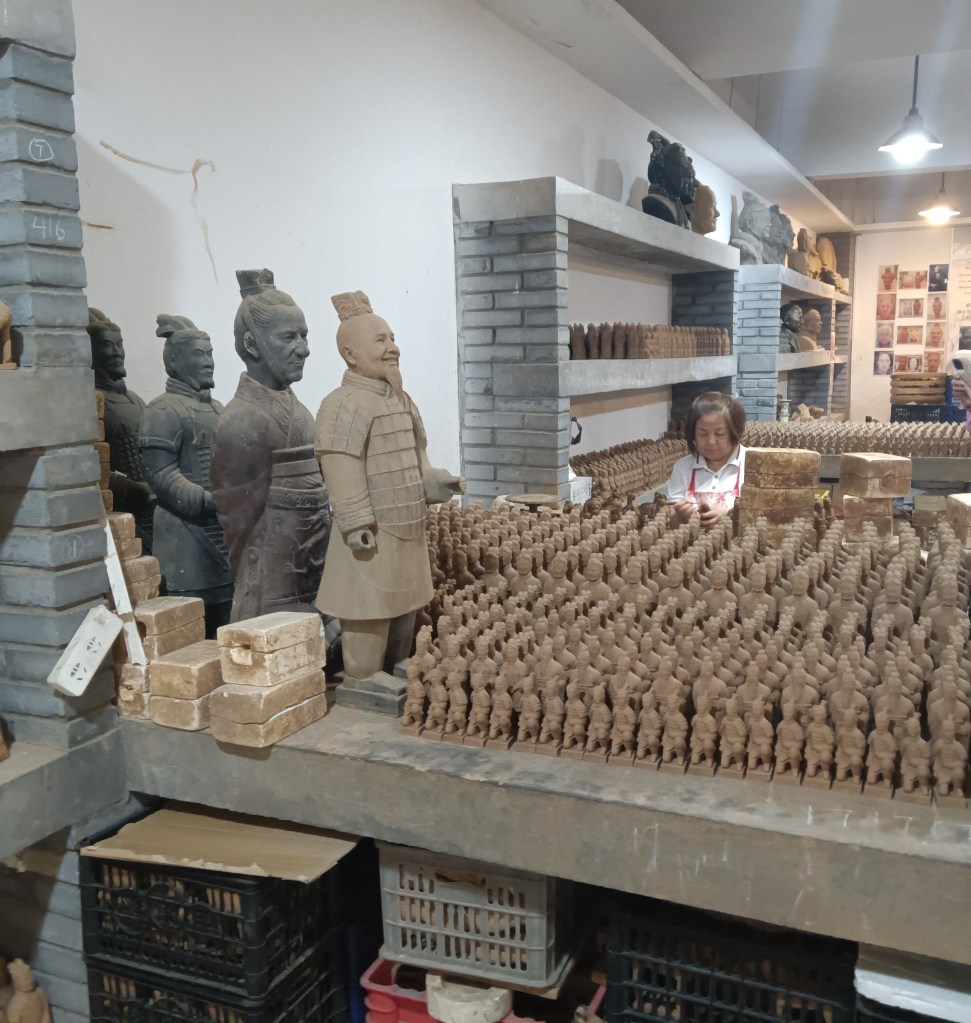
P.C. Cher B. 08 Sept 2024

P.C. Cher B. 08 Sept 2024

P.C.Skip B. 08 Sept 2024
My visit to the site of origin for the Terra Cotta Warriors was all I had hoped – and more. My husband was surprised at how HUGE the complex was. For me, there were no surprises regarding the exhibition or the display, probably because of all my previous study and lessons taught on them. I was surprised that I did not leave with something (besides photos) as a remembrance! I own two desk size copies of the warriors and considered the purchase of a third. Sadly, I did not.
One regret I have is not getting a good personal photo with the warriors. I passed up the opportunity provided to have my “pay for” photo taken with their “photo package,” posing in front of a wall-size copy of the warriors in Pit 1. Since I was lagging behind the group (too many photos!), I quickly rushed by the photo spot. . . In hindsight, I should have taken those few extra minutes! (Note to self for future adventure opportunities!)
TRAVELER TIP: When sites provide photo ops such as this, I encourage you to take advantage of it. I have found that you don’t have to pay until you see the photo and can determine if it is worth the cost. This service is a good way for visitors who are traveling alone or unable to get a good shot – or any shot – during the visit, to have proof that they were there! The photos are professional with choices of hard and/or digital copies. I think it is well worth the investment.
Visit
Where? Xi’an is a major city serviced by bus, train, and an international airport. The mausoleum and museum can be reached by bus, minibus, taxi, or a plethora of guided tours.
When? The Mausoleum of the First Qin Emperor is worth a visit in any season. Summers, though crowded, are hot and wet, and winters quite cold. The spring and fall seasons offer fewer temperature extremes.
How and How Much? Cost depends on many things. I recommend pre-purchase to guarantee entry. Lines were long. Guided tours are available on-line and on site. I read that renting a headset for a recorded audio tour is a less expensive option that offers a bit more flexibility but I can’t advise on how one goes about this.
Sources
- All photos by Cher B or Skip B on-site, 08 September 2024
- University and High School Art History Course Studies developed and taught by Cher B between 1999 and 2024
- Viking Tour Guide on-site at Terra Cotta Warriors, 08 September 2024


The background story of warriors is fascinating, the amount of laborers and time and scale of project.
LikeLiked by 1 person