Experiencing Klimt & the Belvedere
The paintings of Gustav Klimt are golden – literally! He used gold leaf on many of his paintings to make them shimmer and glow. His paintings – and to be the subject in his paintings – were both highly sought after in Vienna during the first half of the 20th century.
My interest in Klimt’s work was piqued after watching the movie “Woman in Gold” and reading the book by Anne-Marie O’Connor on which the film was based. The book tells the engaging story of one of Gustav Klimt’s famous paintings, officially titled “Portrait of Adele Bloch-Bauer.” It chronicles the fascinating life of Adele, her connection to Klimt, the impact of World War II on her Jewish family, and the lengthy legal battle for restitution of the painting.
Viking’s Grand European River Cruise
One of the highlights of our Viking Grand European River Cruise through Austria was a stop in Vienna. On a prior visit, I had enjoyed much of the city. This included the “Kunst” (Kunsthistorisches Museum), one of my all time favorite art museums. Although it was difficult to not visit the Kunst again; this time, I sought to experience new things such as the Belvedere and Klimt’s art.
Gustaf Klimt
Viennese artist Gustav Klimt (1863-1918) is renowned for flamboyance in his work, especially in the women he painted. A favorite theme was depicting members of Vienna’s wealthy bourgeoisie in their societal roles. These highly commissioned portraits shared intimate moments of his subjects, while maintaining dignified and self-assured poses.
On a visit to Italy, Klimt had experienced the mosaics of Ravenna and Venice. He was awe struck by these magnificent works of art. They inspired him to skillfully incorporate the idea of mosaics – and gold – into his glittering masterpieces.
I was also awe struck by the rich mosaics of Ravenna and Venice. Experiencing them in person was a highlight of my travels in Italy. I believe that this is one of the reasons I greatly admire the works by Klimt that incorporate this mosaic-inspired style. I’ve selected these to highlight in this blog.
“The Kiss“
As a lover of art and art history, art museums top the list of places I love to visit in my travels. I relish in the discovery and first-hand experience of great art and architecture. The Belvedere and its works of Gustav Klimt were on my radar. While “The Lady in Gold’ no longer resides in the Belvedere, it does proudly own and display his most famous work: “The Kiss.”

P.C. Cher B. 29 May 2025
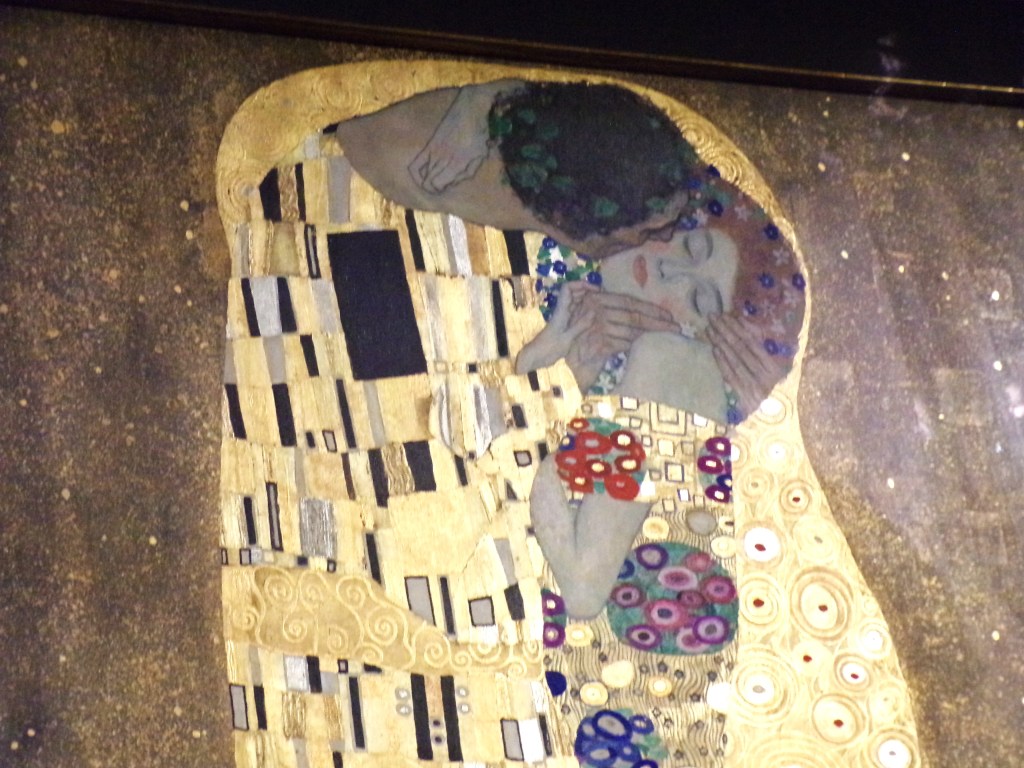
“The Kiss” was painted at the height of Klimt’s Golden Period. The couple, locked in a passionate embrace, seem to melt into one another. The setting is flat and two-dimensional; their faces are very three-dimensional. Hands and feet dart in and out of the mosaic-like surface, emerging suddenly from the patchwork quilt that covers them. Their bodies can be differentiated by the slightly different patterns in their color-coordinated robes. His robe has rectangular shapes; hers is composed of circles.
P.C. Cher B. 29 May 2025
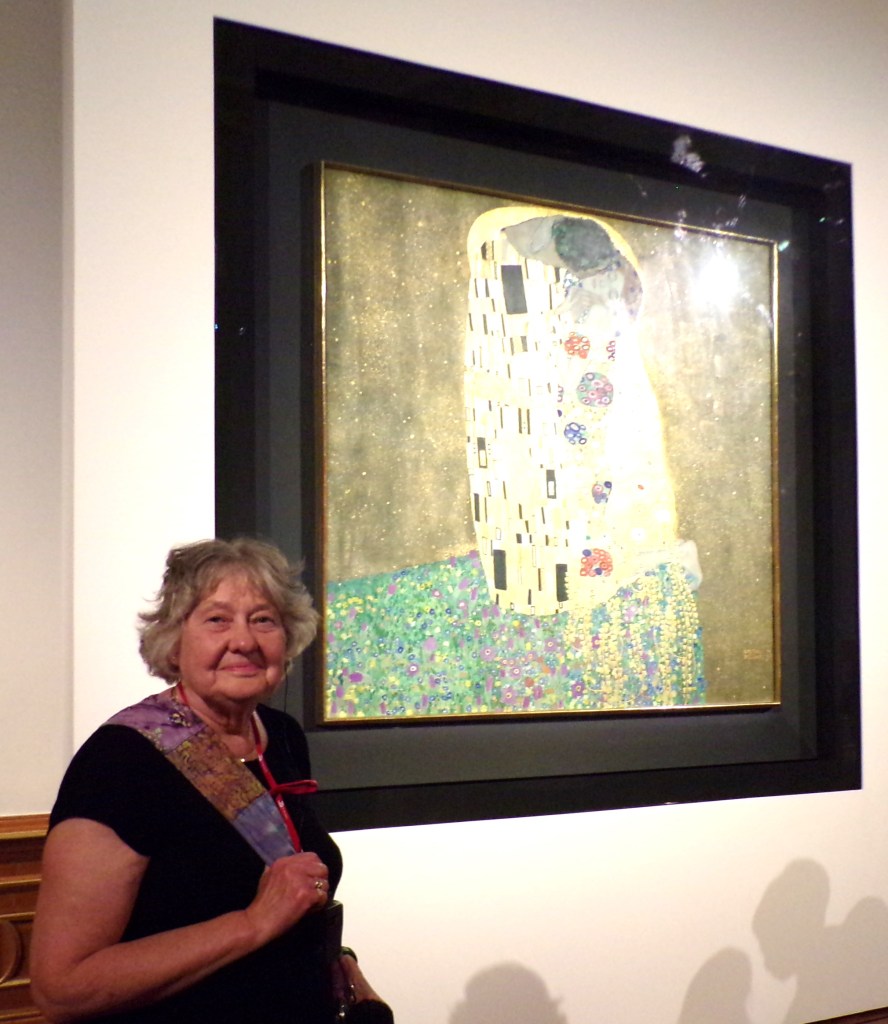
The painting is impressively large – nearly 6′ square (5′ 10.75″x 5′ 10.75″). Begun in 1907, Klimt exhibited the painting in 1908 at a show at the Kunstachau. It was purchased by the Ministry of Art (now the Belvedere). Originally titled “Lovers,” it was listed in its catalog as “The Kiss,” – the world famous title by which it is known today.

P.C. Cher B. 29 May 2025
Klimt used real gold leaf, silver and platinum in the picture to wrap the couple in a shimmering golden halo. In person, the painting is mesmerizing. The bright, shiny gold cannot be easily discerned in photos, the professional ones in art books or in mine. As with all great art, it has to be seen in real-time!
P.C. Skip B. 29 May 2025
The other Klimt Portrait: “Fritza Riedler“
Another mosaic-inspired Klimt portrait at the Belvedere also caught my eye. Fritza Riedler (1860-1927) was the wife of a wealthy mechanical engineer. In a patchwork, geometric style, similar to to “The Kiss,” the dignified subject sits, reserved and majestic, as if enthroned in a chair. In striking contrast to her dark hair, Klimt features her face as pale and delicate. As in “the Kiss,” her three-dimensional, realistic face is set against a background of two-dimensional ornamentation. Her face is highlighted by a half-circle shape placed directly behind her. This shape is filled with Klimt’s geometric, mosaic-inspired, golden designs.

P.C. Cher B. 29 May 2025
Even the chair is transformed into a decorative ornament. Composed of wavy lines and ancient Egyptian eye motifs, it took me awhile to identify it as a chair! Typical of Klimt’s Golden Period, the painting displays the emphasis on the picture plane and the interplay between flatness and depth.

P.C. Cher B. 29 May 2025
The Lady in Gold:
“Portrait of Adele Bloch-Bauer”
“The Lady in Gold,” as she is affectionately known, is the large, Klimt painting of a wealthy Jewish lady in Vienna in the early 20th century. It was stolen from her home by the Nazis during World War II. After the war, it hung proudly in the Belvedere for many years. As the result of Restitution of Art Stolen by the Nazis, “Lady in Gold” was finally regained by her niece, a Jewish woman now living in California, in a lengthy legal battle for restitution. I became interested in her story after reading the book and watching the movie that ensued. It is currently in the United States, at home in New York City at the Neue Galerie.
(“Lady in Gold” is discussed in my blog; it is a must-read and must-see! See Arm Chair Travel below)

P.C. Cher B. 29 May 2025
The Belvedere: Baroque at its Best
The Belvedere is included as one of the Top Ten must-see places in DK Eyewitness Travel: Top Ten Vienna. It is a masterpiece of Baroque architecture.
Hapsburg Prince Eugene of Savoy built the elegant palace as a summer residence (1714-1723). Following his victory over the Turks in 1683, he became the most celebrated of the Hapsburg generals. With the reward money he received for his success, he commissioned two palaces in Vienna. They are separated by a spacious, three-level formal garden situated on a gently sloping hill. The complex includes a chapel, a hall of mirrors, a marble gallery, statuary, grand staircases, an orangery, a fabulous art collection and much, much more.
Our tour included the Upper Palace and nearest gardens

P.C. Cher B. 29 May 2025
A decorative wrought iron gate welcomes visitors to the vast entrance of the Upper Palace.

P.C. Cher B. 29 May 2025
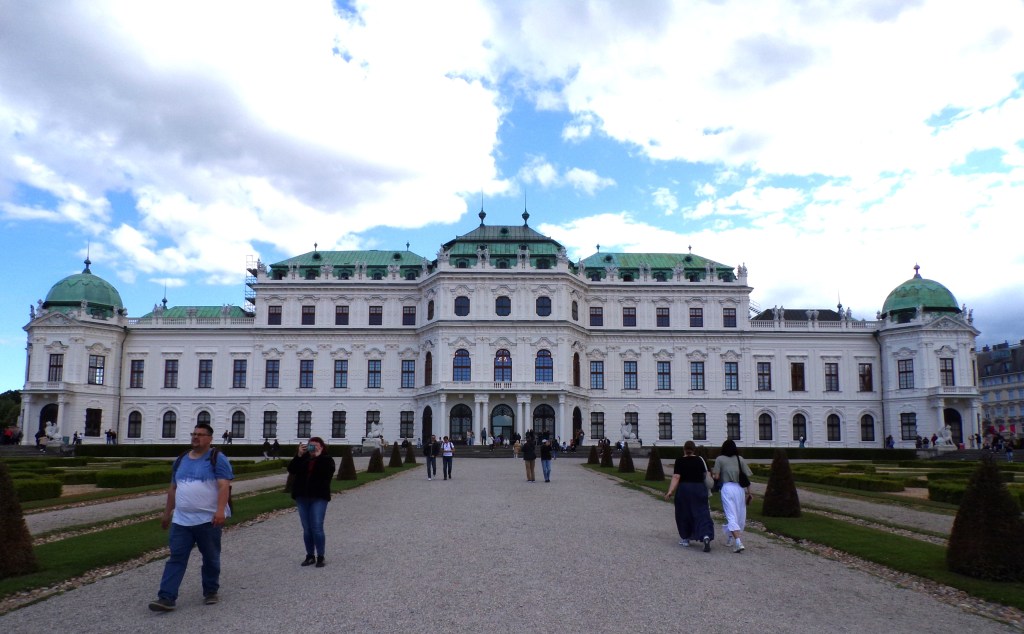
The expansive size of the Upper Belvedere can be seen from the back. It overlooks the formal gardens and houses the main art collection, including Klimt.
P.C. Cher B. 29 May 2025
The gardens are adorned with sculptures of sphinxes with their lion bodies and human heads. These figures are said to represent strength and intelligence.

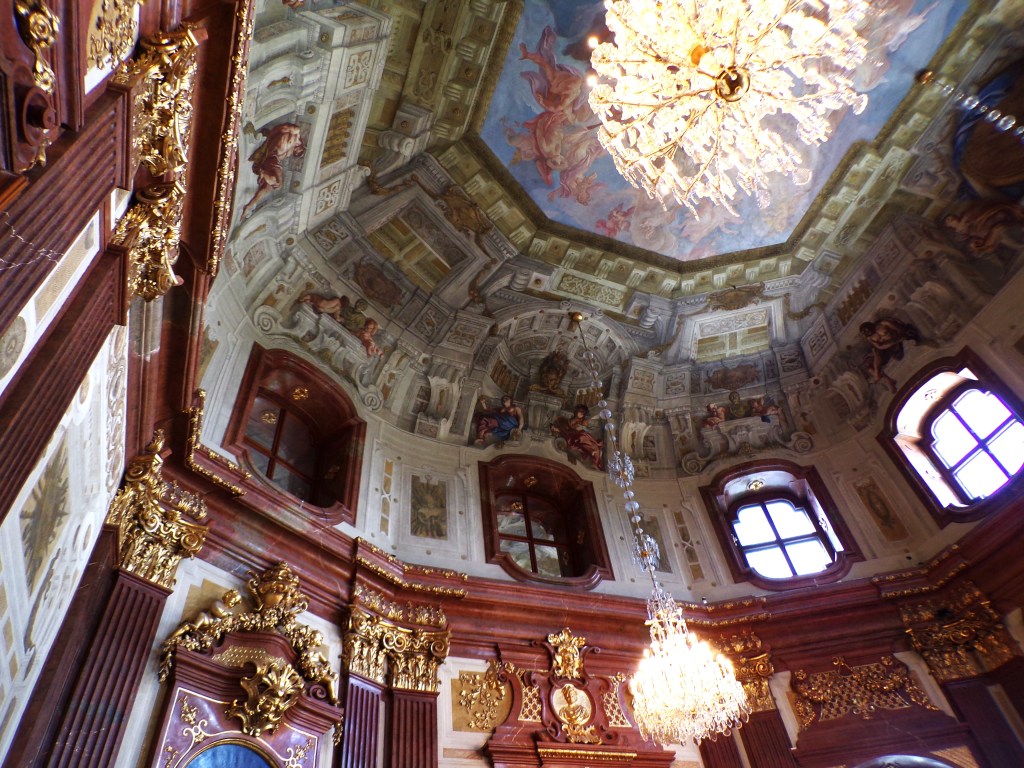
The interior is the epitome of Baroque architecture. Its elaborate crystal chandeliers and massive ceiling frescoes move the eyes of the viewer always heaven-ward.
P.C. Cher B. 29 May 2025

P.C. Cher B. 29 May 2025

P.C. Cher B. 29 May 2025
Galleries throughout the Belvedere display a magnificent collect of 19th and 20th century Austrian art in addition to that of Klimt.

P.C. Cher B. 29 May 2025
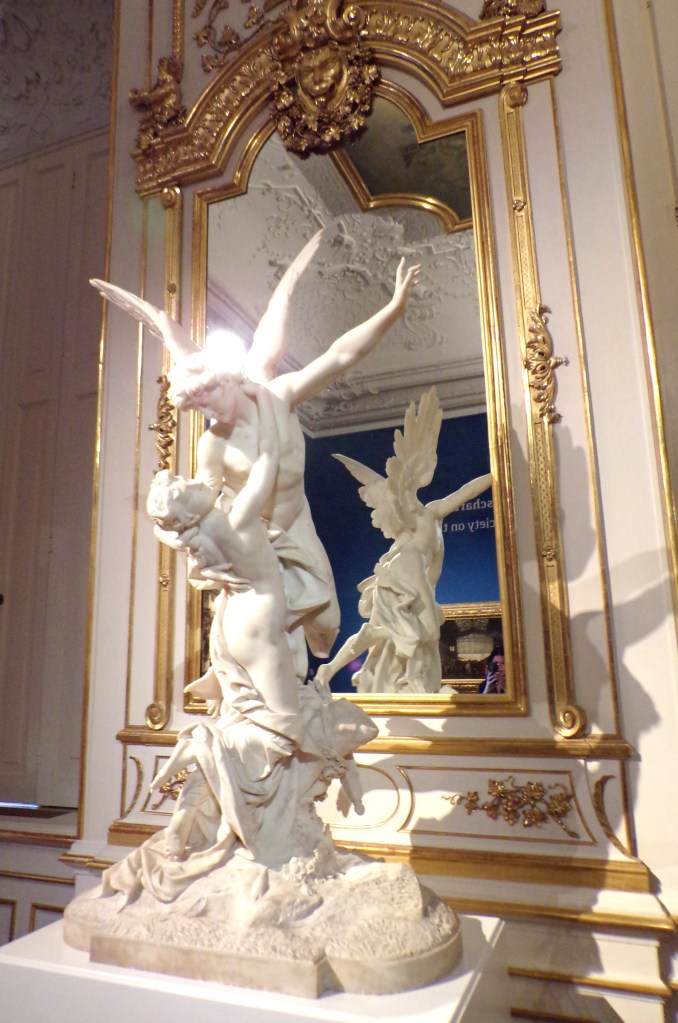
Marble sculptures adorn the rooms, maximized by the gilded mirrors that lined the walls.
P.C. Cher B. 29 May 2025
Belvedere: A Place in History
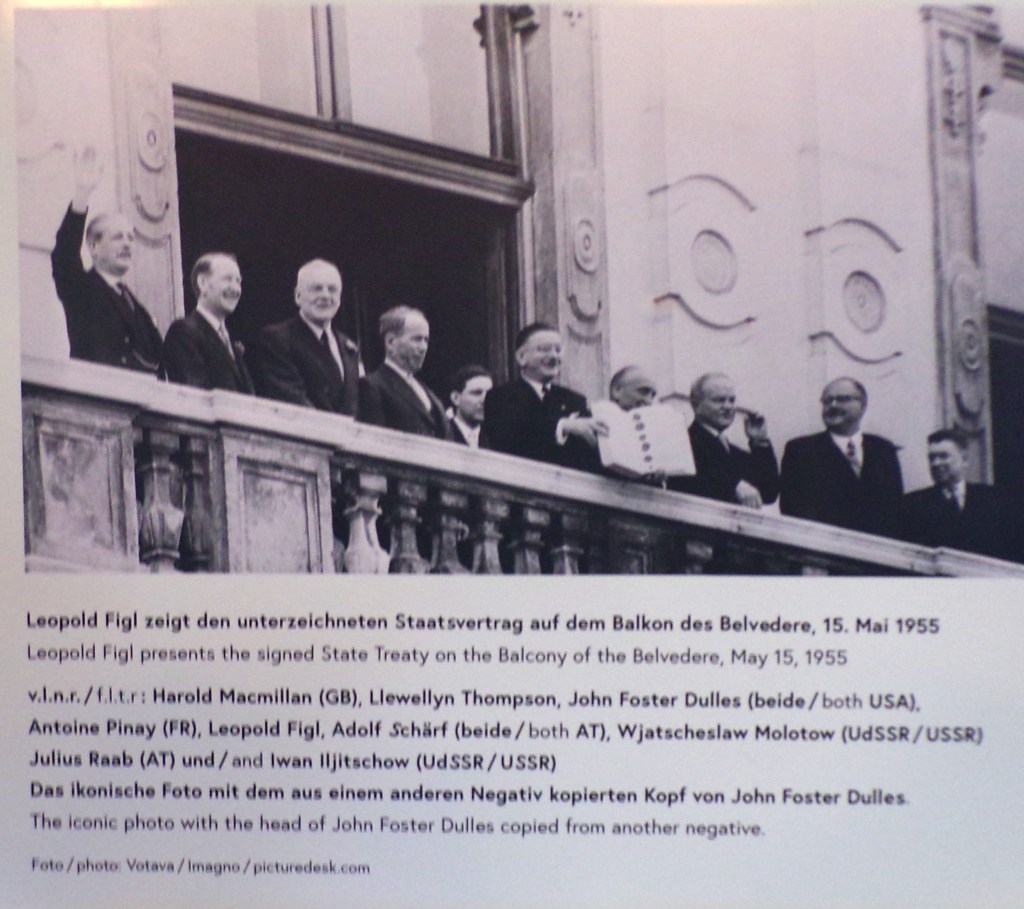
In 1955, the Upper Belvedere became the scene of celebration for Austria! After World War II, Austria had been occupied by four world powers: United States, Great Britain, France and the USSR. The State Treaty, signed by the four world powers, granted sovereignty to the country of Austria. John Foster Dulles (US), Harold Macmillan (GB), Wjatscheslaw Molotow (USSR), and Antoine Piney (FR), met in the Marble Hall and signed the document. The State Treaty was then displayed from the balcony to cheering crowds that filled the gardens below.
P.C. Cher B. 29 May 2025
The balcony off the Marble Hall looks over the vast Baroque gardens. The fountains were not yet turned on during our visit. That display should be fantastic!
The Lower Belvedere can be seen in the distance. Our visit allowed only a few minutes in the gardens, so we can look forward to a more complete experience on another visit to this fabulous complex!

P.C. Cher B. 29 May 2025
Creating a Klimt Inspired Work of our own!
Our Viking tour of the Belvedere included the opportunity to channel our Klimt-inspired creativity in a private workshop. Here we were were given the tools and materials to create our personal small, framed work of art using colored tiles and golf leaf. The experience gave me a better appreciation of the skill of working with gold leaf – and greater admiration for Klimt’s skillful use of the medium in his paintings!
Visit
For a lover of art and art history, I can recommend the Belvedere while visting Vienna – especially if one loves Klimt and/or Baroque art and architecture. Utilizing the services of a Belvedere museum guide is good, but one can easily explore the palace on one’s own. Allow at least two hours on-site. We were with a tour bus, but public transportation appears to be very workable, as it is throughout Vienna. If I were to go again, I would go on my own, allowing me more time to meander through the gardens. Touring the site on my own, without having to keep up with my group, would also help me avoid the crowded areas and get better photos of the beautiful rooms. But, as always, do your homework on the site, examine your objectives and style of museum-visits, and go with what suits you best – and enjoy this fabulous palace and art!
Arm Chair Travel
Armchair Travel: “Woman in Gold”

My interest in Klimt’s work was piqued after watching the movie “Woman in Gold” and reading the book by Anne-Marie O’Connor on which the film was based. The book tells the engaging story of one of Gustav Klimt’s famous paintings, officially titled “Portrait of Adele Bloch-Bauer.” It chronicles the fascinating life of Adele, her connection to Klimt, the impact of World War II on her Jewish family, and the lengthy legal battle for restitution of the painting. See my film discussion and blog on this movie.

Did you enjoy this post? Did you learn something new? If so, I’d love to hear from you with a simple “Like” click below. Positive, encouraging comments are always welcome! Thanks! ~Cher
Sources
- Belvedere Tour Guide on private group tour. 29 May 2025.
- DK Eyewitness Travel, Austria. Belvedere. ed. 2010. pp 98-99.
- DK Eyewitness Travel, Top Ten Vienna. ed. 2011. pp 22-25.
- Gardner’s Art Through the Ages, a Global History. 14th ed. p 823.
- Viking Tour Guide, Lecture in Preparation for the Visit. 29 may 2025
P.C. Cher B. 29 May 2025
 Charamana Consulting