Taliesin West & Frank Lloyd Wright
As a professor of Art History and Design, I have long been enchanted with the architecture of Frank Lloyd Wright. My first encounter was when I lived in New York City where I loved visits to the Guggenheim Museum, one of his masterpieces. It became an all-time favorite of mine. We took a road trip a few years ago to his Wisconsin home and studio, the original Taliesin. I created a whole blog on it. When we decided to do a New Mexico/Arizona road trip that included Scottsdale, Arizona, Taliesin West was quickly added to the itinerary. This blog highlights that adventure.
P.C. Cher B 30 March 2024
What? – and Where? – is Taliesin West?
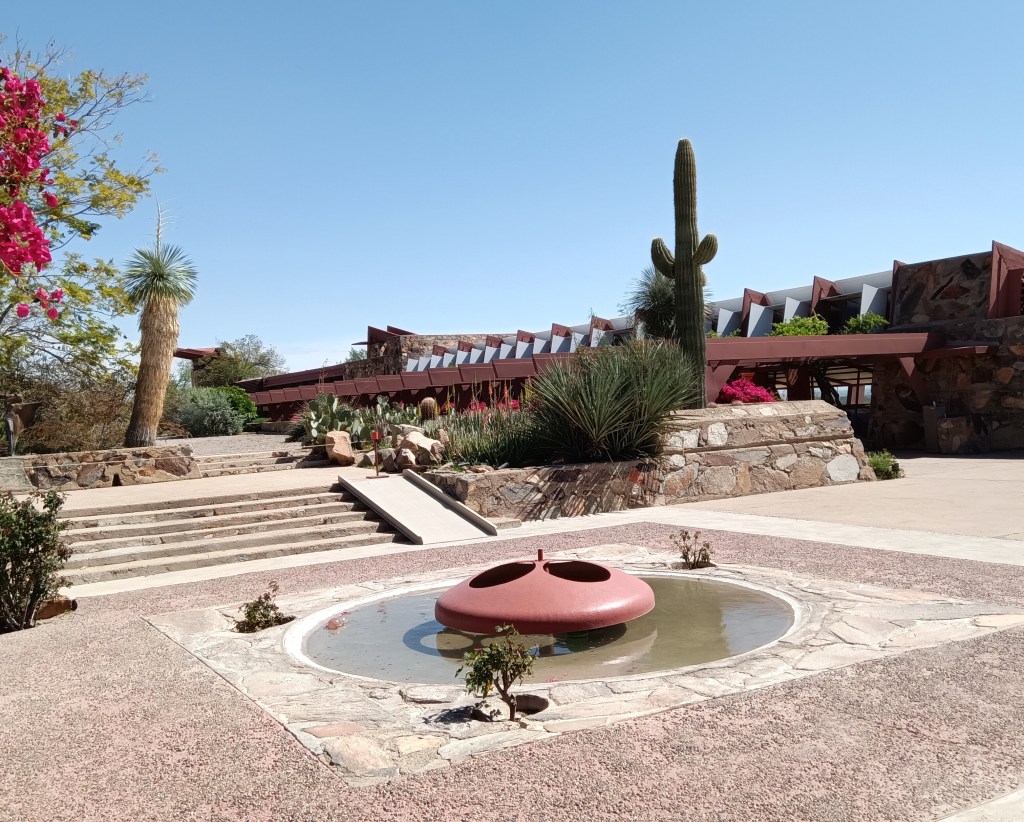
Tucked into the foothills of the McDowell Mountains in Scottsdale, Arizona, is the winter home and studio/laboratory of famous 20th century American architect/designer, Frank Lloyd Wright.
In the summer, Wright’s home and studio headquarters were the original Taliesin, nestled into the rolling green hills of Spring Valley, Wisconsin. Later in life, on the recommendation of his doctors, he created his southern winter home/studio in the warmer drier, Arizona desert.
The southern home/studio became known as Taliesin West. Today it is a World Heritage site and National Historic Landmark, renowned for its ‘desert masonry’ which, going along with Wright’s philosophy of building with local materials, used local rock and concrete. The low, yet expansive spaces, are filled with light and the angular lines and shapes are a trademark of Wright’s architecture which is designed to blend into it the landscape – in this case, the Sonoran Desert.
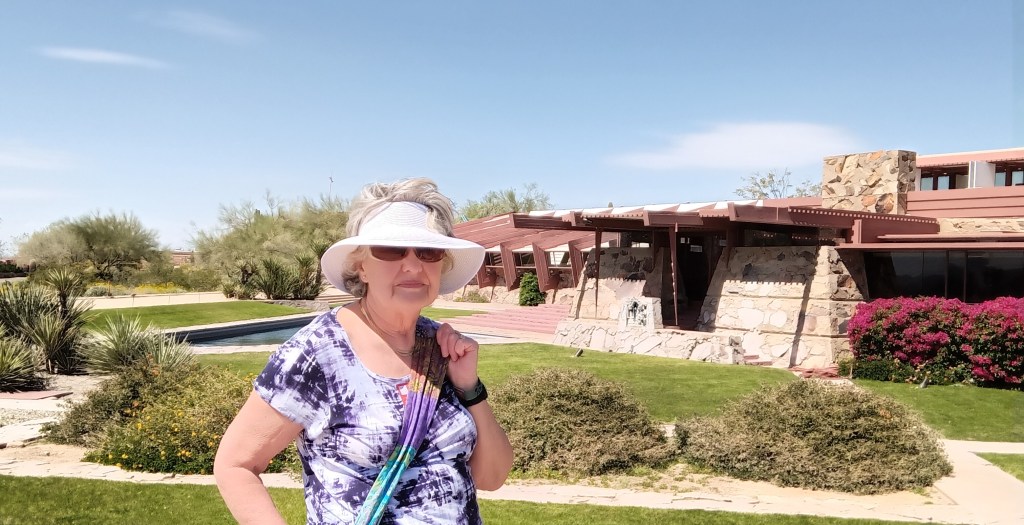
My Visit to Taliesin West
Over the years of teaching art history and design, I became increasingly enthralled with Wright’s architecture. I had toured Wisconsin’s Taliesin West twice, visited New York City’s Guggenheim Museum numerous times as well as the Wright-inspired Prairie style Purcell-Cutts Home in Minneapolis (details at end of this blog). I was eager to see his desert masterpiece. It did not disappoint.
P.C. Skip B 30 March 2024
Who is Frank Lloyd Wright?
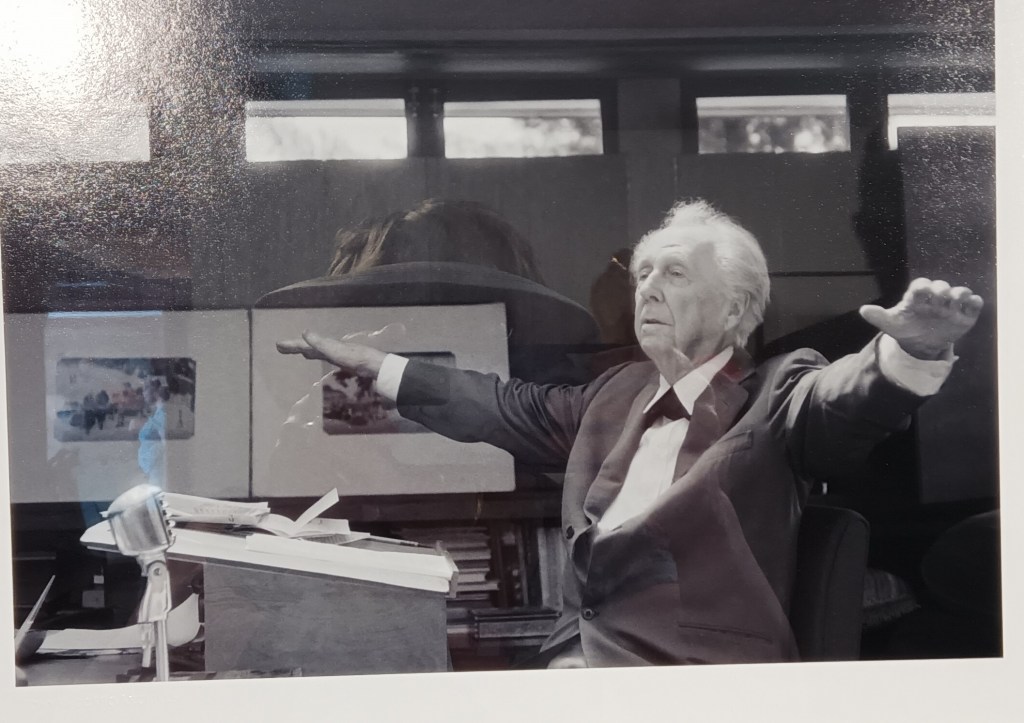
Frank Lloyd Wright (1967-1959) was one of the most influential architects of the 20th Century, His career spanned more than 70 years. During that time, he designed hundreds of buildings,and over 1,000 structures including lighting fixtures, windows, home decor etc. Besides the iconic Solomon R. Guggenheim Museum in New York City, buildings include the Kaufmann Fallingwater House in Bear Run, Pennsylvania which has been called “the best all-time work of American architecture.”
Wright’s legacy lies not only in his design abilities, but in his philosophy. He called this philosophy organic architecture, and with which he created each of his masterpieces in design. It can honestly be said that Wright forever influenced our relationship with architecture and shaped our idea of how to live in balance with nature.
Wright was a pioneer in what is called the Prairie School Movement of Architecture. His Prairie School houses use themed, coordinated design elements (often based on plant forms) that are repeated in windows, carpets, and other fittings. The interior elements he designed included furniture (more on this with the origami chairs, below), leaded glass windows, floors, furniture and even tableware, all which were integrated into these structures.
I greatly appreciate Wright’s philosophy of organic architecture; I also feel connected to him as a fellow-Midwesterner. Raised in rural Wisconsin, (next door to my native Minnesota) Wright studied civil engineering at the University of Wisconsin. In Chicago, Illinois, he apprenticed with architect Louis Sullivan and in 1893, he opened his own successful Chicago practice. Chicago was home to his first studio and home as well as a number of his renowned architectural creations. A visitor to Chicago can enjoy tours of these masterpieces. Experiencing one of these tours is on my bucket-list in a future visit to Chicago.
Wright’s Wisconsin boyhood home and studio in Spring Green, Wisconsin can also be toured. I shared highlights of our visit to this original Taliesin in my blog.
P.C Cher B 30 March 2024
Wright received many honors during his lifetime, including one from the American Institute of Architects who recognized him as”the greatest American architect of all time” in 1991. I totally agree.
Wright moves to the Southwest
In 1937, Wright left the cold, damp, mid-western Wisconsin winters and moved to Arizona for his health. Here he created what became known as Taliesin West and established a winter home and desert laboratory and, with his students, diligently handcrafted it over many years. He continued to spend winters here until his death in 1959.
My visit to Taliesin West
We participated in a guided tour with a knowledgeable, interesting and passionate Taliesin West guide. The sequence of this blog and photos follow the path on which he took us.
P.C. Cher B 30 March 2024
Wright’s Vision for Taliesin West
To appreciate Taliesin today, one must get a glimpse of its origins and see what Wright saw in its original state. Having purchased several hundred acres of land in the then rural foothills of northeast Scottsdale, Wright began to conceive of a desert utopia comprised of low-slung buildings designed to reflect the sweeping expansiveness of the desert, in line with his philosophy of buildings that aligned organically with their surroundings. Rustic at first, over the years it evolved into the complex site open to visitors today.
It was built and maintained almost entirely by Wright and his apprentices, making it among the most personal of the architect’s creation.
P.C. Cher B 30 March 2024
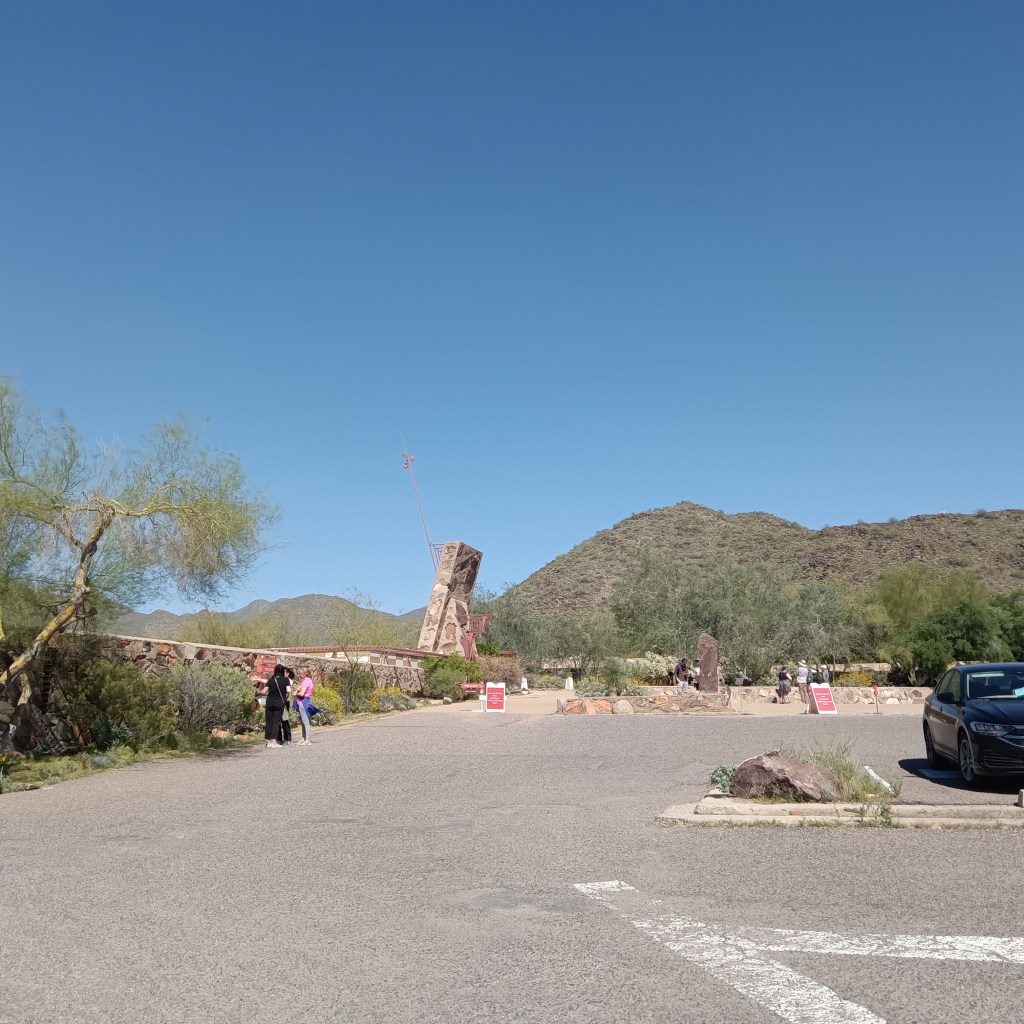
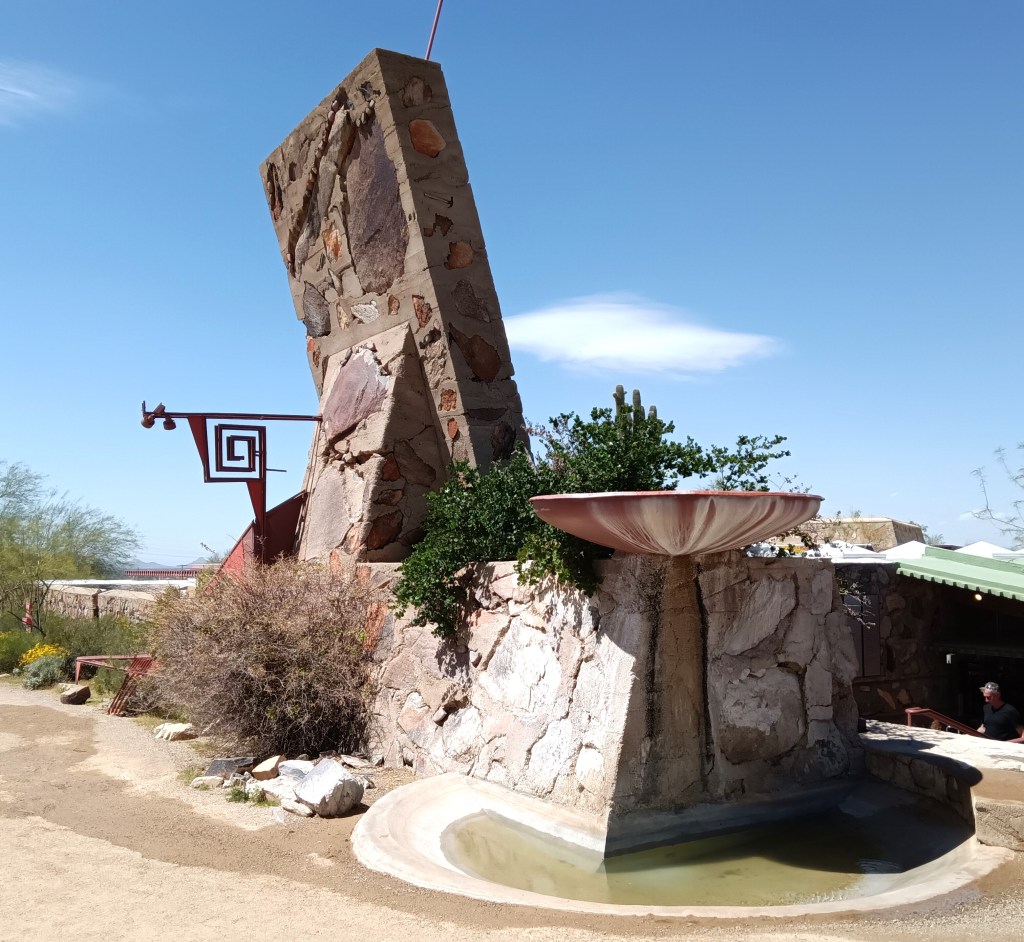
Our entrance to Taliesin West prepared us for visit: landscape first, buildings later. The buildings are set within and among and become one with the landscape in the true style of Frank Lloyd Wright.
P.C. Cher B 30 March 2024
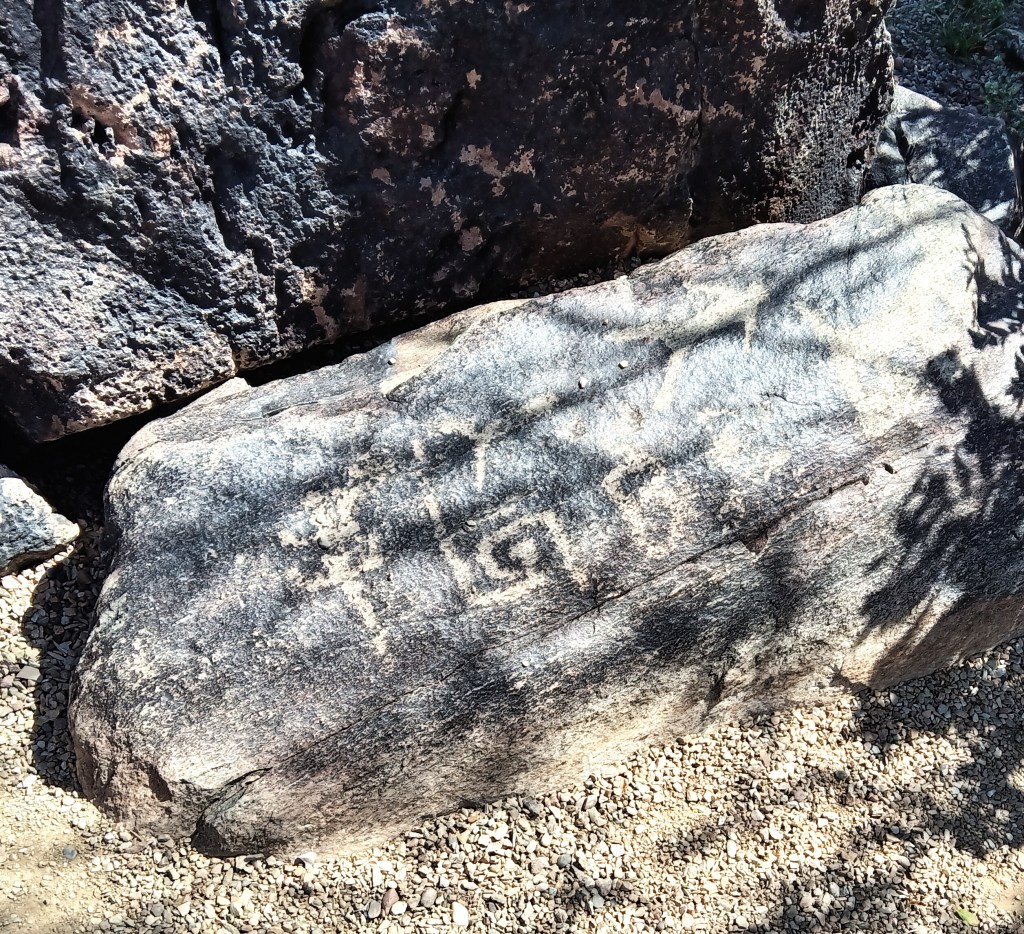
Petroglyphs – origins of logo
Deeply connected to the desert, parts of Taliesin West possess a seemingly prehistoric feel. This can be seen in the petroglyphs still seen on many of the rocks left exposed for visitors to enjoy. This one, in particular, reveals the source of the Taliesin logo.
P.C. Cher B 30 March 2024
My Tour of Taliesin
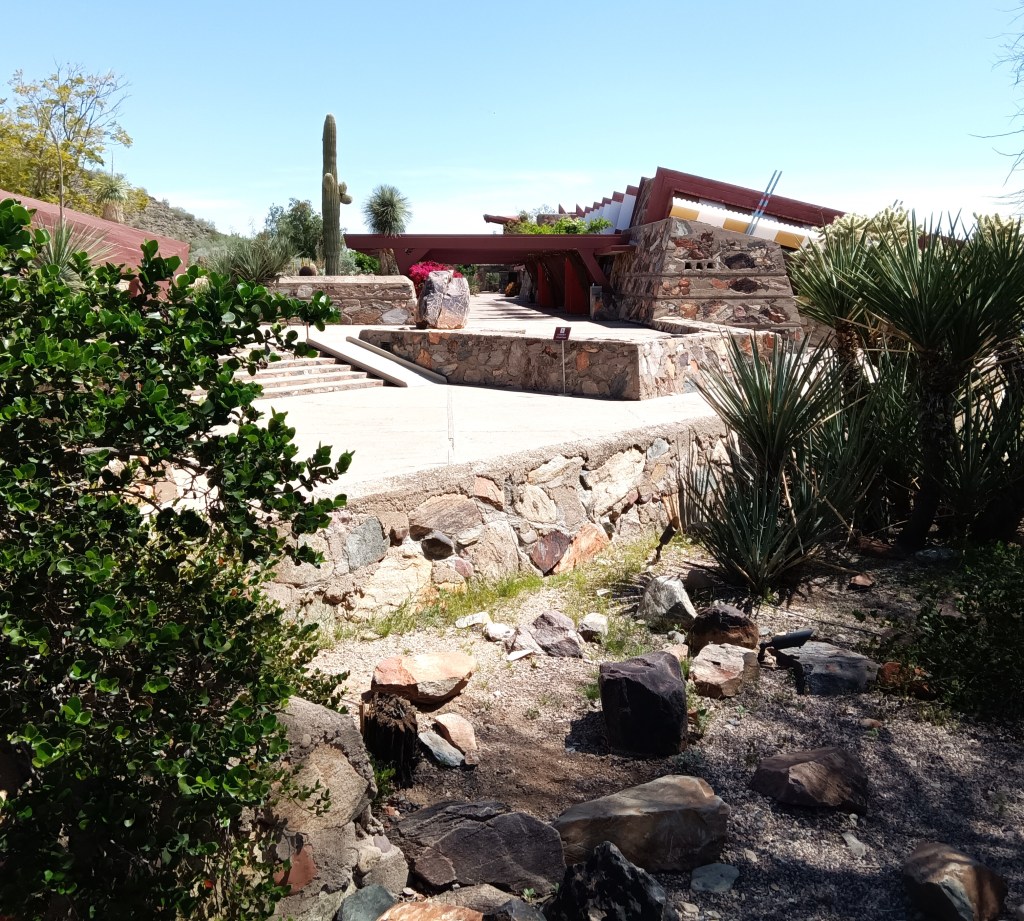
Over the years, the complex was continually altered and expanded. It eventually included a drafting studio, dining facilities, three theaters, a workshop, Wright’s office and private living quarters, and residences for apprentices and staff. I was excited as we caught sight of our first view of the complex.
P.C. Cher B 30 March 2024
Always in favor of using local materials, Wright constructed Taliesin West largely of “desert masonry”: local rock set in wooden forms and bound by a mixture of cement and desert sand. In so doing, Wright hoped to preserve as much of the desert environment as possible by embedding his structures within the landscape.
Studio
We first visited a small intimate studio built into the landscape. The larger drafting studio was separate.
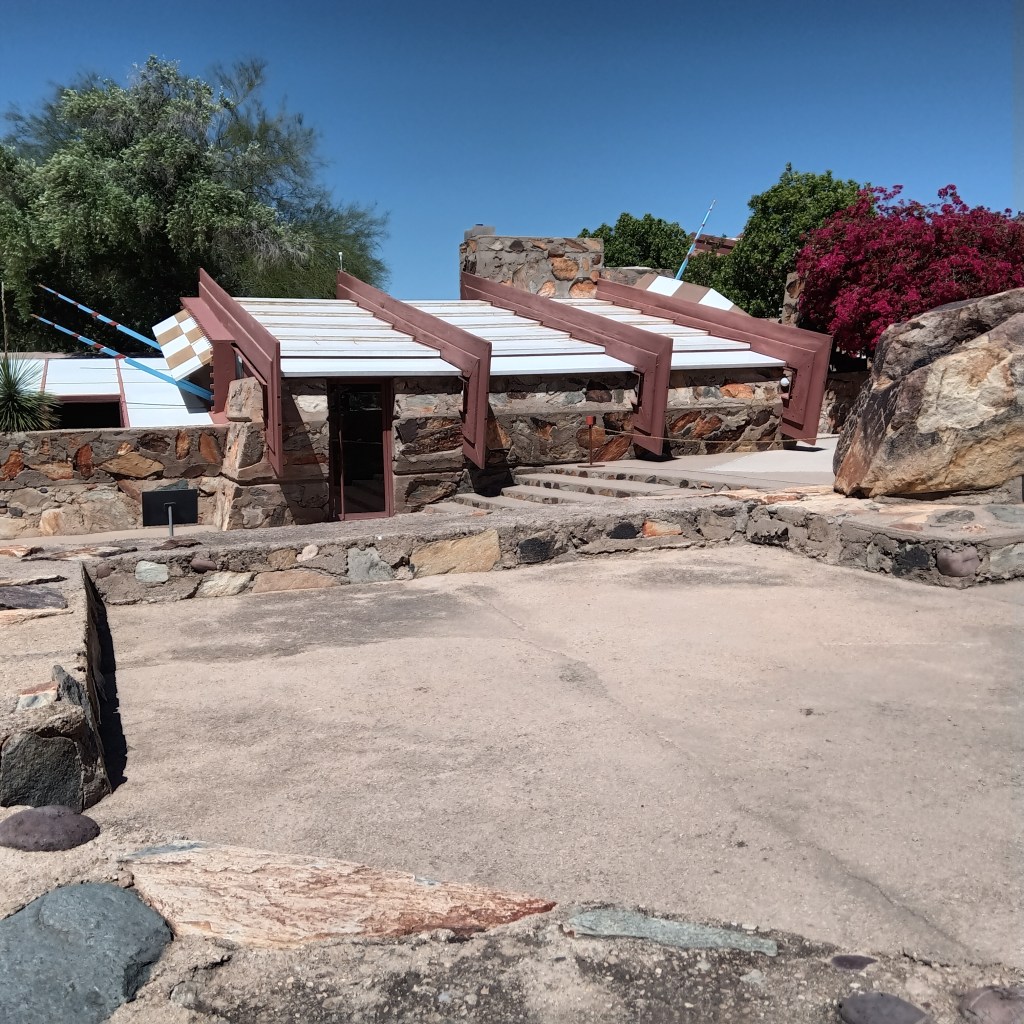
P.C. Cher B 30 March 2024
Canvas roofs provide the interior spaces with light, while the redwood beams, flooring, and chairs give us our first sample of the Wright’s favorite red accents seen throughout the complex
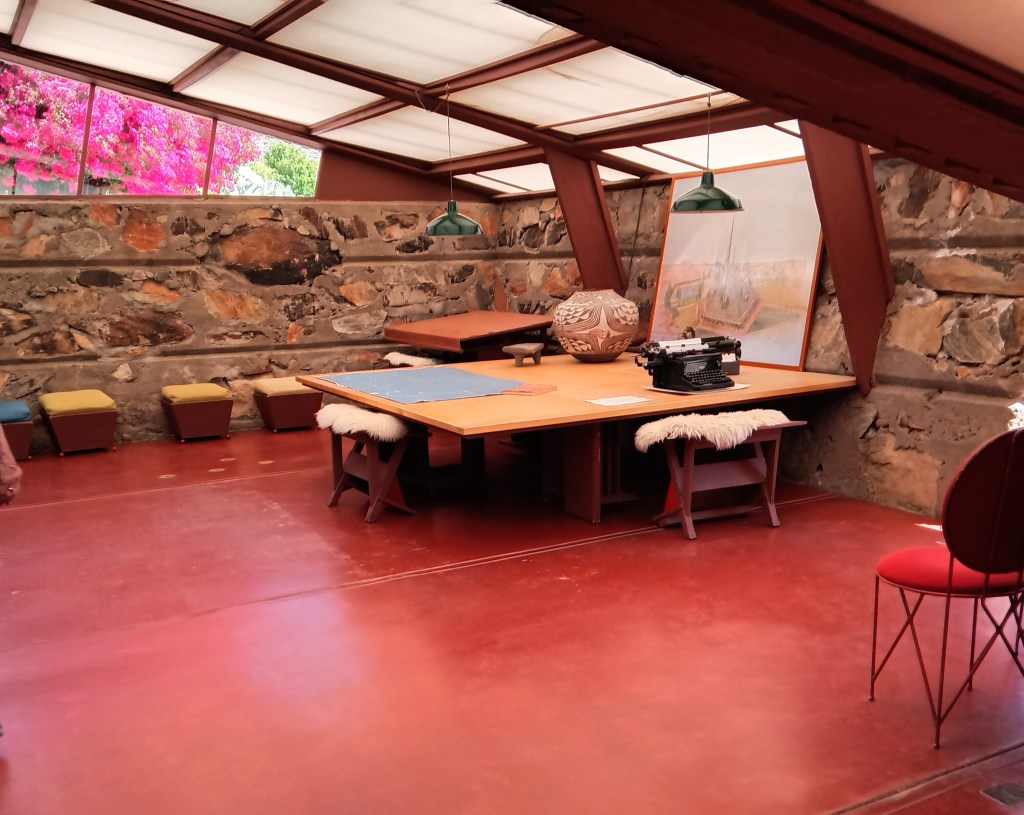
P.C. Cher B 30 March 2024
Reflecting Pool
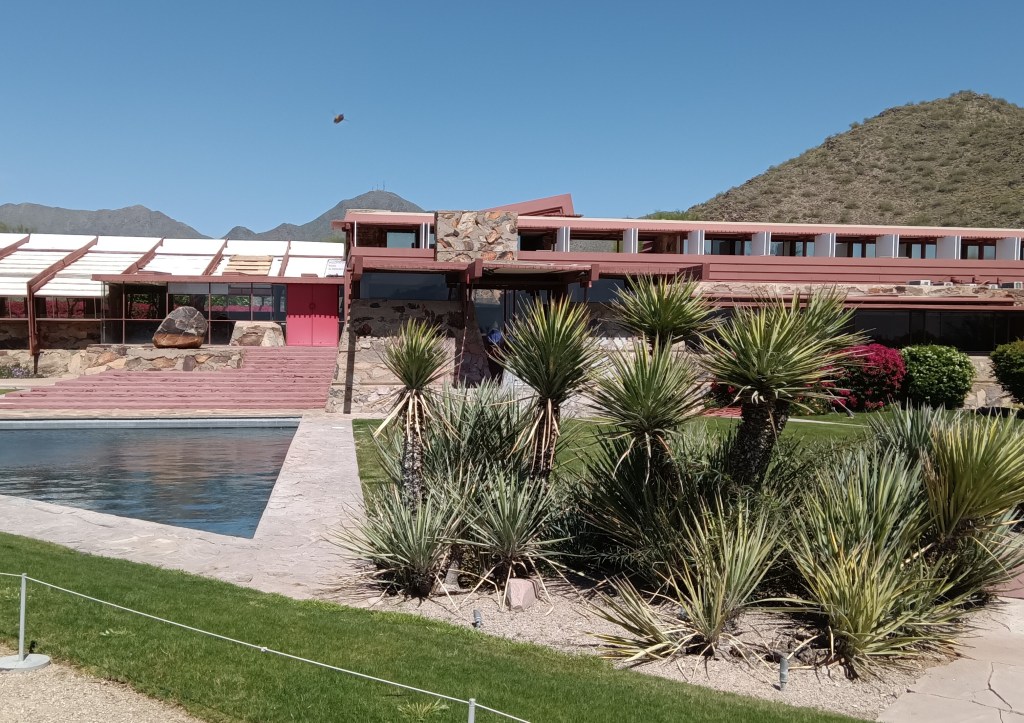
The entrance to the home could not have been more picturesque! The reflecting pool emphasized the magnificent angled architecture on one side, the desert on the other.
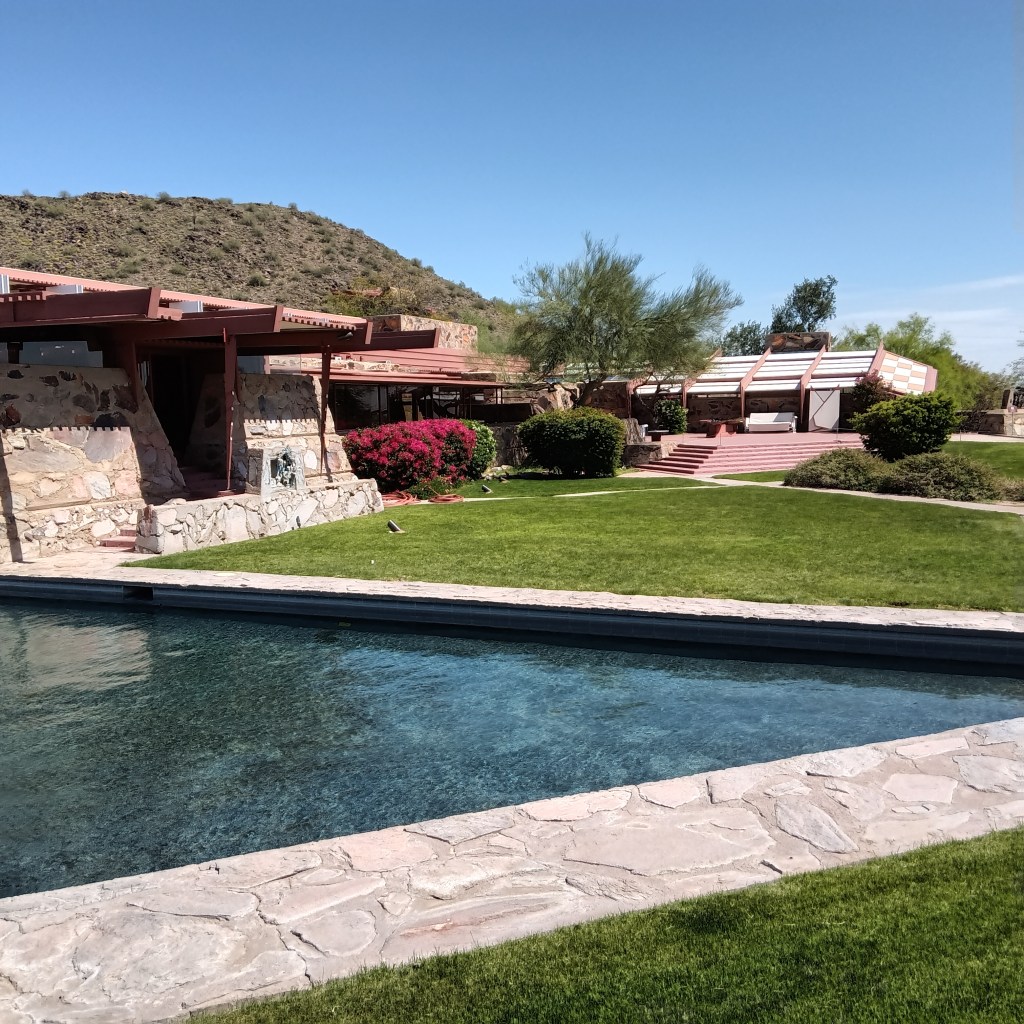
P.C. Cher B 30 March 2024
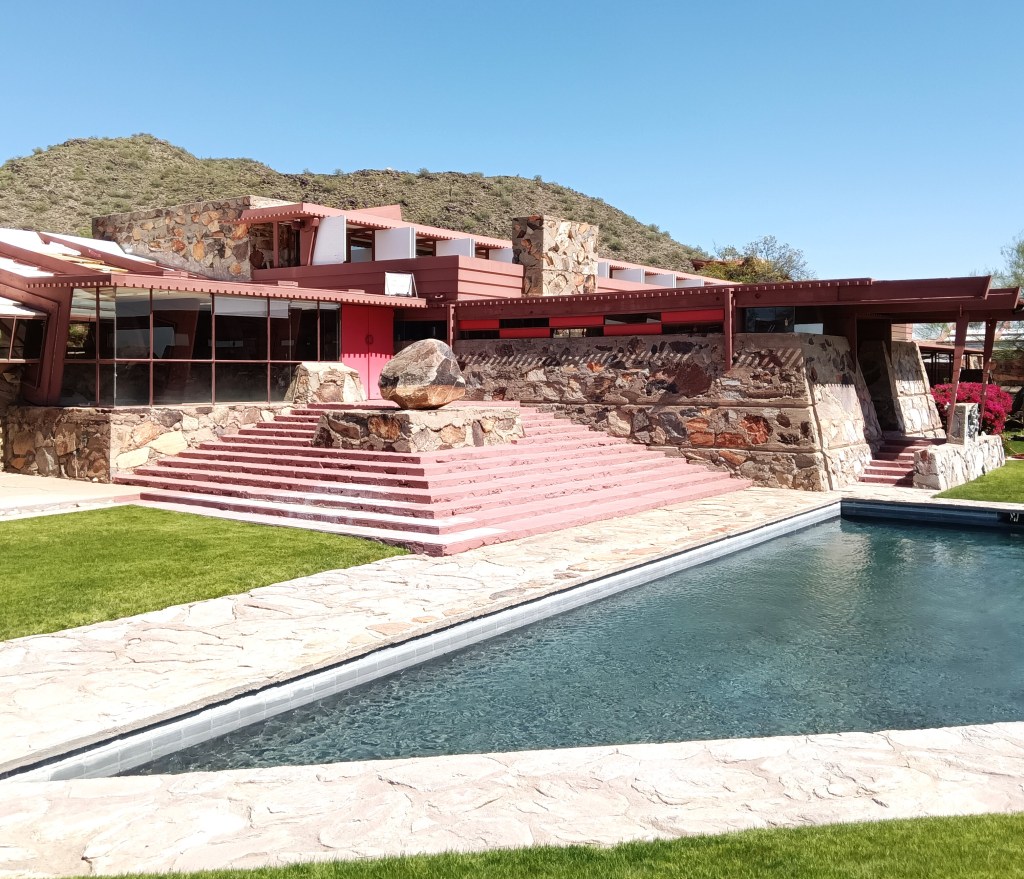
P.C. Cher B 30 March 2024
Public and private events are hosted on these spacious lawns and patios today. What a great venue, especially a sunset which I understand are spectacular!
P.C. Cher B 30 March 2024

P.C. Skip B 30 March 2024
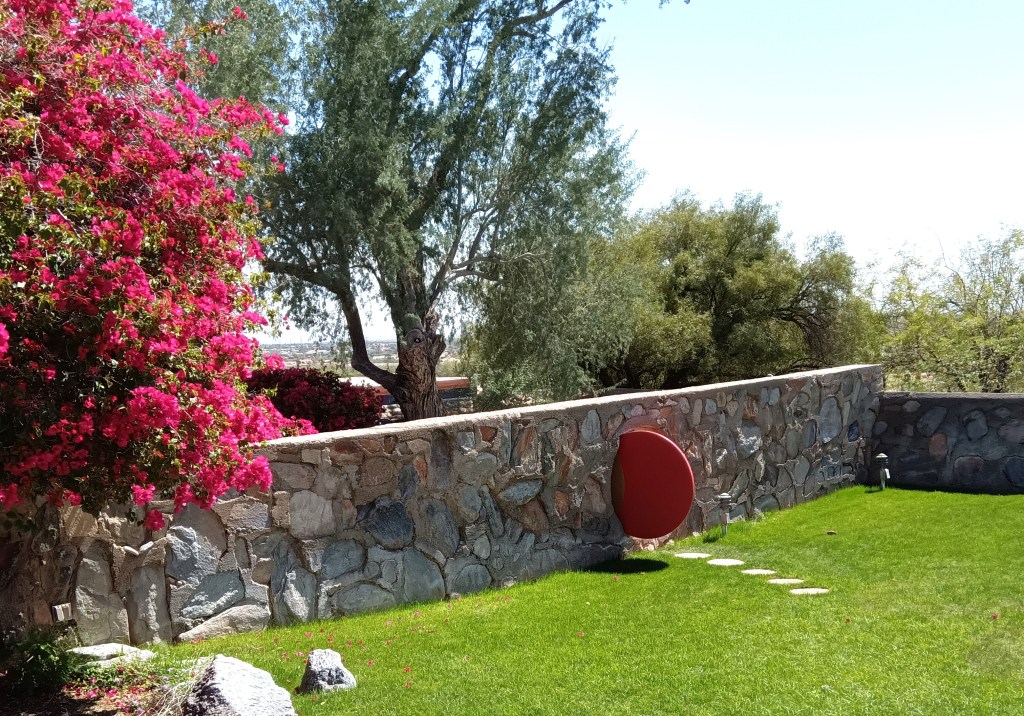
This “Hobbit-like”spot in the garden wall with the round red door was one of my favorite places. And it was red, of course!
P.C. Cher B 30 March 2024
Interior
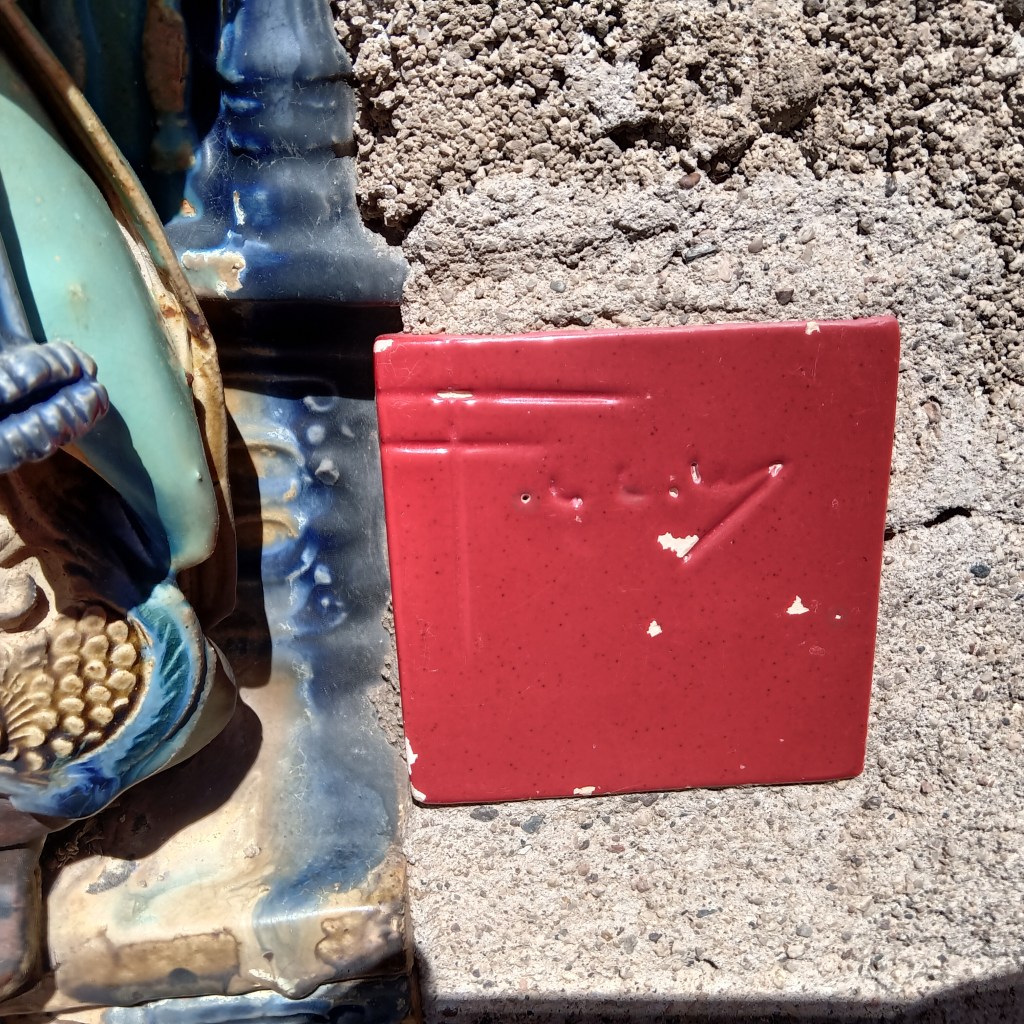
This red tile (or “red square”) at Taliesin and in some of Wright’s buildings was initiated in the 1950s. Our guide shared that it acts as a personal seal of Wright’s approval and signifies that the structure was designed by him and was completed to his specifications. These “Cherokee Red” glazed tiles bear his initials “FLLW.” They were placed as a branding mechanism in select, completed projects such as Taliesin and signified a mark of his personal pride.
P.C. Cher B 30 March 2024
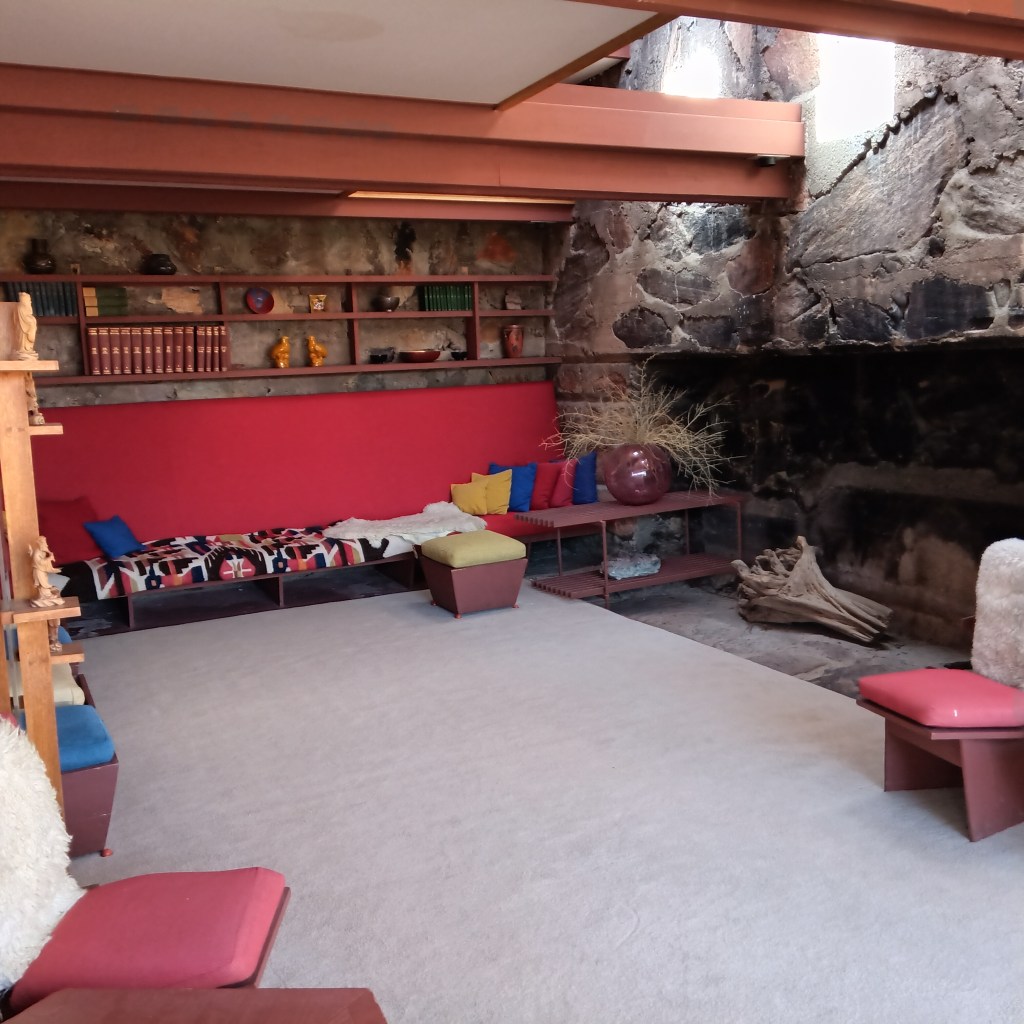
Wright designed all of the interior furniture and decorations specifically for each room and each space, the majority of which were made on site by the apprentices. Preservationists take great pains – and pride – to make today’s Taliesin West as close to the time when Wright lived and worked here.
P.C. Cher B 30 March 2024
Living & Dining space – the Garden room
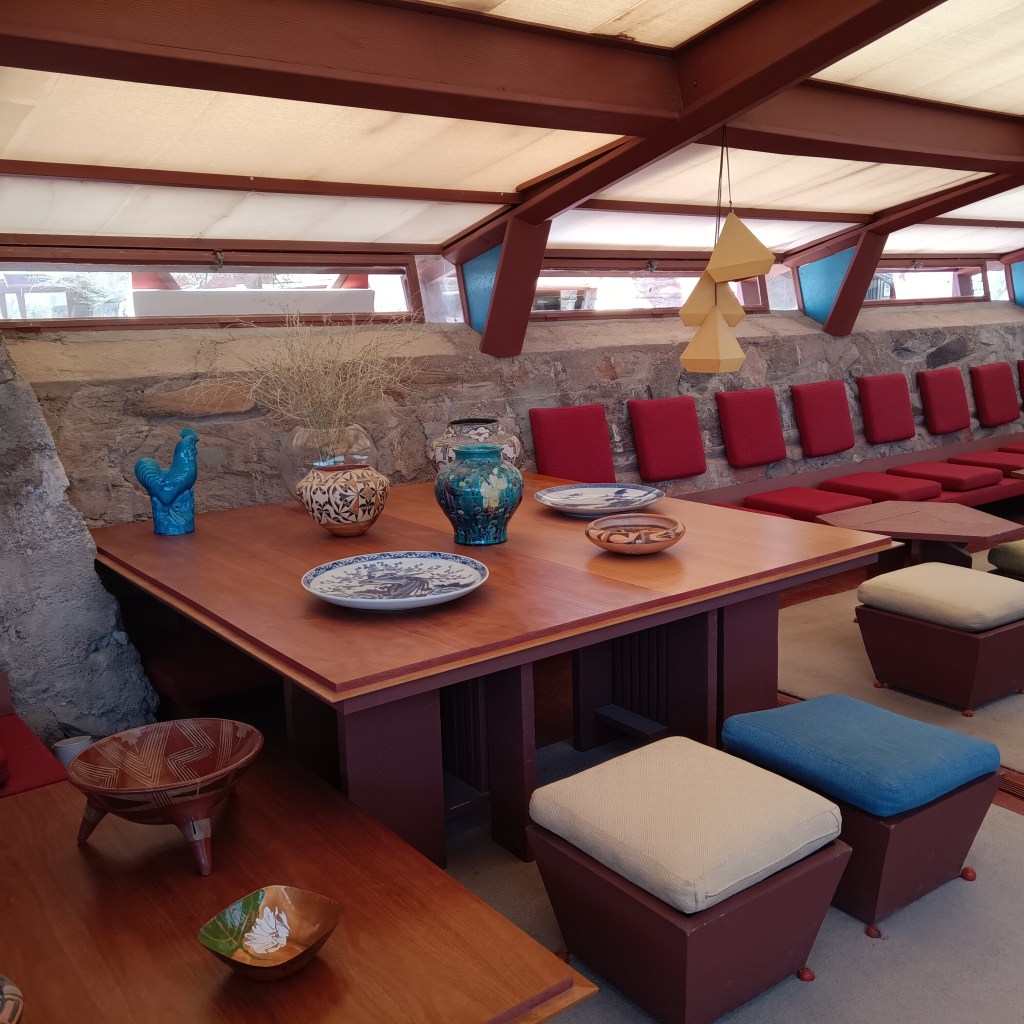
I was impressed with the significant collections of art, artifacts, furnishing, prototypes, and more on display in the various rooms, both here at Taliesin West and what I saw at Taliesin Ill, Wisconsin. Credit is given to the hard work of a dedicated preservation team of the Frank Lloyd Wright Foundation which provides the most authentic and inspiring experiences for visitors. This living and dining space in the Garden Room is a great example.
P.C. Cher B 30 March 2024
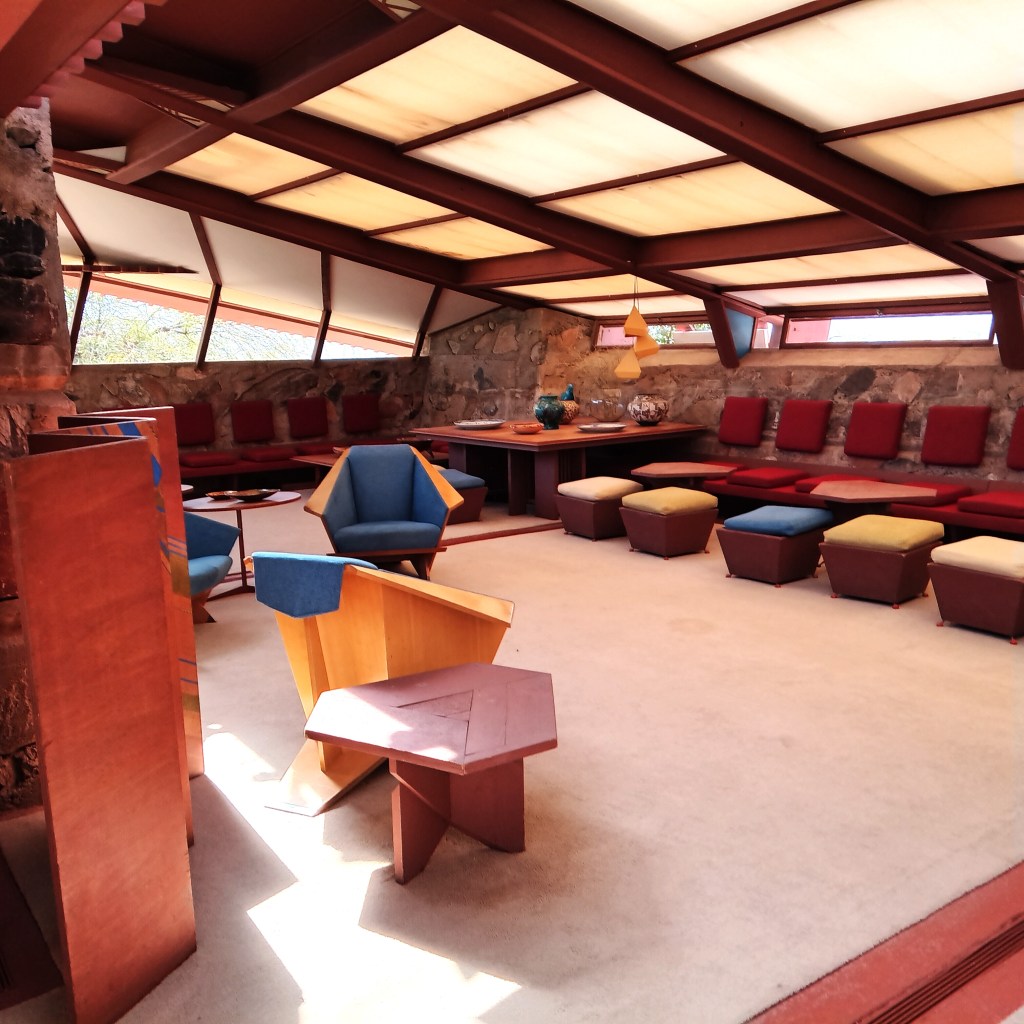
The combination living and dining room is bathed in light despite the low ceiling, typical in Wright homes. The furniture was designed by Wright specifically for this room. His appreciation and enjoyment of Asian designs can be seen everywhere.
P.C. Cher B 30 March 2024
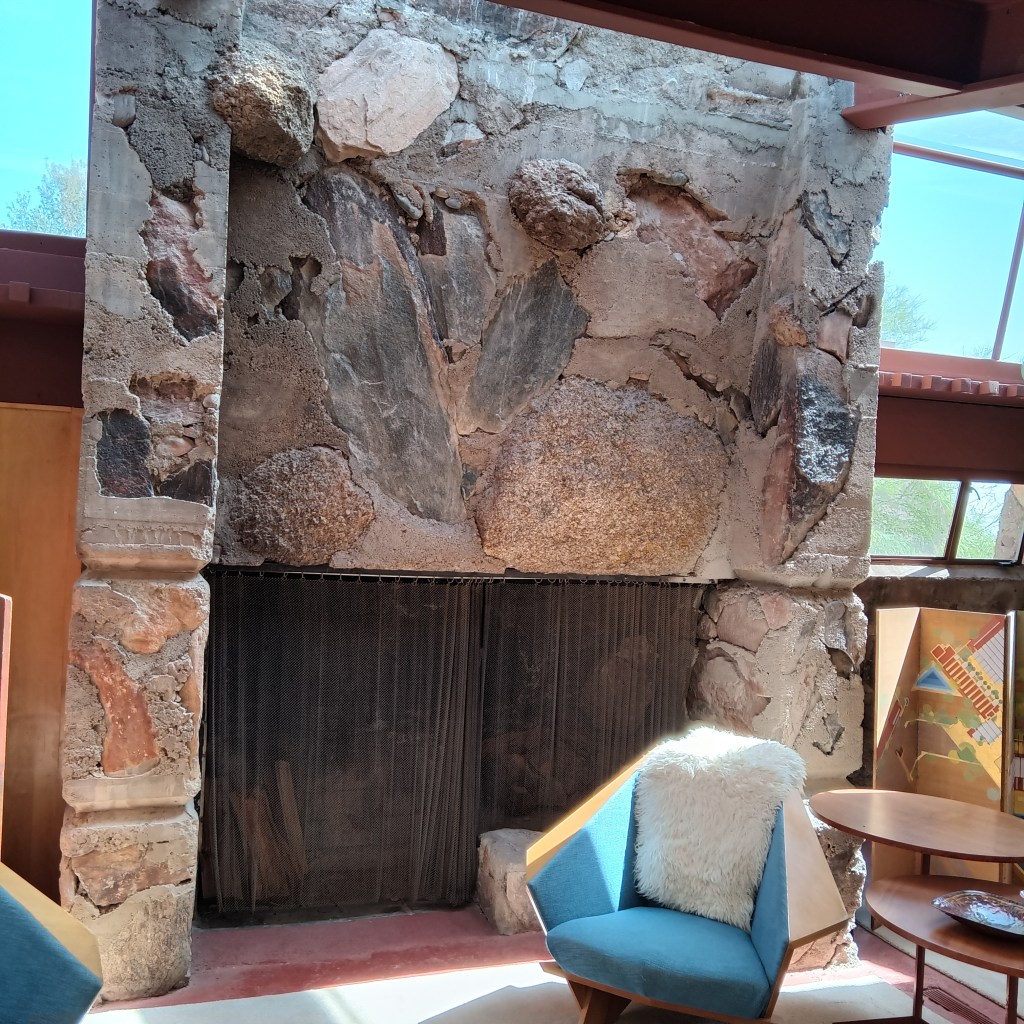
This massive fireplace of local materials is the backdrop for the origami chair, one of his original creations.
P.C. Cher B 30 March 2024
The Origami Chair
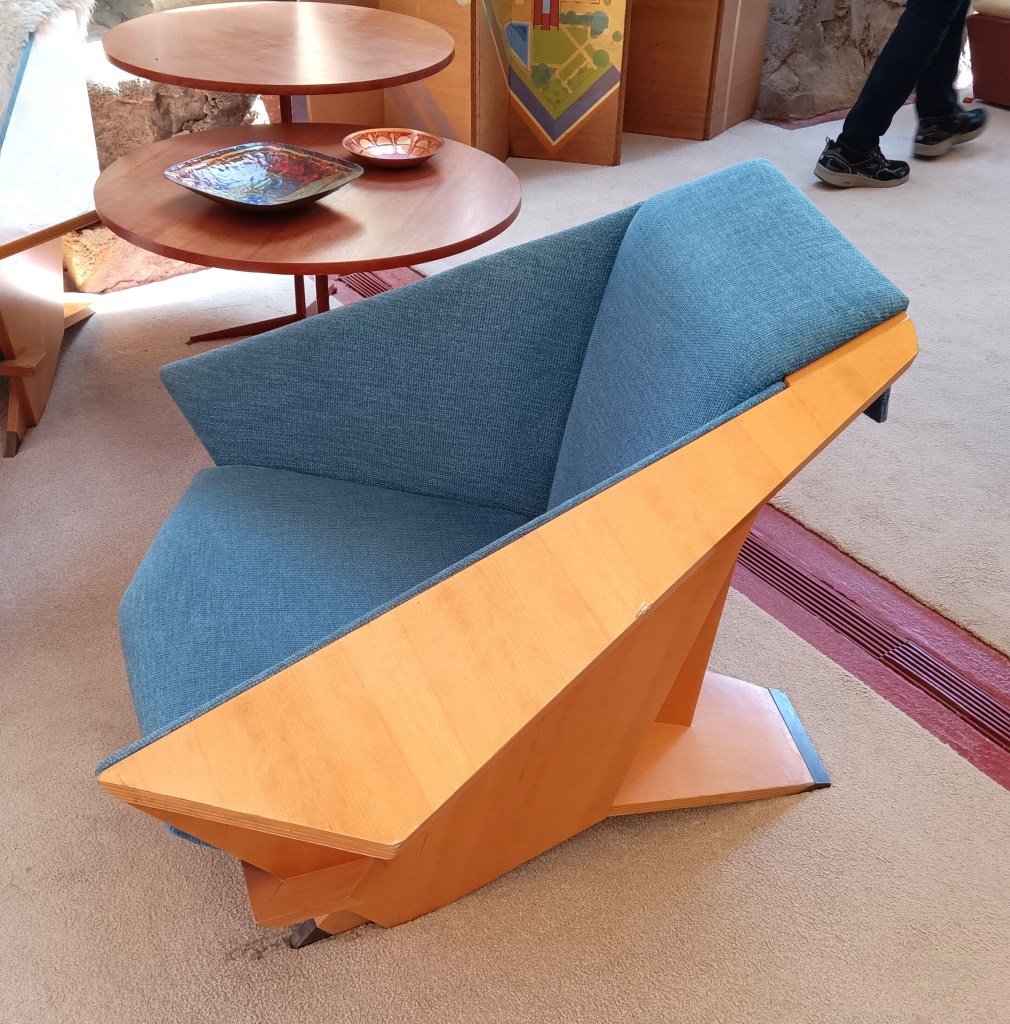
A focal point of the Garden Room is what has been dubbed the Origami chair since it was inspired by origami, crafted from a single sheet of laminated plywood, one of Wright’s favorite materials of choice. Designed in 1949, it embodies Wright’s organic architecture. As with much of his designs, it was created to not look like a separate piece of furniture but to fit into the environment. It showcases a modern, sleek aesthetic and blurs the line between furniture and architecture and, I might add: sculpture. The angular, geometric lines are meant to echo the Arizona desert landscape outside the windows and doors.
P.C. Cher B 30 March 2024
The chair is a great example of Wright’s total design philosophy: a chair was never just furniture, it was an integral part of the design of the home where furniture matched the architectural style of the building. The chair remains a significant symbol of Wright’s later career and his relentless experimentation with new forms, materials, and his commitment to creating a “living laboratory” in his homes.
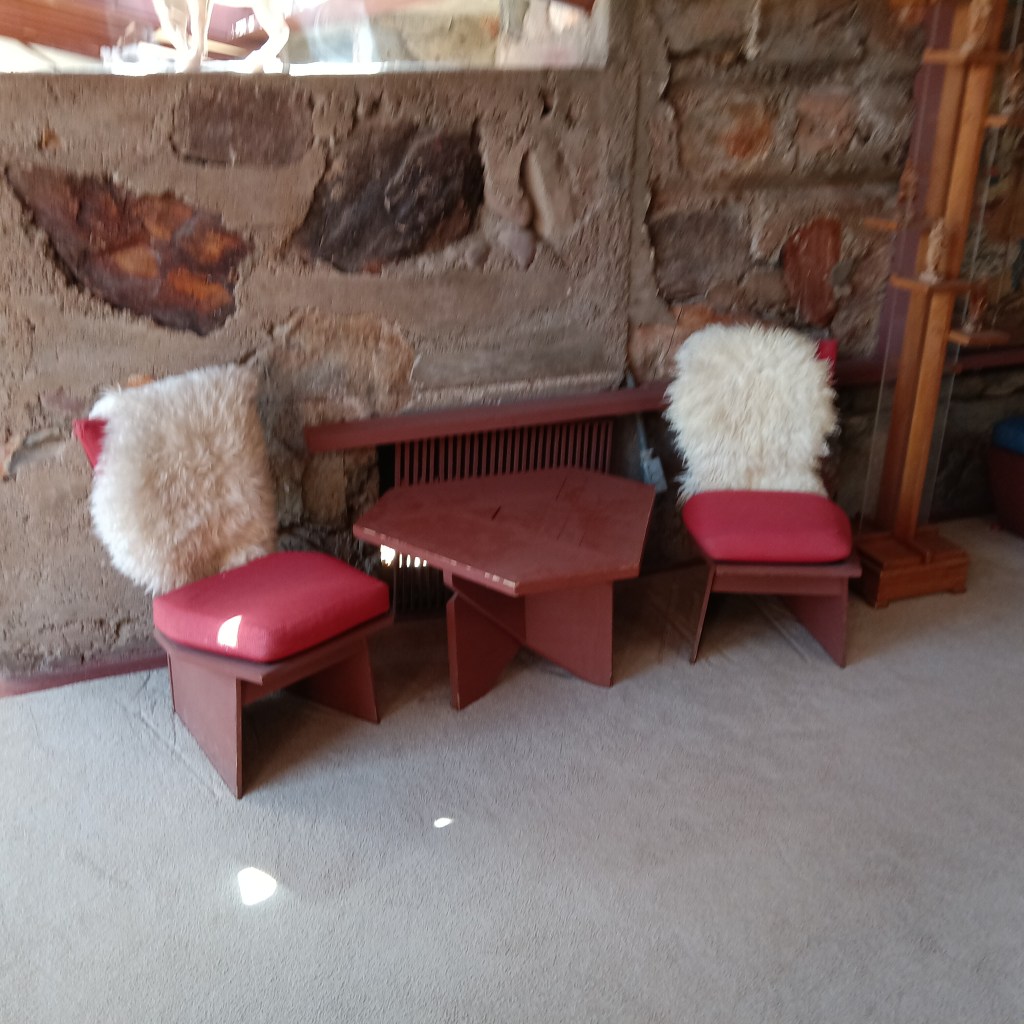
Wright liked to create things low such as this table and chair ensemble. Of course it includes his favorite accents of red.
P.C. Cher B 30 March 2024
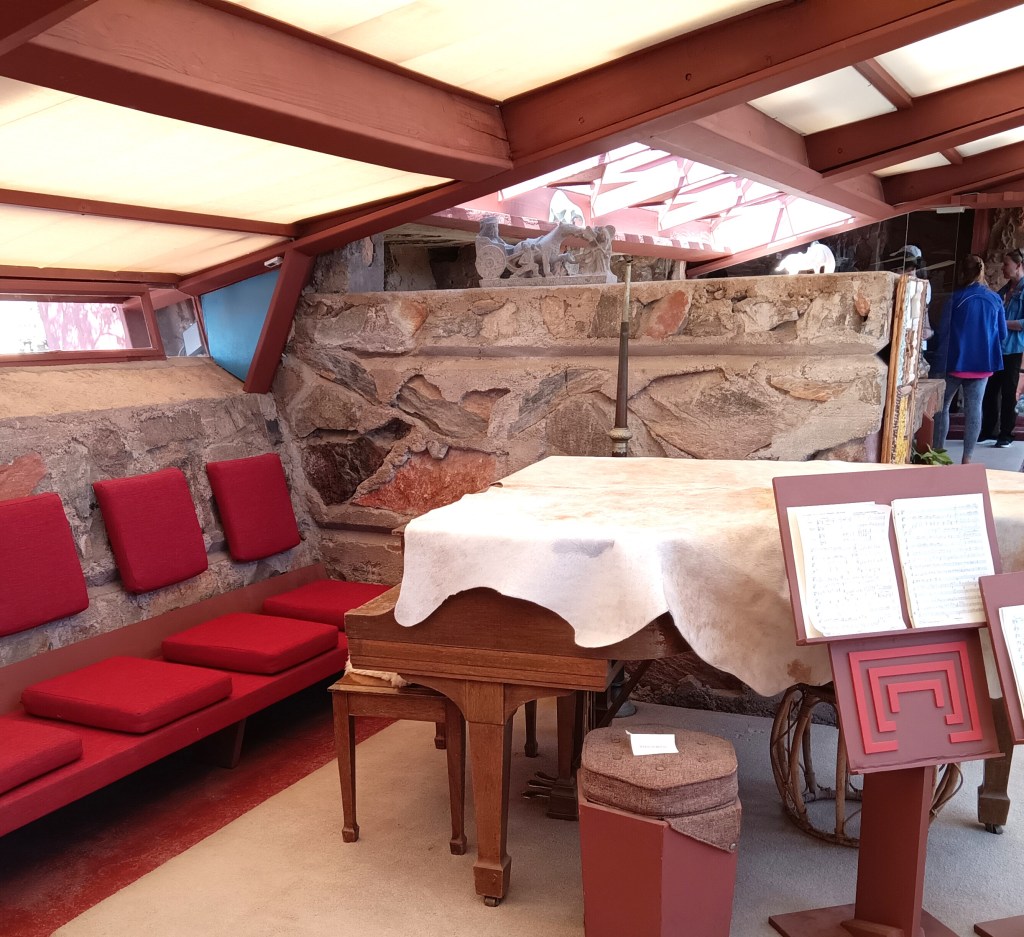
Music was actively incorporated into life in both the Wisconsin and the Arizona Taliesin homes. Wright even designed the music stands!
P.C. Cher B 30 March 2024
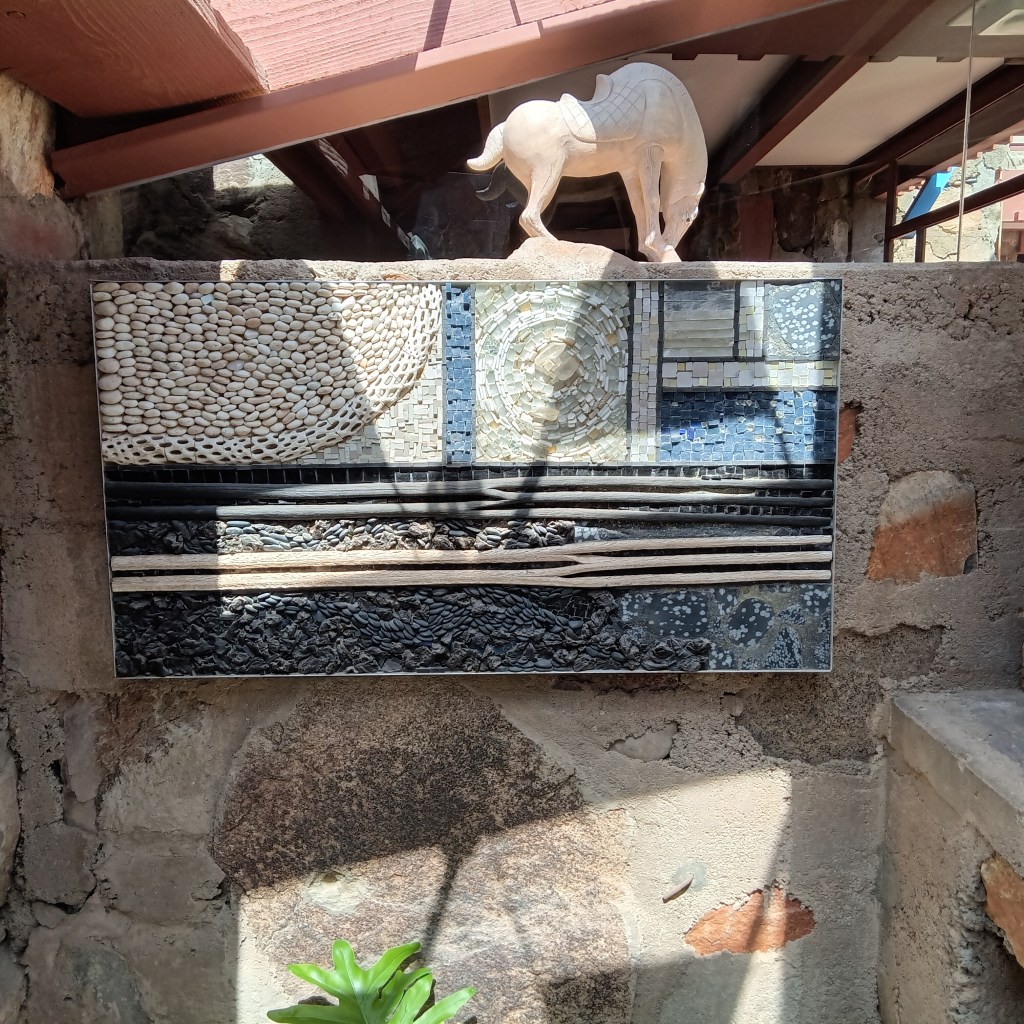
Organic local elements were incorporated into the mosaics and sculptures throughout. I enjoy his uses of positive and negative shapes.
P.C. Cher B 30 March 2024
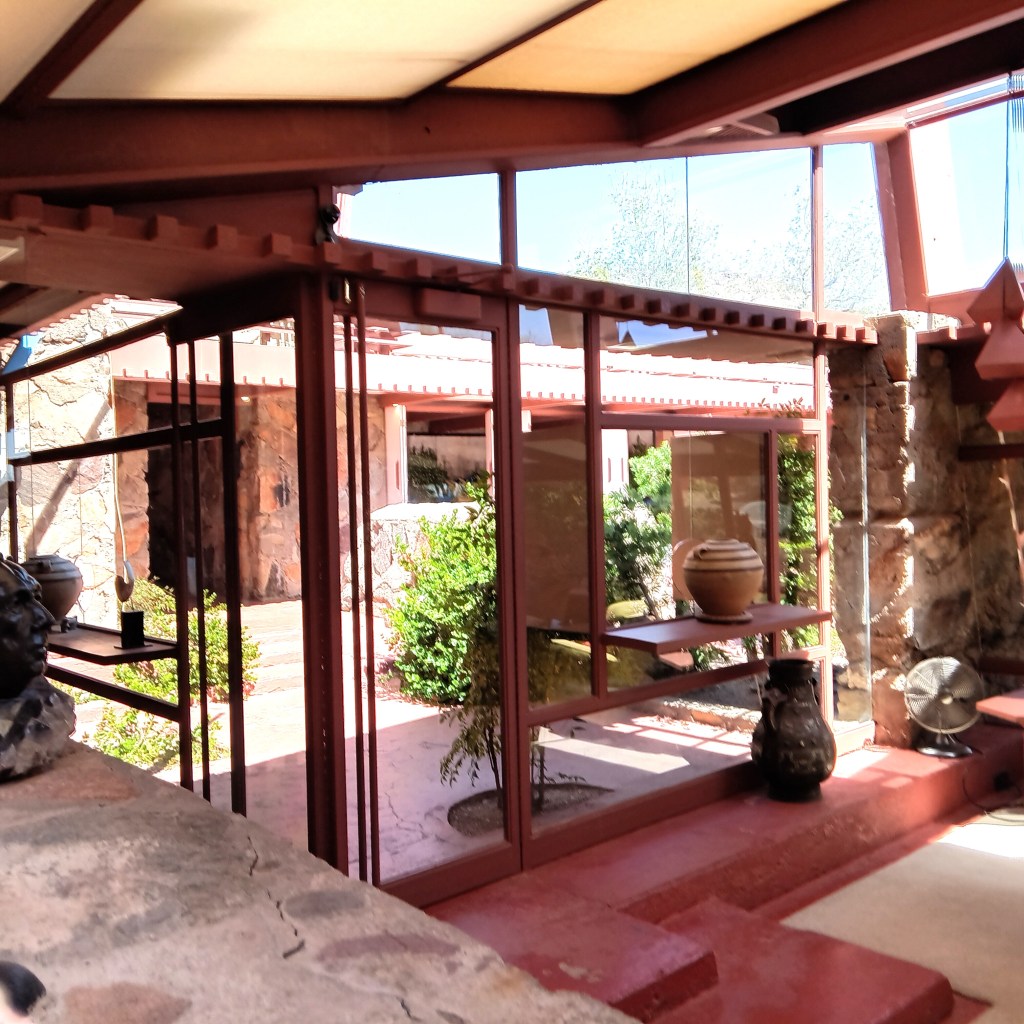
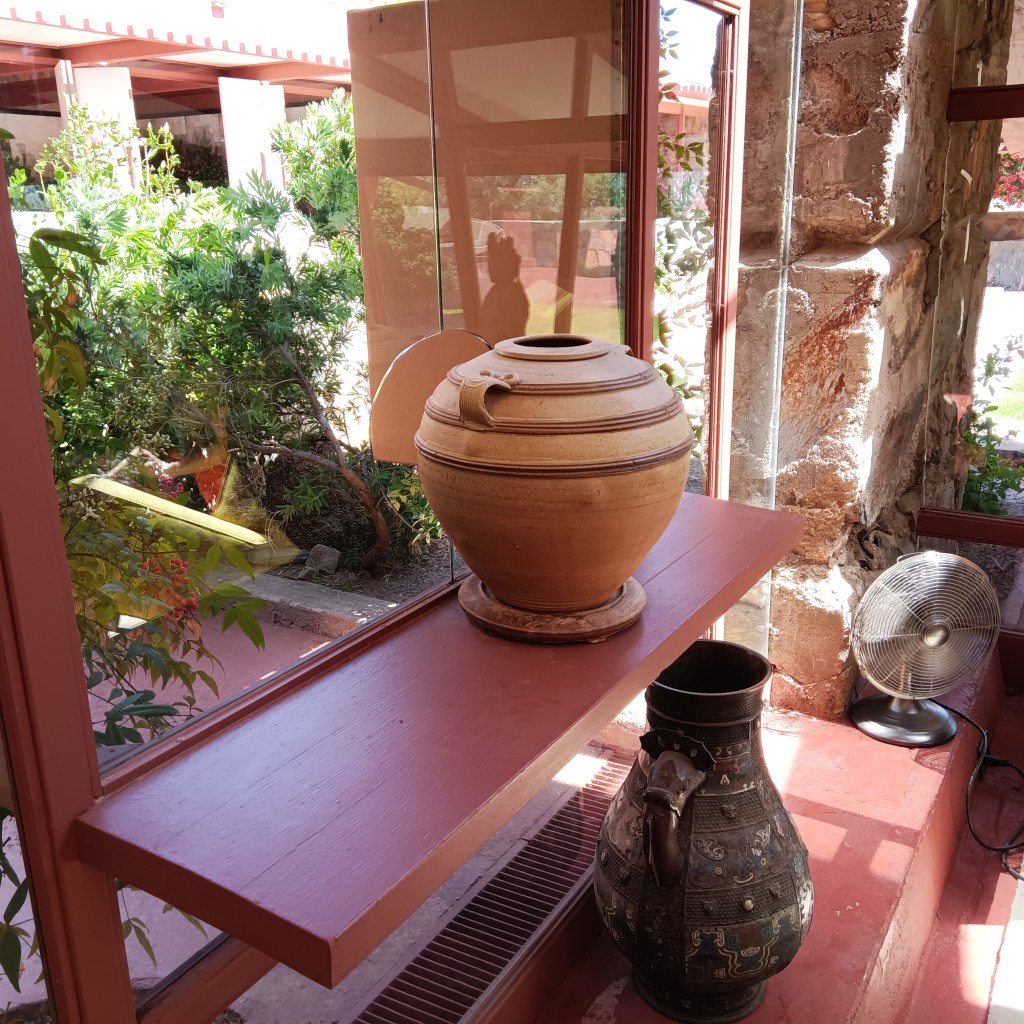
Off the living room is a welcoming foyer and passageway into a garden and leads to the wing with bedrooms and private suites. The vase in the center fight was of particular interest.
P.C. Cher B 30 March 2024
A unique spot in one of the spaces was this hole cut into the glass to accommodate the size and shape of the vase. Rather than move the vase, Wright cut a hole in the window! I have come to believe this was typical of Wright’s design philosophy. He certainly could not have done this in Wisconsin! Not only would it be prohibitive due to cold winter temperatures, but the bugs as well!
P.C. Cher B 30 March 2024
Office
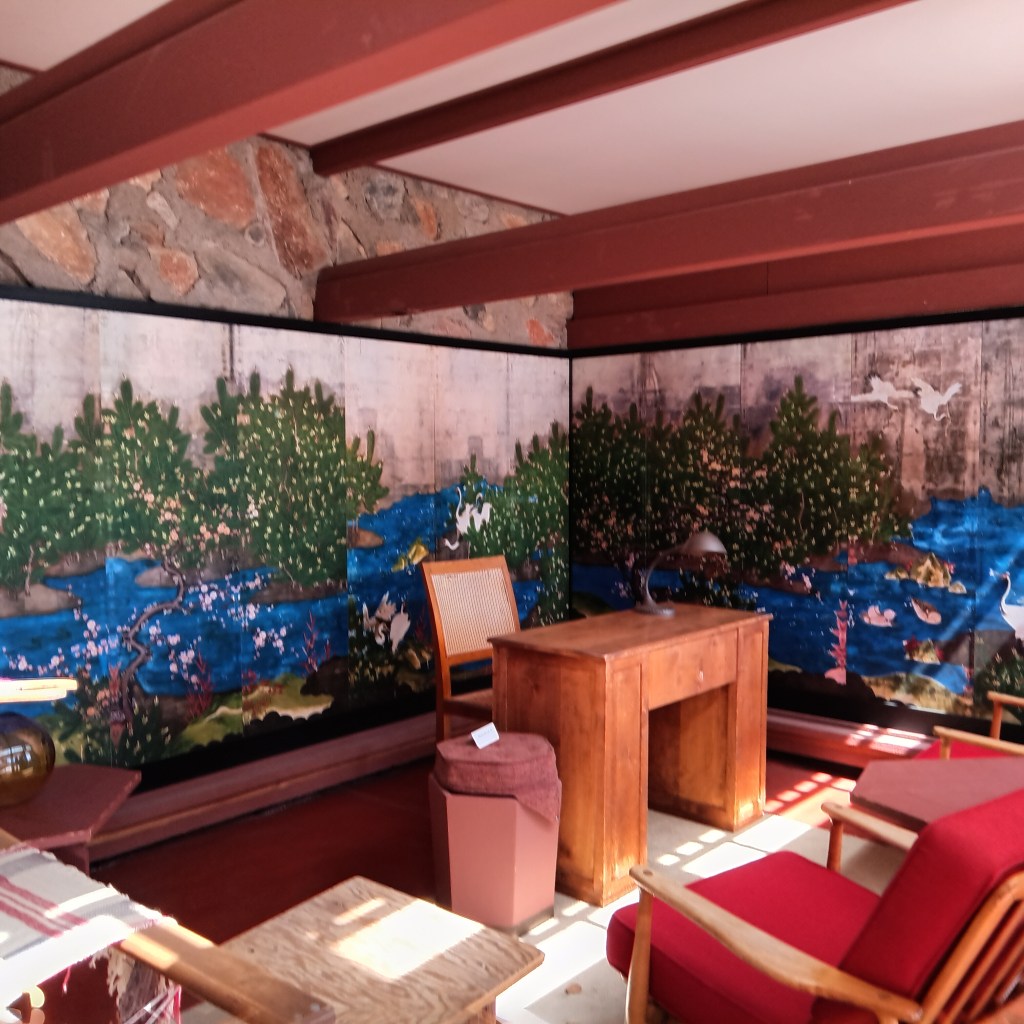
Wright was known to work late into the night in his home office
P.C. Cher B 30 March 2024
Bedroom
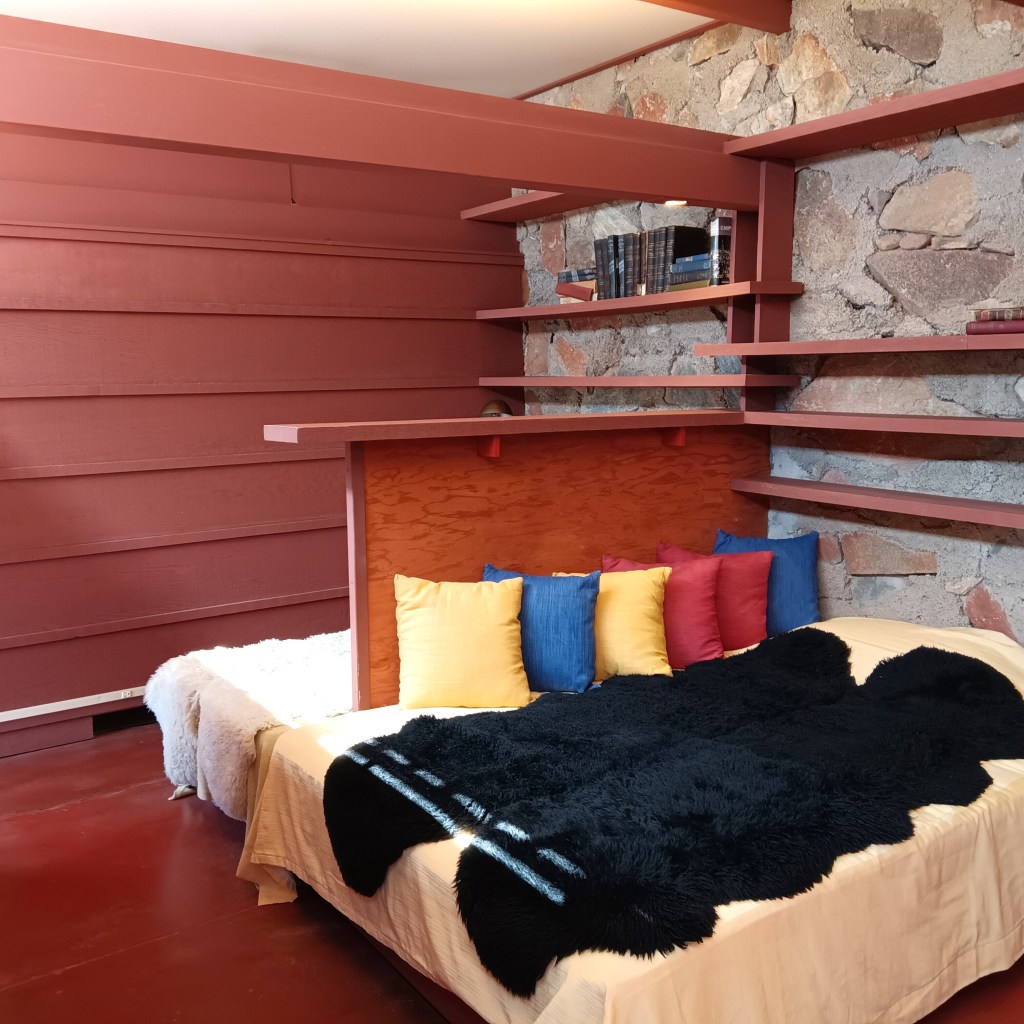
The Wright personal bedroom revealed an interesting insight into his personal life. Since he often got up during the night to to work, the divider kept the direct light out of his wife’s eyes. (I also noted how much narrower her side was… our guide shared no insight into this observation!)
P.C. Cher B 30 March 2024
Tower Pool
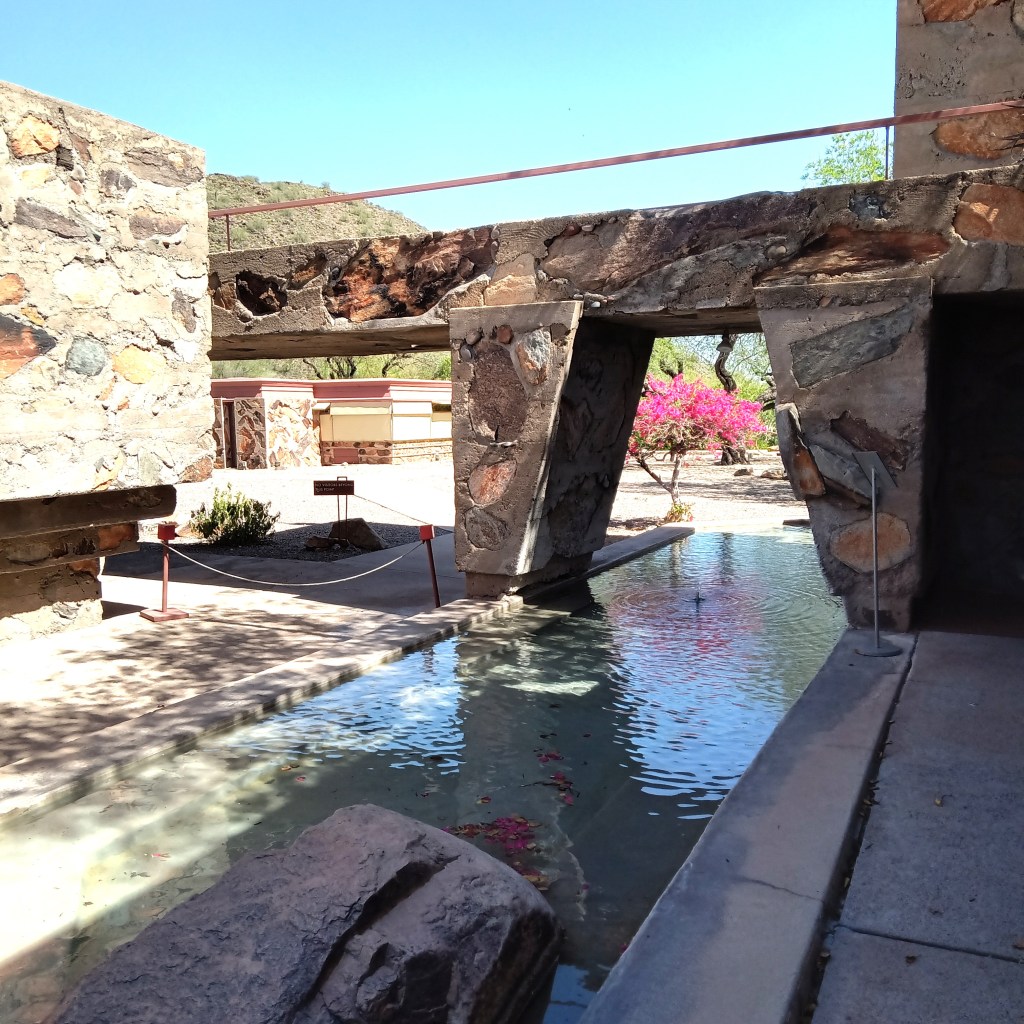
Providing a welcome respite to the desert sand and rocks was the spaces that included pools of water and fountains such as this one in the middle of the complex.
P.C. Cher B 30 March 2024
Each building is connected through a series of carefully and intentionally designed walkways, terraces, pools and gardens.
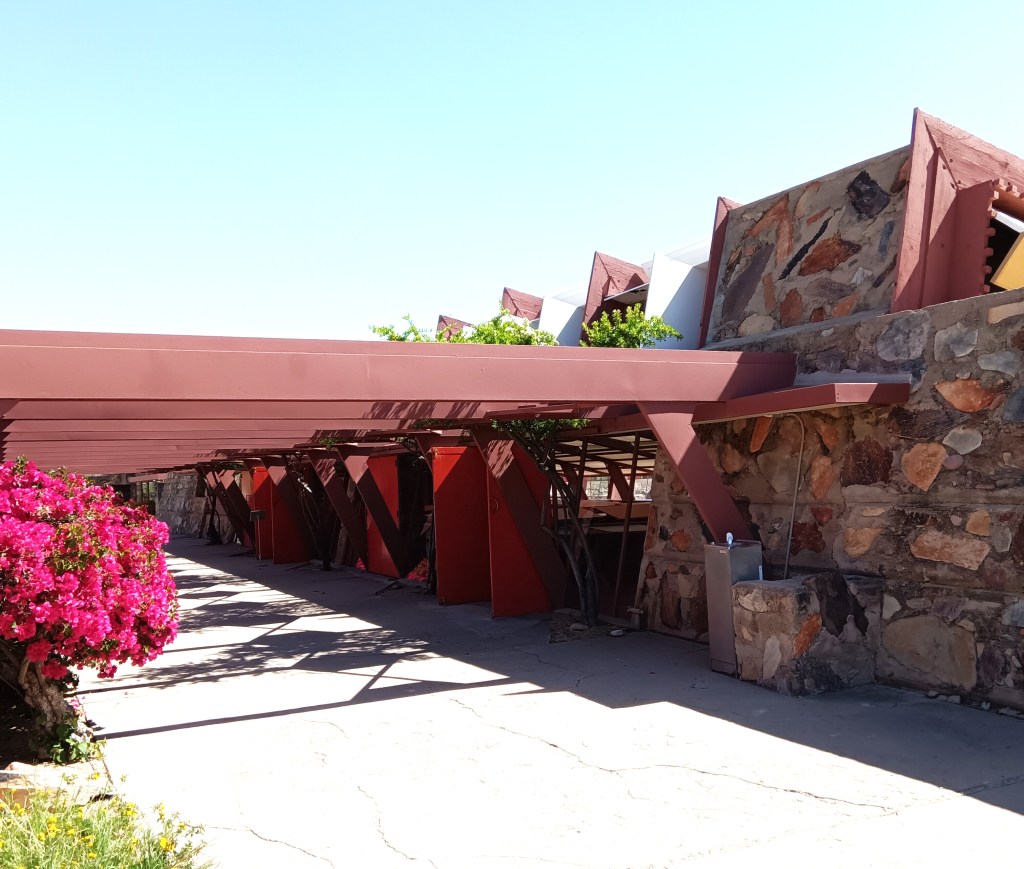
P.C. Cher B 30 March 2024
This spacious patio hallway leads to the cabaret theater inside the red doors
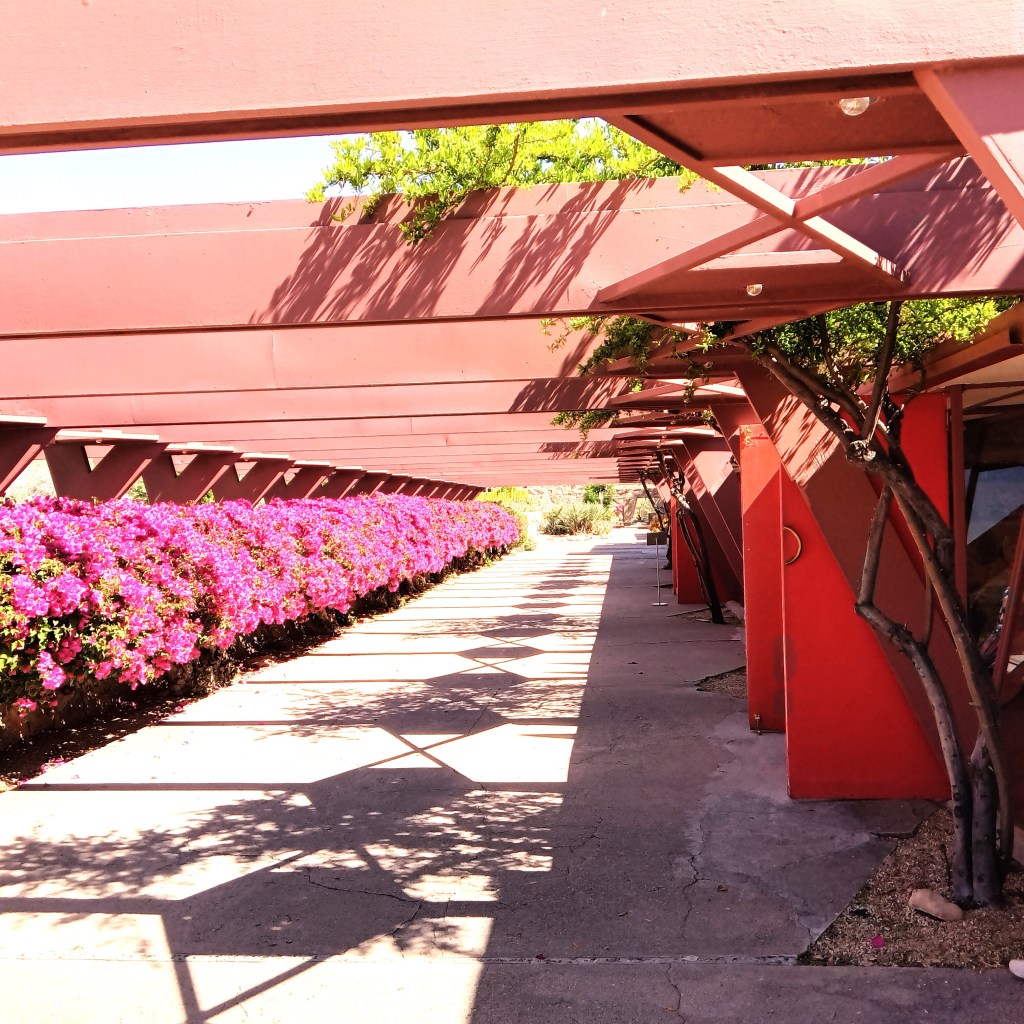
P.C. Cher B 30 March 2024
Wright’s designs can even be seen in he shadows created by the architecture.
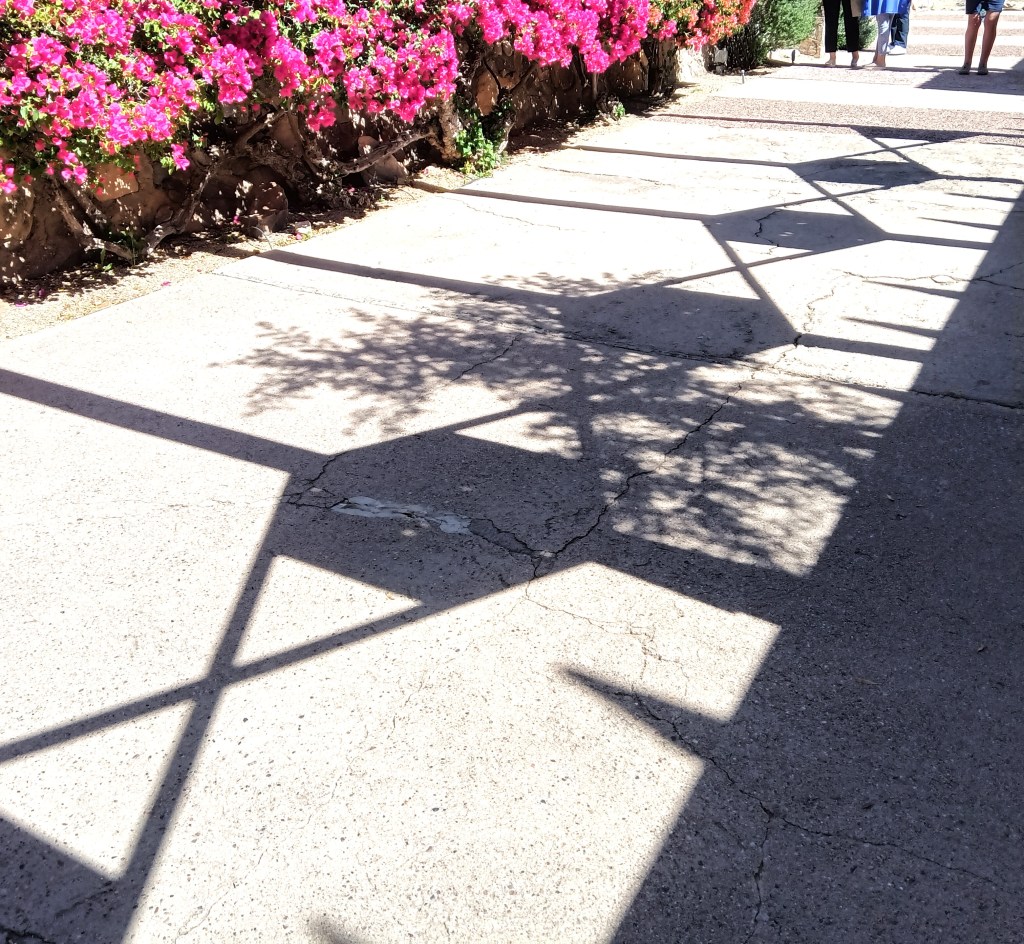
P.C. Cher B 30 March 2024
Drafting Studio
Similar to Wright’s original Taliesin in Spring Green, Wisconsin, Taliesin West was a home, a studio, and most importantly, an educational institution.
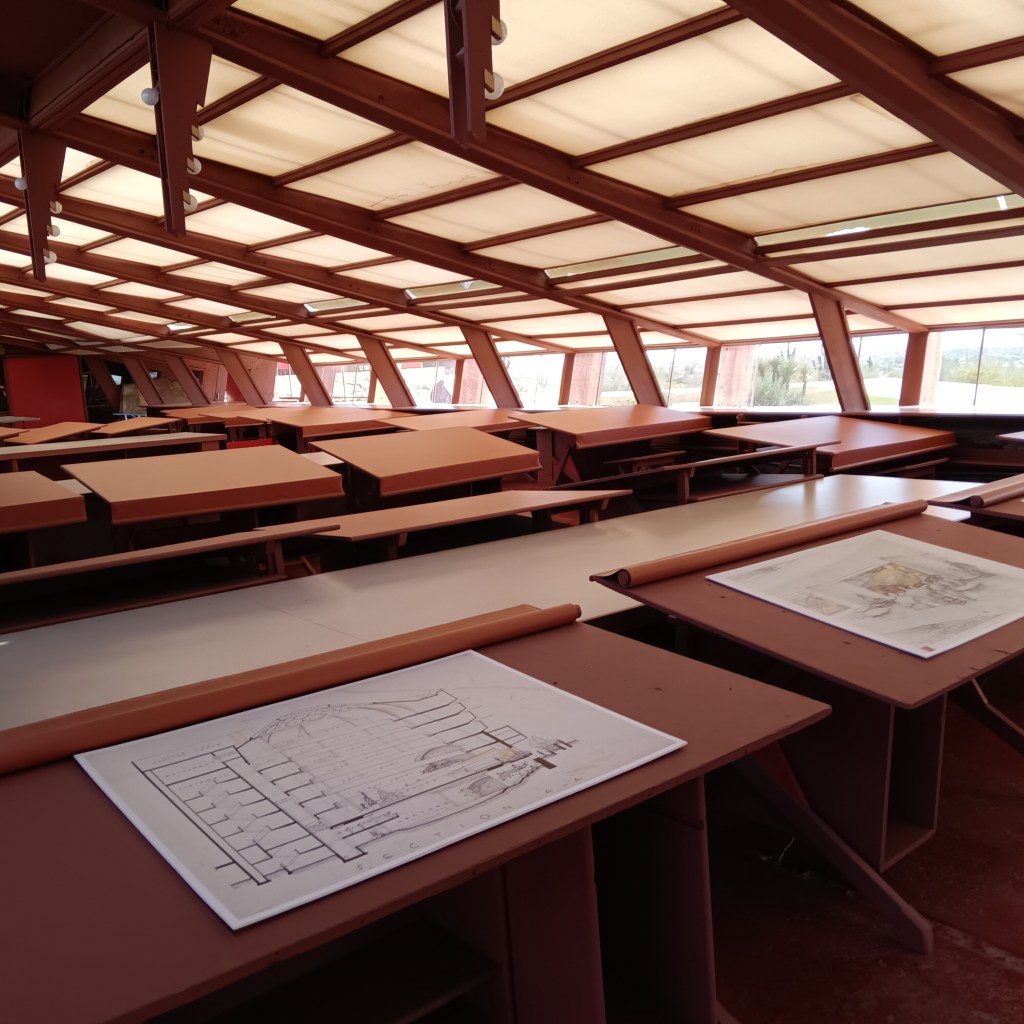
The bright, open and airy “tent-like” space of the drafting studio is bathed with natural light. It also features Wright’s desert masonry, redwood beams and translucent white canvas roof panels which provided consistent bright shadow-free light for drafting. The low-hanging eaves and large windows frame landscape views of the surrounding dessert.
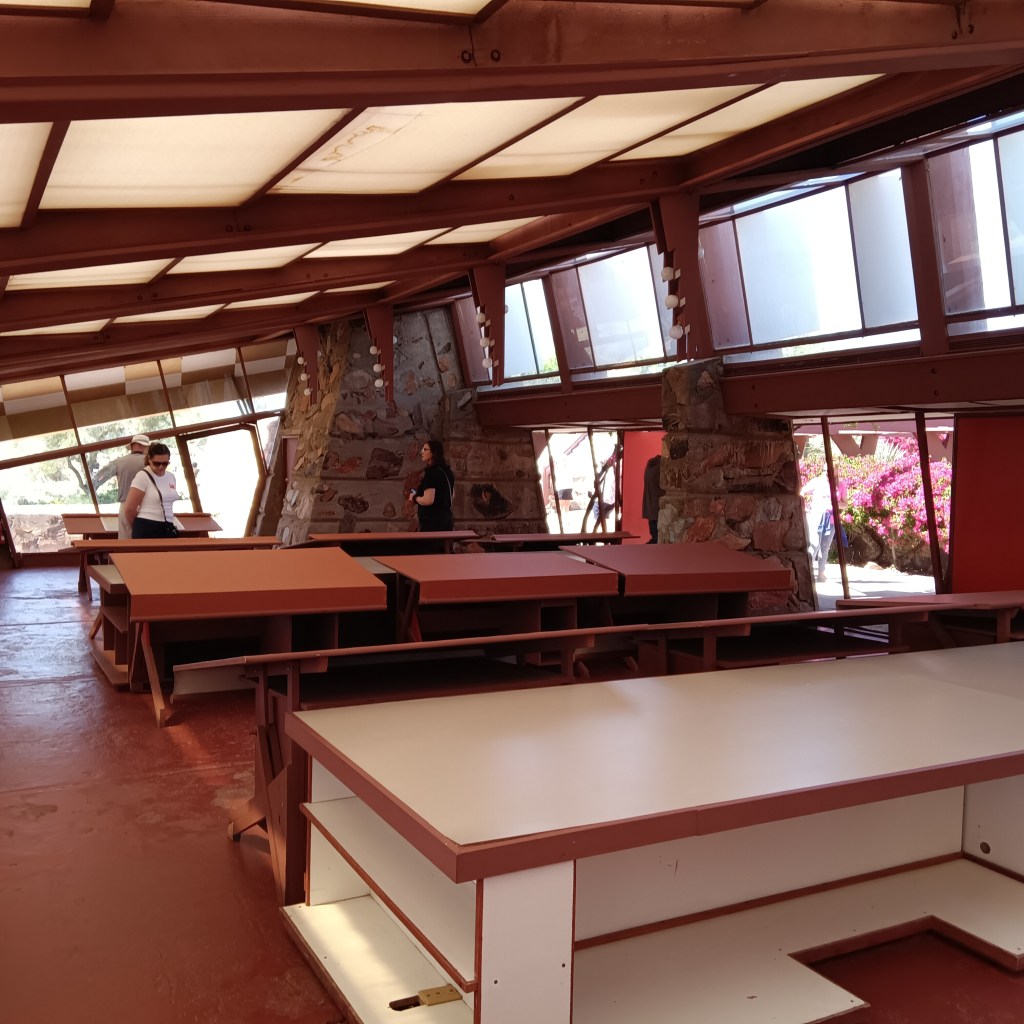
P.C. Cher B 30 March 2024
Th drafting studio was the hub for the Taliesin Fellowship, where apprentices worked on plans and models. Visitors are encouraged to sit down on a handcrafted bench at one of the vintage drafting tables. Drawings such as this one of the NYC Guggenheim are on display.
P.C. Cher B 30 March 2024
Cabaret Theater
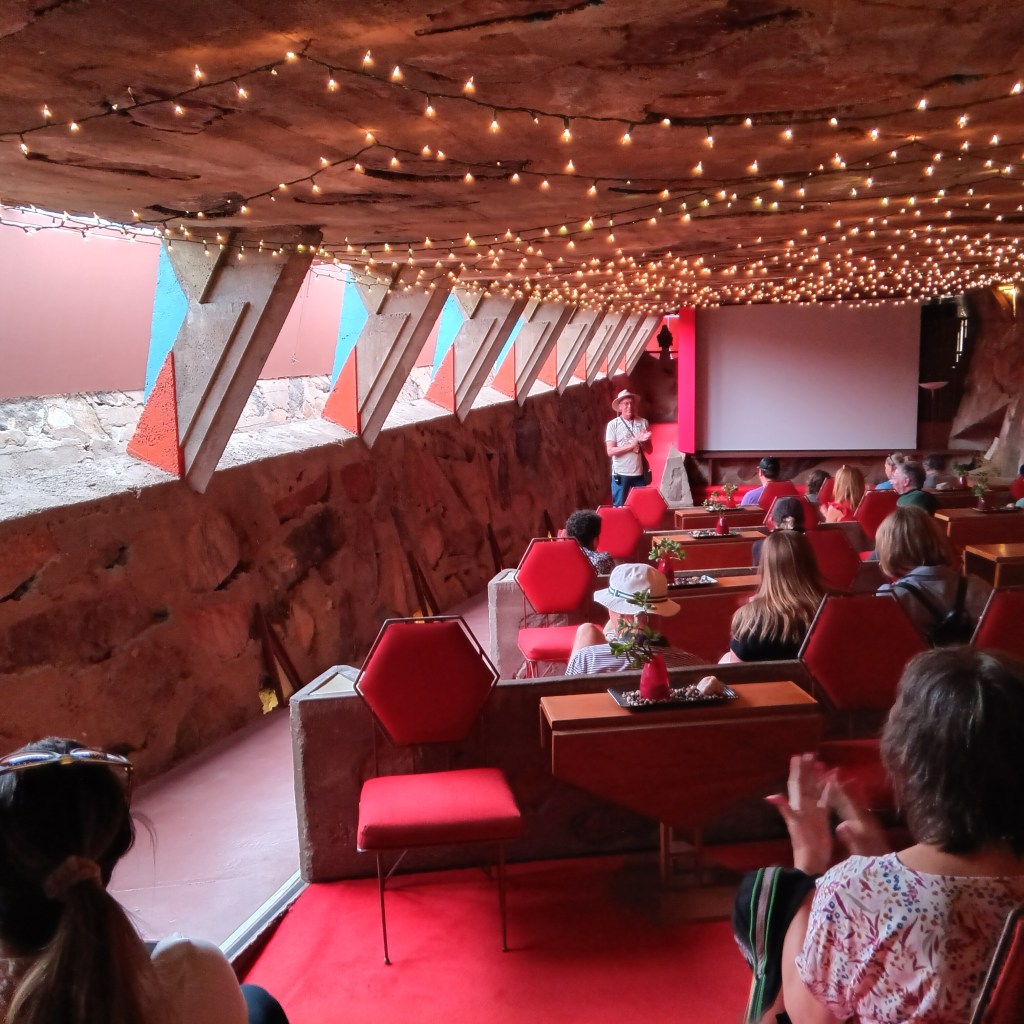
Not every architecture school has its own cabaret theater! Our tour concluded in the cabaret theater, an intimate, subterranean auditorium known for its exceptional acoustics and Wright’s signature desert masonry design. In line with Wright’s mission, it was originally created for the community. Built between 1948-50, life in the desert was active during the early years. The hands-on architectural education was complimented by an active calendar of lectures, evening entertainment, concerts and theatrical performances which continues today.
P.C. Cher B 30 March 2024
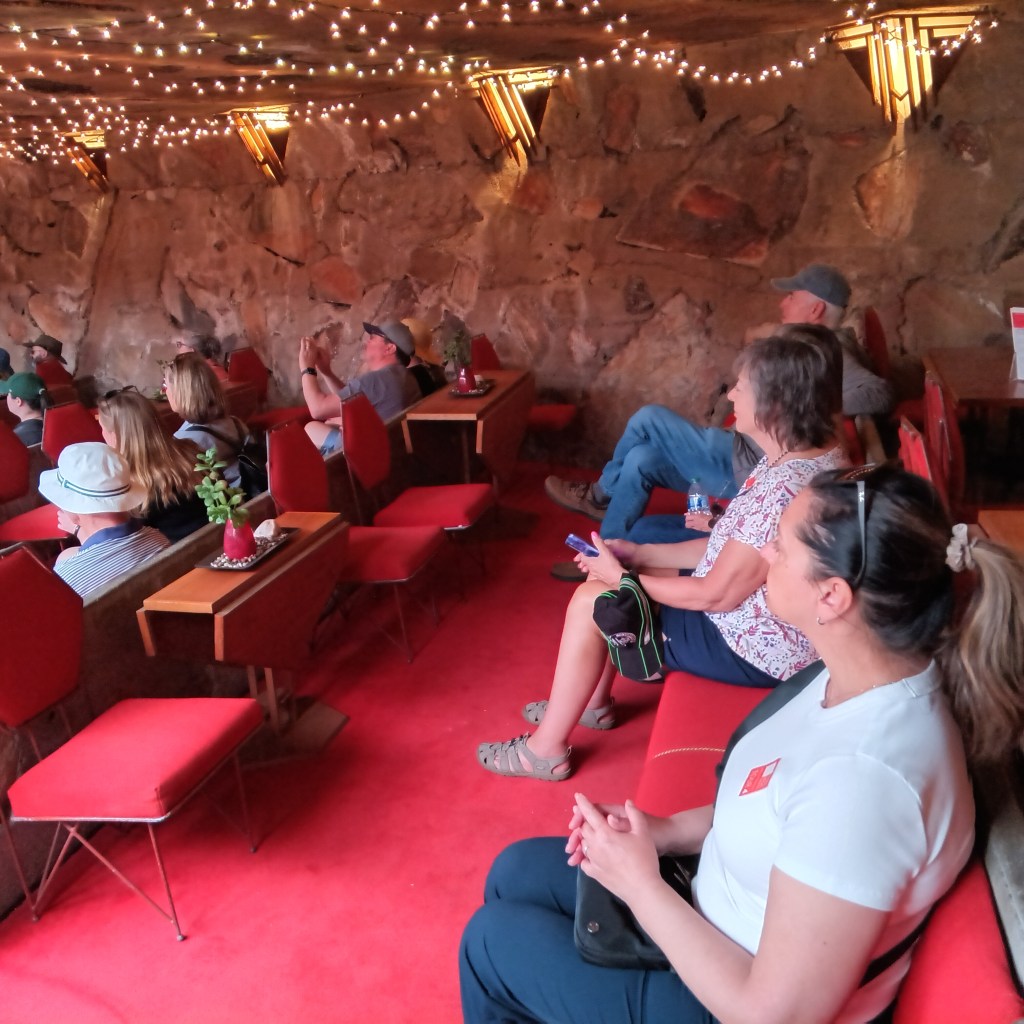
The vibrant home the Frank Lloyd Wright Foundation carries on many of these traditions. Today it continues to host special public events which includes a classic film series. (see website for current offerings). Its unique stage was designed to project sound and is often described as a “soundboard” which highlights Wright’s mastery of sound design. Tickets and seating are available on a first-come-first-served basis and sell out quickly.
P.C. Cher B 30 March 2024
The Fountain
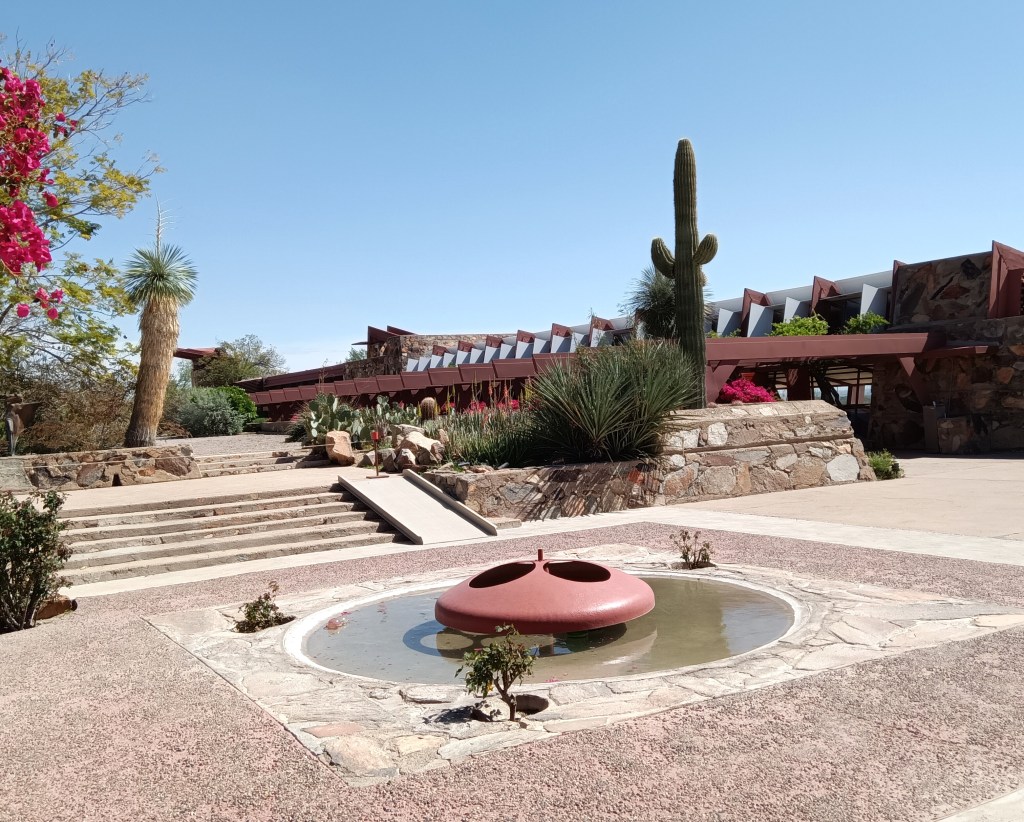
Most photos of Taliesin West include this fountain. Interestingly, I’ve never seen it featured with water spurting out of it – including during our visit!
P.C. Cher B 30 March 2024
It was a picturesque setting in which I felt as if I had stepped into one of the pages of my Art History textbooks.
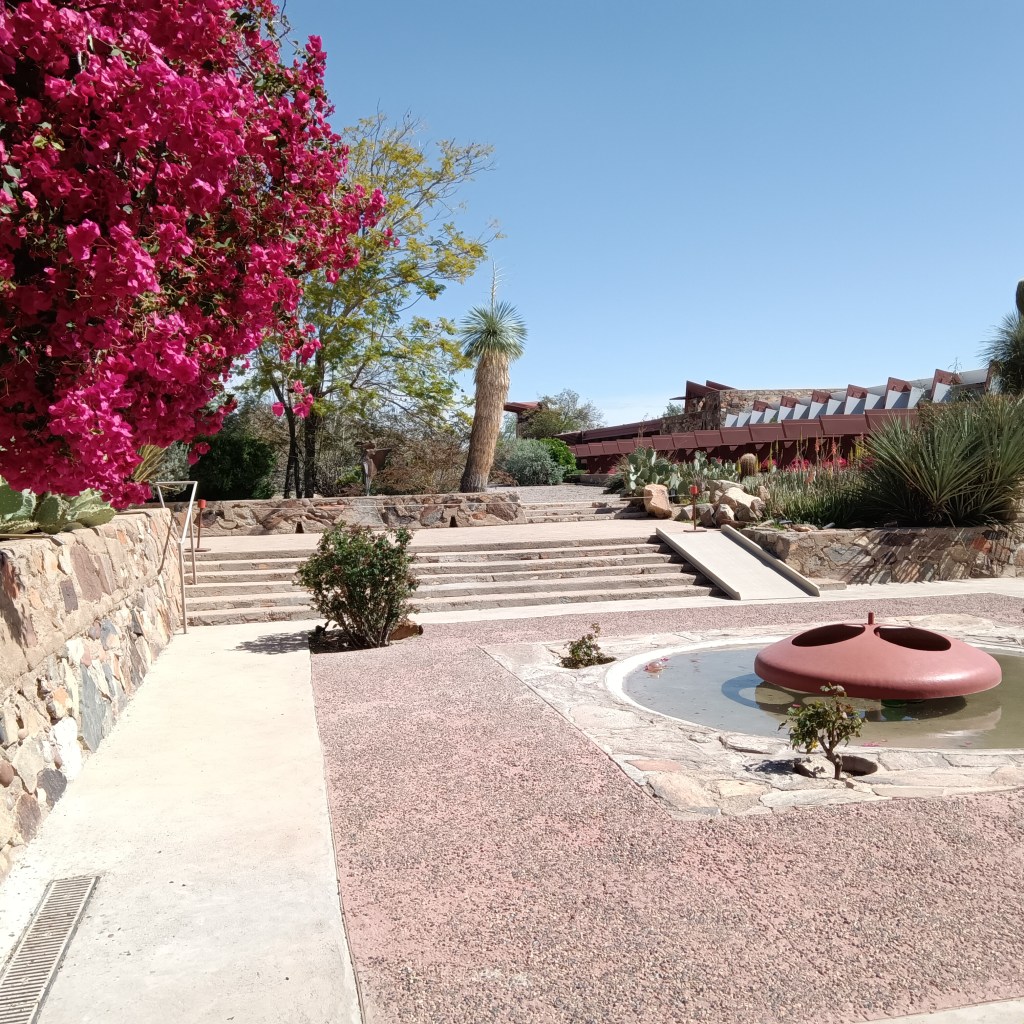
P.C. Cher B 30 March 2024
As it has since the beginning, Taliesin is constantly evolving, and preservation work is ongoing. The constant change and upkeep are to be expected. Our guide shared that none of the buildings at Taliesin West were built professionally or designed to last. Wright called this place a desert camp. Things don’t always last in the desert. Taliesin West was always a place of experimentation and change. This can be said about much of Wright’s work.
Frank Lloyd Wright & Georgia O’Keeffe Connections
Modern American Icons
Wright and O’Keeffe are singular, iconic figures in the history of American art and architecture.
During our visit to Taliesin West, we were privileged to a special exhibit of these two American icons. It was particularly exciting since we had just spent two days exploring the life and legacy of O’Keeffe in Abiquiu and Santa Fe, New Mexico. The exhibit clearly displayed their familiar and contrasting personalities and legacies.
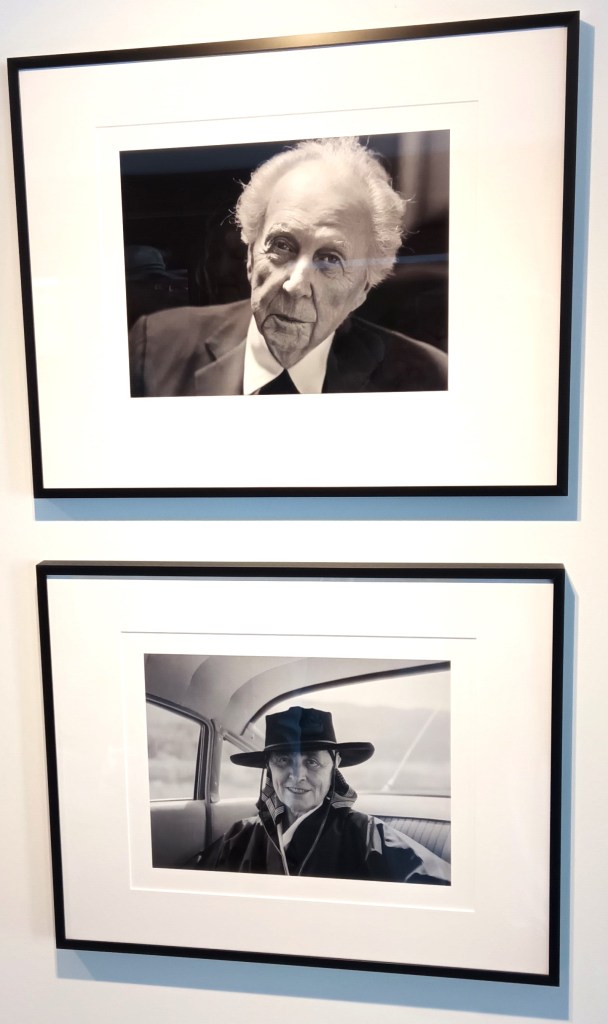
P.C. Cher B 30 March 2024
For both Wright and O’Keeffe, the concept of time is ever-present in their homes. The exhibit highlighted that they continuously improved their spaces, changing and adapting them over time to suit their changing needs. In doing so, these homes hold the markers of time, in their walls, collections, and grounds. To see them both in such close proximity of time was a rare delight for me.
Georgia O’Keeffe
For more information on the life and art of Georgia O’Keeffe in SW USA, I’ve posted 4 blogs about our visit with focus on her in New Mexico on this same trip: O’Keeffe’s Abiquiu Home, O’Keeffe’s Ghost Ranch Landscape art, Abiquiu, New Mexico, and the Georgia O’Keeffe Georgia O’Keeffe Museum, Santa Fe, New Mexico Museum in Santa Fe which includes an extensive bio on this 20th century contemporary of Frank Lloyd Wright.

P.C. Cher B 30 March 2024
As with all things, visiting and experiencing something in person truly makes it come alive and REAL! Such was my visit to Taliesin West, combined with our visit to his Wisconsin Taliesin. And pairing it with our Georgia O’Keeffe pilgrimage in New Mexico made this an especially significant and unforgettable adventure into the lives of two of my favorite 20th century artists!
Visit
Address: 12621 N. Frank Lloyd Wright Blvd, Scottsdale, AZ 85259
Tours of Taliesin West are available and advance reservations are highly recommended as they sell out quickly. Available on the website, several options are available: Self-guided audio tour, Family tours which are billed as engaging for children, Behind-the Scenes and Sunset tours range from 60 to 90 minutes. Ample free parking is available, easy and clear access off of the freeway. The gift shop is stocked with a variety of FLW related items.
Sources
- All photos by Cher B or Skip B. 31 March 2024
- franklloydwright.org/taliesin-west/ 26 March 2026
- Information provided on-site and by our Taliesin West tour guide. 31 March 2024.
- Information used by Cher B in various Art History courses for the past 30 years
Other Frank Lloyd Wright sites
Taliesin, Wisconsin
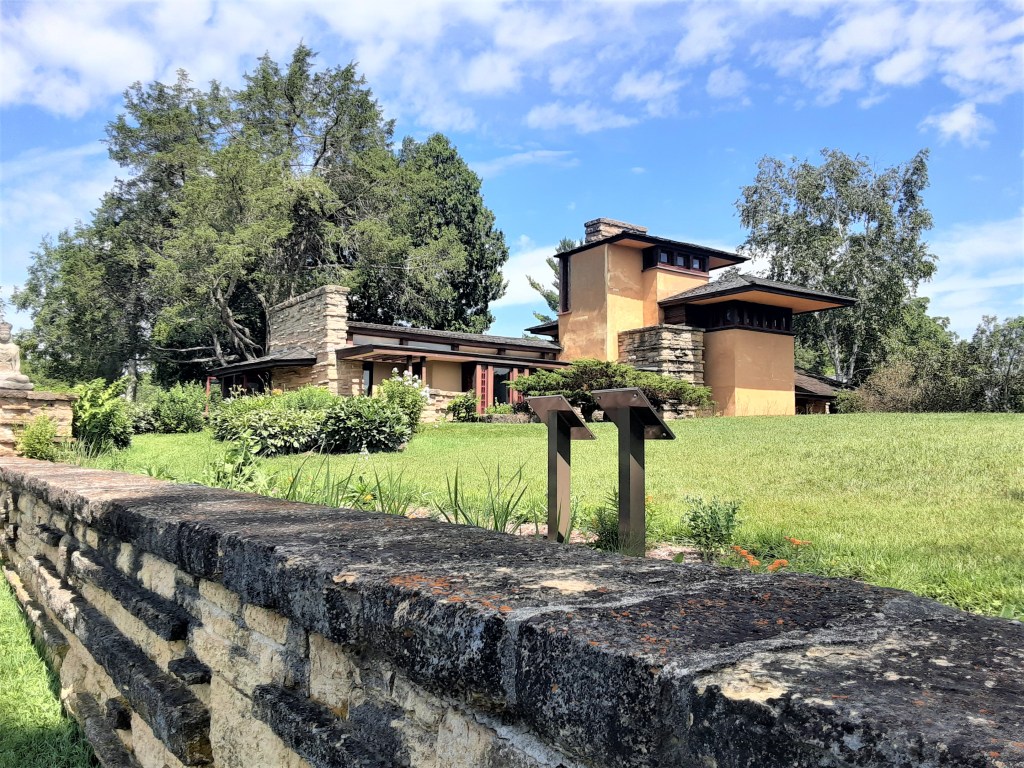
The original Taliesin in Spring Green, Wisconsin provides the foundation for understanding and better appreciating the work of Frank Lloyd Wright. This blog with great photos and full-site details, highlights the original home/studio of Frank Lloyd Wright
Purcell-Cutts House, Minneapolis, MN
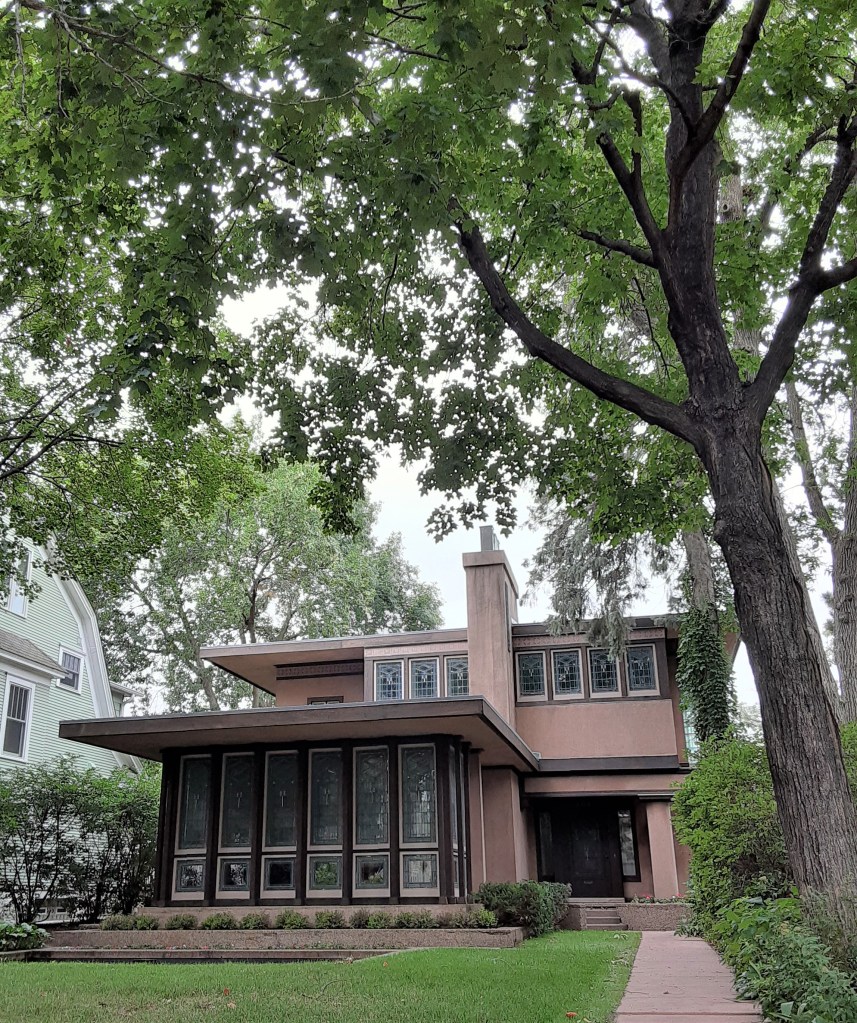
This Prairie style house in Minneapolis, Minnesota, USA was designed by contemporaries of Frank Lloyd Wright an embraces his philosophy of designing the furniture and fixtures to fit the style of the house. It is owned by with tours available through the Minneapolis Institute of Art (Mia) artsmia.org.
Blogs on sites nearby are the Mary Tyler Moore House and Lake of the Isles in the Chain of Lakes in the City of Lakes
 Charamana Consulting